When reviewing large amounts of AI-generated code, I often find that the LLM chooses terms for abstractions that do not always map to my own choices. For instance, what it may call a MutationIntent might personally be more natural to me as an EditRequest. Because the LLM's choice of words is not my ideal choice, I have to do a mental lookup of what it means every time I see it, which adds cognitive load.
How Generative and Agentic AI Shift Concern from Technical Debt to Cognitive Debt
The term technical debt is often used to refer to the accumulation of design or implementation choices that later make the software harder and more costly to understand, modify, or extend over time...

The 80% Problem in Agentic Coding
Managing comprehension debt when leaning on AI to code
There are no lossless transformations of natural-language text
In my work at Clay I recently wrote an internal policy on acceptable use of AI writing by engineers, and I’m sharing it here. It’s my hope that one day better AI tools might be able to help us think, but until then I fear that using AI to write does the exact opposite.
Harnessing Frustration: Using LLMs to Overcome Activation Energy
One of my biggest weaknesses as a software engineer is procrastination when facing a new project. When the scope is unclear, I have a tendency to wait until I feel I’ve “felt out” the problem to start doing anything. I know I’ll feel better and work much faster when I get “stuck in” but I still struggle with that first step, overcoming the “activation energy” required to engage with the details. LLMs have been a game-changer for me in this respect: I can just throw a couple of sentences at them with the shape of the problem. This leads to one of two outcomes: The LLM comes up with a good solution, usually in a slightly different way than what I was thinking. I realize “oh wow the solution is much simpler than I thought”. Straight away I start thinking about the consequences of implementing and improving what the LLM suggested. The LLM comes up with a solution that I intuitively recognize as “wrong”. My immediate reaction is frustration (“How could it get it so wrong”) which leads me to go back and forth with the model, explaining to it why its solution could not possibly work. But in the process of arguing with the model, my brain is churning away and generating variations or different approaches that could work. After a while, even if the AI is still on the wrong track, the debate will trigger a moment of inspiration where suddenly the solution will come to me. I’ll excitedly start up a new conversation and start working through it with the model. The key is the emotional reaction I have immediately to the LLM’s response, either excitement or frustration. By harnessing this immediate feedback loop, I get my brain out of its passive, procrastination mode. It’s almost like a jolt: either I’m thrilled because it’s simpler than I thought, or I’m spurred to action by the urge to correct a perceived ‘wrong’ answer. This forces me to engage with the problem in a meaningful way.
What AI coding costs you | Tom Wojcik
What's the effect of the prolonged AI usage among coders and is it tracked correctly, if it all?
Does Code Cleanliness Affect Coding Agents? A Controlled Minimal-Pair Study
As autonomous coding agents see rapid adoption, their evaluation has primarily focused on task completion rates holding the target codebase fixed. This leaves a critical question unanswered: does the structural and stylistic quality, or ``cleanliness'' of the underlying code affect an agent's ability to navigate and modify it? To isolate the effect of code cleanliness from agent capability, we introduce an evaluation protocol built around minimal pairs: repositories that match on architecture, dependencies, and external behaviour, but differ on static-analysis rule violations and cognitive complexity. The pairs are constructed in both directions, by agent pipelines that either degrade a clean repository or clean a messy one. We author 33 tasks across six such pairs, evaluated through hidden tests at the application's public surface. Across 660 trials with Claude Code, code cleanliness does not change the agent's pass rate. However, it substantially alters the agent's operational footprint: agents working on cleaner code use 7 to 8% fewer tokens and reduce file revisitations by 34%. Our findings suggest that traditional maintainability principles remain highly relevant in the era of AI-driven development, shaping the computational cost and navigational efficiency of coding agents. Code cleanliness joins model choice, harness, and prompting as a factor that materially affects agent behaviours.

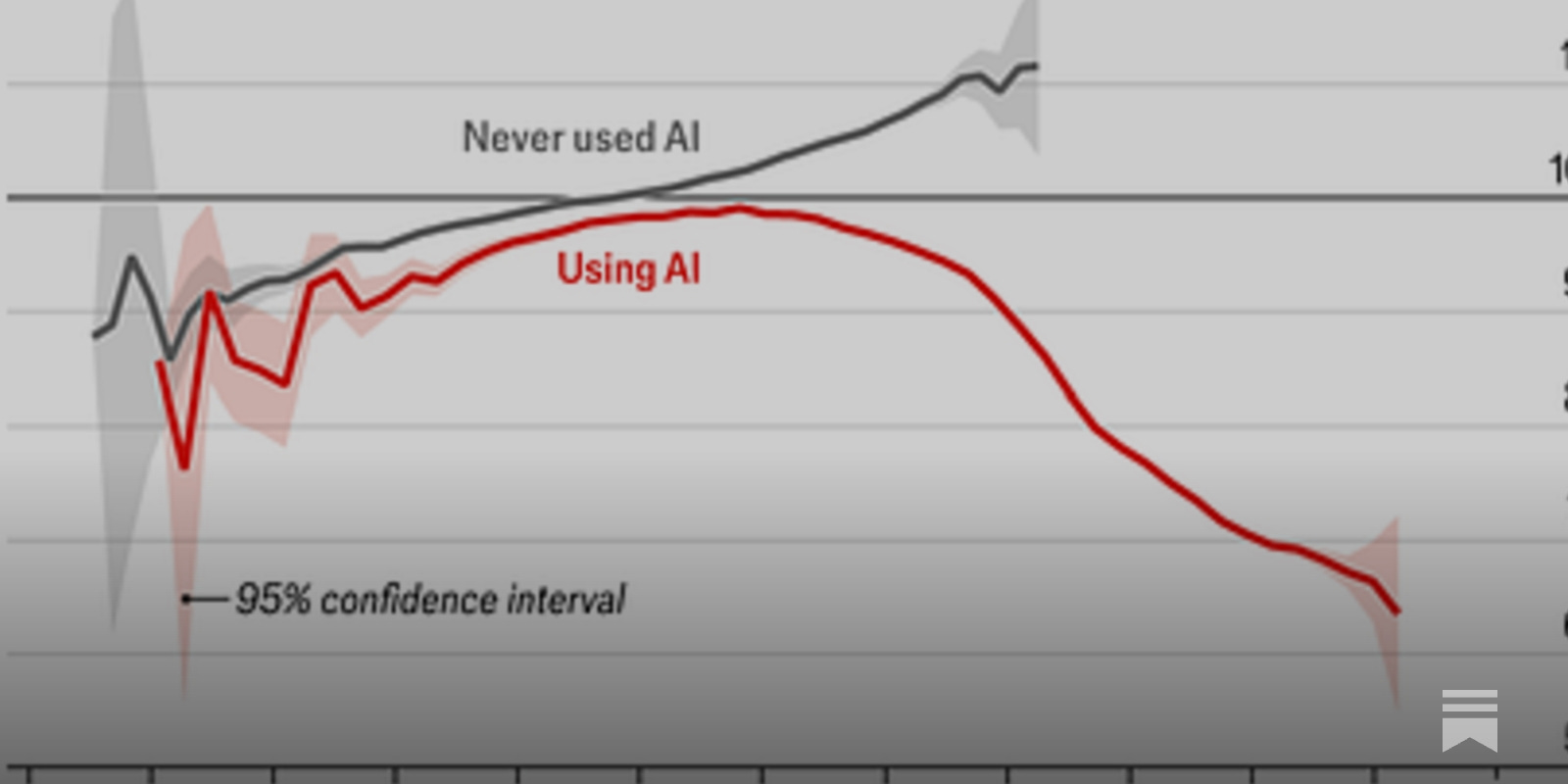
The 50 Percent Problem
Empirical evidence of the educational harm of generative AI
Cognitive Bias Lab | Learn to Make Better Decisions
Explore cognitive biases with interactive tests, simulations, and real-world examples. Free platform to sharpen decision-making and critical thinking — no sign-up needed.
Cognition | Agent Trace: Capturing the Context Graph of Code
We’re excited to join in Cursor, Cloudflare, Vercel, git-ai, OpenCode and others in support of [Agent Trace](https://agent-trace.dev/). As described in the spec, Agent Trace is an open, vendor-neutral spec for recording AI contributions alongside human authorship in version-controlled codebases.
I don't know if I like working at higher levels of abstraction
AI tools push us to higher abstraction. I'm not sure I like what that costs us.
Artificial Intelligence Glossary | Stanford HAI
Artificial Intelligence (AI) is rapidly growing, with new terms and concepts being introduced at a breakneck speed. You may have seen terms such as AGI, machine learning, or foundation models in media headlines, emerging legislation, or in your everyday life.
Why so many game developers don't want to use generative AI
With credits ranging from Dispatch and Marvel Rivals to Uncharted and Dragon Age, over 30 devs share their thoughts on gen AI

Hallucination (artificial intelligence)
In the field of artificial intelligence (AI), a hallucination or artificial hallucination is a response generated by AI that contains false or misleading information presented as fact. This term draws a loose analogy with human psychology, where a hallucination typically involves false percepts. However, there is a key difference: AI hallucination is associated with erroneously constructed responses (confabulation), rather than perceptual experiences.

I'm becoming AI-blind - Rafal Cymerys
Recently I've been catching myself having these little moments at work, when I'm trying to read a document someone has sent me and my brain somehow refuses to analyze it. It feels like I'm reading it, but I'm unable to focus on its content. I sat down to analyze these situations and realized they all have a common denominator: the documents all show a strong trace to AI. My brain learned to quickly spot signs of AI-generated content, at least the low effort one, and it now ignores it and moves on without thinking much about it.