


When Sergey Brin and Larry Page came up with the concept of PageRank in their seminal paper The Anatomy of a Large-Scale Hypertextual Web Search Engine (Sergey Brin and Lawrence Page, Stanford University, 1998) they profoundly...

Wikipedia Is Battling for the Soul of the Internet
The internet’s largest stockpile of free knowledge is under threat from MAGA, A.I. and foreign autocrats. A bibliophile ex-ambassador is here to help.

homepages.news — News Homepages documentation
An open-source archive that gathers, saves, shares and analyzes news homepages
atproto-aware concept search engine
a mockup of a webpage search engine that only indexes webpages that are referenced in atproto records. Surfaces related links based on social and community context.
30 Years of Google Search Website Design History - 41 Images - Version Museum
A comprehensive visual history of Google.com from 1996 to 2026. See a gallery of the Google.com evolution from the beginning to present day.

Common Crawl - Open Repository of Web Crawl Data
We build and maintain an open repository of web crawl data that can be accessed and analyzed by anyone.
How the Web Was Lost – James Gleick
This Is for Everyone: The Unfinished Story of the World Wide Webby Tim Berners-Lee with Stephen WittFarrar, Straus and Giroux, 389 pp., $30

Social media algorithms can be redesigned to bridge divides — here’s how
"It falls to both the tech companies that built these systems and an engaged public to create technologies designed for social cohesion."

Nobody knows how the whole system works
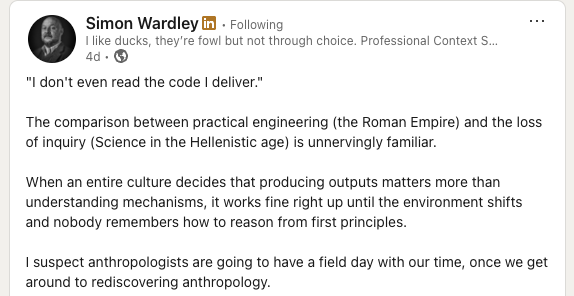
One of the surprising (at least to me) consequences of the fall of Twitter is the rise of LinkedIn as a social media site. I saw some interesting posts I wanted to call attention to: First, Simon W…
AutoSchemaKG: Autonomous Knowledge Graph Construction through Dynamic Schema Induction from Web-Scale Corpora
In the current era of information abundance, transforming vast amounts of unstructured data into structured, machine-readable knowledge remains one of the most significant challenges in artificial intelligence. Knowledge Graphs (KGs) have emerged as the cornerstone technology for this transformation Zhao et al. (2024), providing the semantic backbone for applications ranging from search engines and question answering Wu et al. (2024); Chen et al. (2024c); Zong et al. (2024); Sun et al. (2024b) to recommendation systems Lyu et al. (2024) and complex reasoning tasks Li et al. (2024b). Yet despite their critical importance, current KG construction approaches remain hampered by an inherent paradox: they require predefined schemas created by domain experts, which fundamentally limits their scalability, adaptability, and domain coverage.
When did Google get so f-ing weird?
I recently had an experience while doing a simple Google search that was so profoundly weird that it stopped me in my tracks. Understanding this Google se...


How the small web is creating an anti-slop internet
What is the small web? A new crop of platforms are answering algorithmic fatigue with a return to human-curated basics.

Paper Skygest: Personalized Academic Recommendations on Bluesky
We build, deploy, and evaluate Paper Skygest, a custom personalized social feed for scientific content posted by a user's network on Bluesky and the AT Protocol. We leverage a new capability on...

Monomarks: link-sharing for internet archaelogists
link-sharing for internet archaelogists