

202605 - apenwarr
In recent months I've heard of several teams with an interesting policy: each pull request should be no more than a few files, and no more than a certain number of lines (say 500). And do just one thing and do it well. And be easy for a human to review. And be fully tested by the test suite.
Introducing Tap: Repository Synchronization Made Simple | Bluesky
Just about every app built on AT needs data from a repository at some point. For many use cases – feed generators, labelers, bots – streaming live data through a Relay or Jetstream works well. But some applications need to go beyond what Jetstream was designed for, like tracking specific subsets of a repo, automatically backfilling a database when adding new repos to monitor, or even mirroring the entire Atmosphere.
Opinion | The A.I. Disruption Has Arrived, and It Sure Is Fun
We’re entering a new renaissance of software development. We should all be excited, despite the uncertainties that lie ahead.

Tests Are The New Moat | Daniel Saewitz
As AI becomes better at cloning people's open source work, what ends up becoming most valuable are software contracts, tests, and API surface area. This clashes the incentives of clearly defining your commercialized open source software with protecting it.
Bevy 0.19
Thanks to 261 contributors, 1185 pull requests, community reviewers, and our generous donors, we're happy to announce the Bevy 0.19 release on crates.…

Marathon's next major update runs a few months further away, permanent PvE in hand, as Bungie ditch their "strict seasonal schedule"
Marathon's next major update, dubbed Symbiosis and delivering permanent PvE, has been delayed to December with Bungie ditching their "strict seasonal schedule".

Serpentine software
I don’t usually write hot takes. But StrongDM’s Software Factory post is worth it, so here goes. Their post is elegant, short, and well-written, so I’m going to just go through a bunch of pull quotes. Compounding correctness long-horizon agentic coding workflows [now] compound correctness rather than error This is a big, empirical claim. I’m already convinced by my own experiences that agents, suitably scaffolded, can form a Brownian ratchet, such that pouring on more compute helps, on balance.
AI Tools Accelerates Coding, but Not Overall Software Delivery, GitLab Research Finds
GitLab's 2026 AI Accountability Report highlights an AI Paradox: although 78% of developers say they code faster, overall software delivery has not accelerated due to downstream testing and review bottlenecks and new challenges for enterprise governance and traceability.

Atlassian Enables Default Data Collection to Train AI
Atlassian will begin collecting customer metadata and in-app content from **Jira**, **Confluence**, and other cloud products by default on **August 17, 2026**, to train its AI offerings including `Rovo` and `Rovo Dev`. The change affects roughly **300,000** customers; metadata collection is mandatory for Free, Standard, and Premium tiers and cannot be opted out on those plans. Enterprise customers can opt out of metadata and in-app collection by default. Collected data will be retained up to **seven years**, with in-app data removed within 30 days after deletion or opt-out and models retrained within 90 days. Customers using customer-managed keys, Atlassian Government Cloud, Isolated Cloud, or with HIPAA requirements are excluded from collection.
It’s time to drain the Programmatic Swamp - New Digital Age
"Large parts of the programmatic ecosystem are a scam, and I don't mean slightly inefficient or in need of a tidy-up," writes Daniel Gilbert for New Digital Age...

ZKPROV: A Zero-Knowledge Approach to Dataset Provenance for Large Language Models
As large language models (LLMs) are used in sensitive fields, accurately verifying their computational provenance without disclosing their training datasets poses a significant challenge, particularly in regulated sectors such as healthcare, which have strict requirements for dataset use. Traditional approaches either incur substantial computational cost to fully verify the entire training process or leak unauthorized information to the verifier. Therefore, we introduce ZKPROV, a novel cryptographic framework allowing users to verify that the LLM's responses to their prompts are trained on datasets certified by the authorities that own them. Additionally, it ensures that the dataset's content is relevant to the users' queries without revealing sensitive information about the datasets or the model parameters. ZKPROV offers a unique balance between privacy and efficiency by binding training datasets, model parameters, and responses, while also attaching zero-knowledge proofs to the responses generated by the LLM to validate these claims. Our experimental results demonstrate sublinear scaling for generating and verifying these proofs, with end-to-end overhead under 3.3 seconds for models up to 8B parameters, presenting a practical solution for real-world applications. We also provide formal security guarantees, proving that our approach preserves dataset confidentiality while ensuring trustworthy dataset provenance.

Does Code Cleanliness Affect Coding Agents? A Controlled Minimal-Pair Study
As autonomous coding agents see rapid adoption, their evaluation has primarily focused on task completion rates holding the target codebase fixed. This leaves a critical question unanswered: does the structural and stylistic quality, or ``cleanliness'' of the underlying code affect an agent's ability to navigate and modify it? To isolate the effect of code cleanliness from agent capability, we introduce an evaluation protocol built around minimal pairs: repositories that match on architecture, dependencies, and external behaviour, but differ on static-analysis rule violations and cognitive complexity. The pairs are constructed in both directions, by agent pipelines that either degrade a clean repository or clean a messy one. We author 33 tasks across six such pairs, evaluated through hidden tests at the application's public surface. Across 660 trials with Claude Code, code cleanliness does not change the agent's pass rate. However, it substantially alters the agent's operational footprint: agents working on cleaner code use 7 to 8% fewer tokens and reduce file revisitations by 34%. Our findings suggest that traditional maintainability principles remain highly relevant in the era of AI-driven development, shaping the computational cost and navigational efficiency of coding agents. Code cleanliness joins model choice, harness, and prompting as a factor that materially affects agent behaviours.
File Over App: A Philosophy for Digital Longevity
My take on the 'file over app' philosophy and why it’s essential for keeping my data resilient and built to last.
“Policy Without Tools Is Just Poetry” - AT Protocol
Juliet Shen from ROOST joins the show to talk through the Coop 1.0 release, what open-source trust and safety unlocks for new builders, and where AI actually belongs in moderation

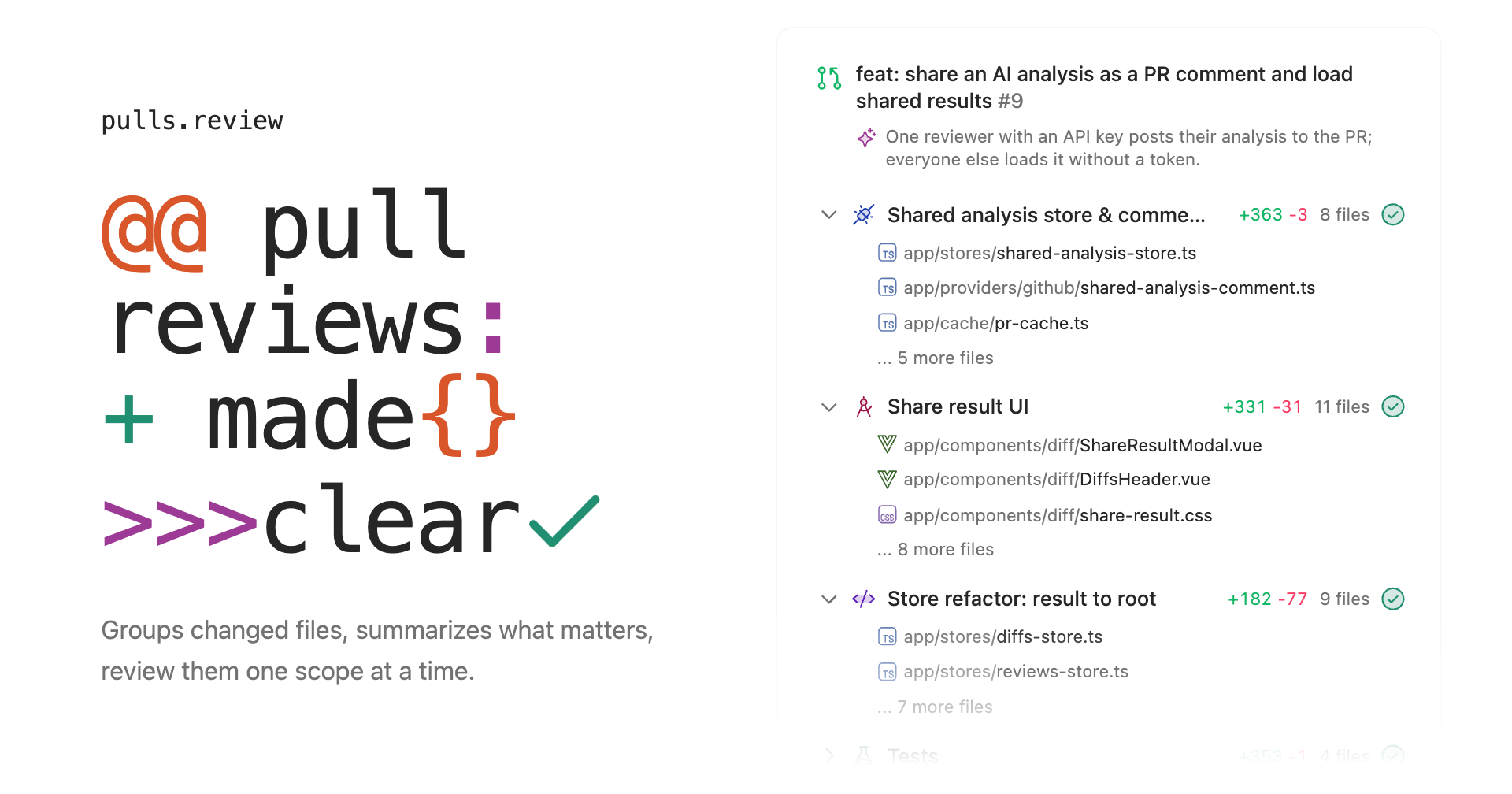
pulls.review
A better way to review a GitHub pull request’s diff: grouped, summarized, and fast.
AWS is pushing its DevOps Agent into the delivery pipeline itself, adding release readiness review and autonomous release testing as AI-generated code floods the merge queue.

AWS puts an AI bouncer at the merge queue
bit.ly
