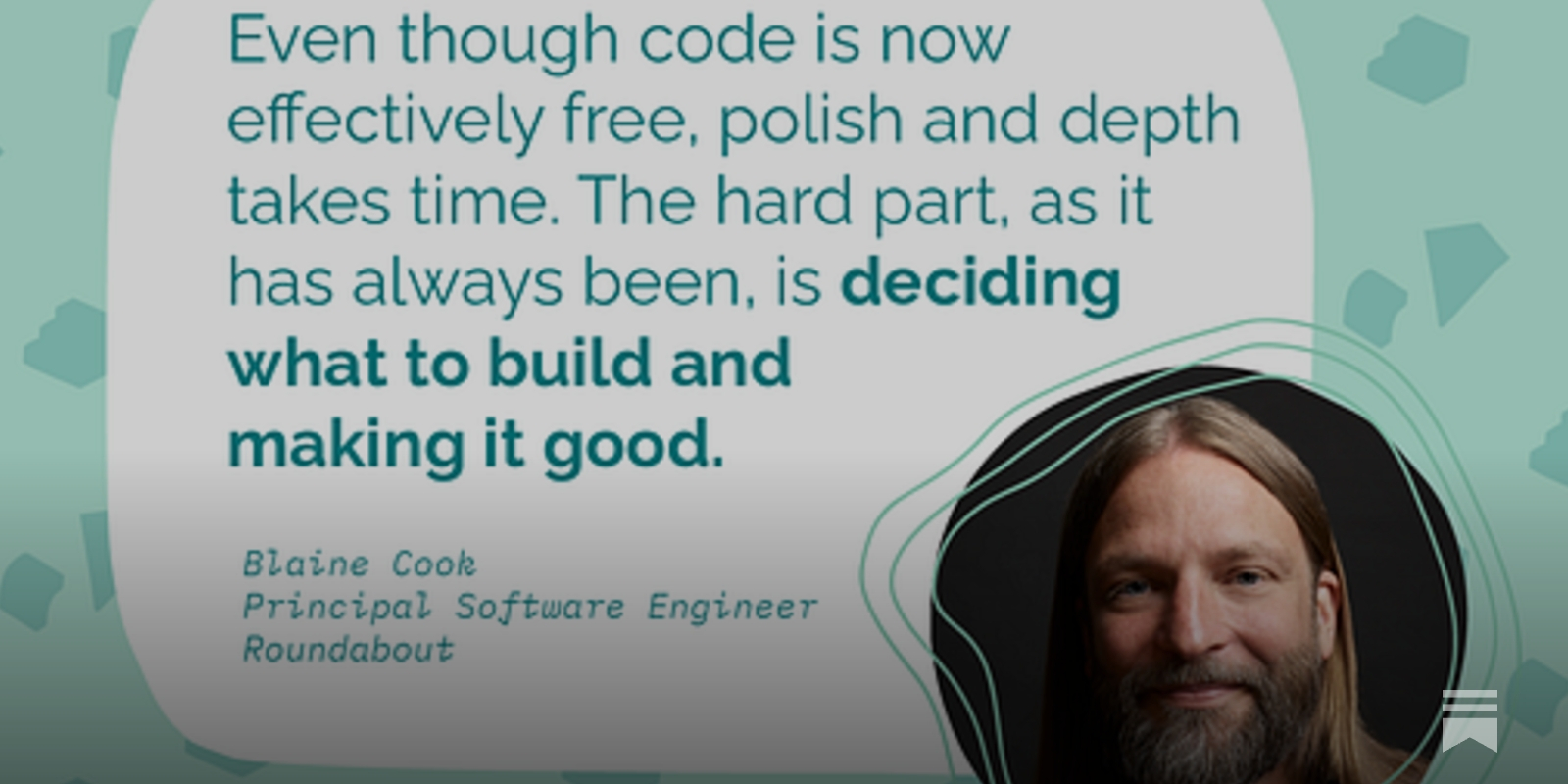
Emily M. Bender and Nanna Inie In our op-ed for Tech Policy Press ("We Need to Talk About How We Talk About 'AI'"), we made the case against the...
AI is a software un-crisis
I haven't asked her, but I bet Margaret Hamilton feels right at home bossing Claude around.
More Than a Tool
What We Learned from a Year of Conversations About AI

Something Big Is Happening
A personal note for non-tech friends and family on what AI is starting to change.

Statement from Dario Amodei on our discussions with the Department of War
A statement from our CEO on national security uses of AI
Michael R. Crusoe (@biocrusoe@fairpoints.social)
Oh, I like this part > No AI-generated text in human-to-human communication > When our maintainers volunteer their time to review your issue, PR, or proposal, they do not want to talk to a machine. This is a basic principle of respect. https://mastodon.gamedev.place/@godotengine/116839550229253906
Dario Amodei, hype, AI safety, and the explosion of vibe-coded AI disasters
What the AI cheerleaders don’t tell you
The Socialist Charcuterie Board - The Ideas Letter
Taking issue with Benanav’s institutional vision of a democratic political economy of technology, Morozov argues that generative AI exposes a deeper problem that socialism has yet to solve: how to…
AI Index | Stanford HAI
The mission of the AI Index is to provide unbiased, rigorously vetted, and globally sourced data for policymakers, researchers, journalists, executives, and the general public to develop a deeper understanding of the complex field of AI. To achieve this, we track, collate, distill, and visualize dat

After the feed with Eli Pariser, Ben Smith, and Jasmine Sun
Breaking My Own Rule (Again): AI and the Job Hunt - Jacky Alciné
I said I wasn't going to lean on generative AI but I also said I was going to leave the tech industry. Here's what I actually used to keep applying and what it did (and didn't) do for me.

AI Safety Is a Narrative Problem · Special Issue 5: Grappling With the Generative AI Revolution
This op-ed explores power and narrative dynamics around AI. Drawing on pop-culture references, the professional experiences of the author and examples from 2023’s “Great AI Safety Hype Roadshow,” this piece draws on the literary criticism technique of practical criticism to consider how speeches and announcements from both Silicon Valley executives and research scientists to interrogate the media-friendly nature of p(doom) discourse—which focuses on the existential risks of AI (PauseAI, 2023)—and its likely consequences. The complexities of AI and its numerous social impacts can be difficult for even the most expert analyst to unpack. In spite of this, the potential of “existential threats” has successfully cut through to become a mainstay of mainstream media coverage over the last year. This piece will make the case that this is an effective narrative conceit that has achieved a number of ends that traditional science communication tends to find difficult, if not impossible, to achieve. Firstly, it is easy to understand. Simplification of this nature—that removes jargon and complexity and focuses on a single outcome—is much easier to fit on a TV rolling news ticker or on the cover of a tabloid newspaper than more well-balanced, representative opinions. Secondly, it inherits prior assumptions from well-known dramatic forms. P(doom) plays to stories familiar from Greek tragedy through to Marvel movies, in which lone male heroes battle ineluctable forces. Thirdly, it is imbued with urgency and so becomes difficult to ignore.

I am often wrong
[I shared this note with my team earlier this week, and am posting it here as well. I hope it is interesting or helpful for others working on building product in the age of AI.]
AI Mania Is Eviscerating Global Decisionmaking
The reality of how much damage AI mania is doing to our ability to run institutions effectively.
✨🙌 AI that helps communities thrive on their own terms
Open protocols + AI-enabled coding = building what we need for ourselves