
An introduction to the idea that code should be approached with a mindset towards compressing it semantically, rather than orienting it around objects.
Dictionary Compression is finally here, and it's ridiculously good
Dictionary compression could completely change how applications send data over the web. It's recently gained broad support, and offers absurd real-world...

Compression is prediction | ngrok blog
Compression and LLMs are trying to solve the exact same problem: predicting what comes next. Learn the fundamentals of compression and how better prediction leads to better shrinkage.
Self-Instruct: Aligning Language Models with Self-Generated Instructions
Large "instruction-tuned" language models (i.e., finetuned to respond to instructions) have demonstrated a remarkable ability to generalize zero-shot to new tasks. Nevertheless, they depend...

Magicoder: Empowering Code Generation with OSS-Instruct
We introduce Magicoder, a series of fully open-source (code, weights, and data) Large Language Models (LLMs) for code that significantly closes the gap with top code models while having no more...
Coding After Coders: The End of Computer Programming as We Know It - …
archived 16 Mar 2026 15:14:04 UTC

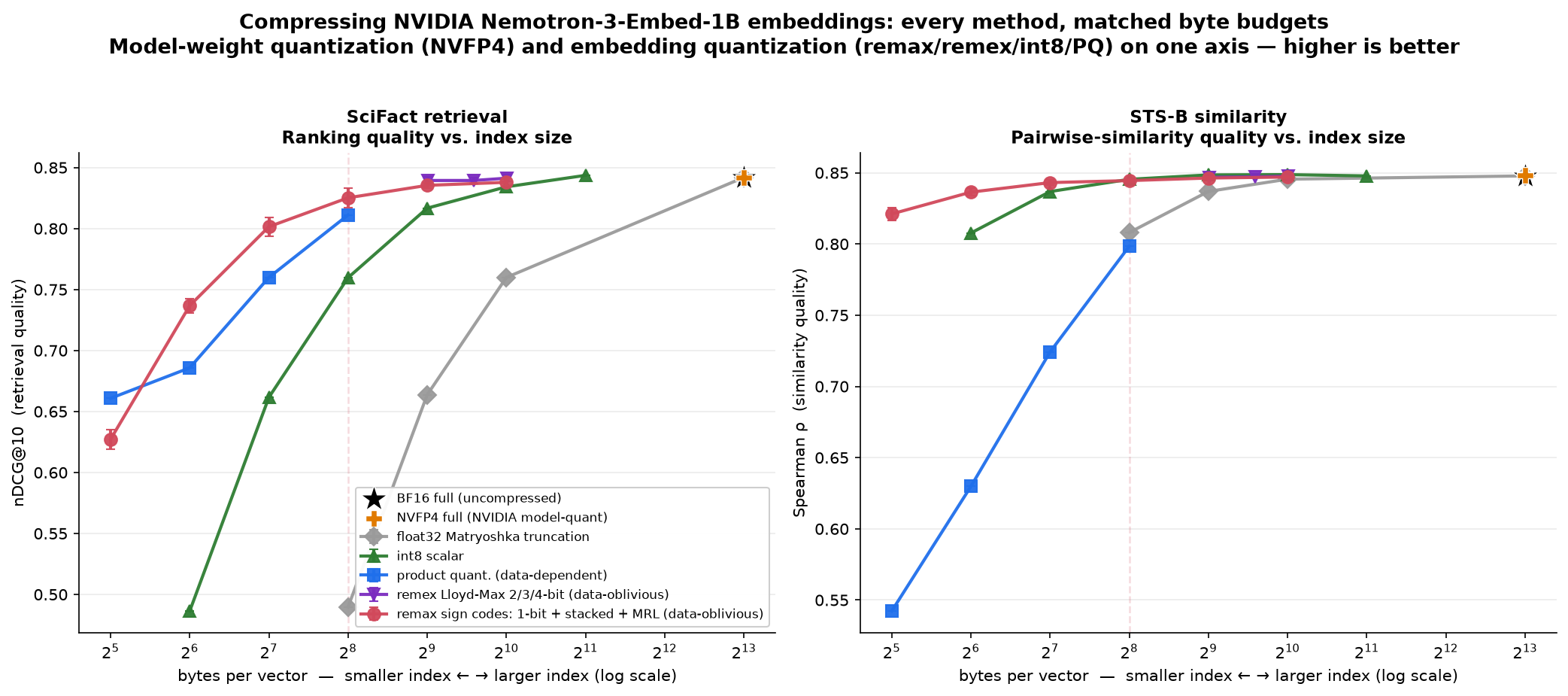
A 4-Bit Model and a 1-Bit Index
Running NVFP4 Nemotron on a CPU, then mapping every embedding-compression method at matched byte budgets. The two quantizations compose.
Machine-readable attitudes - Computational Semantics++
User intent declarations can be viewed as propositional attitudes (permission, prohibition, desire, intention, belief, etc.) over structured descriptions of data use. Treating them that way gives you composable building blocks from existing theory and lens-based translations between community vocabularies that make explicit what each translation cannot carry through.
Reducing the cognitive load of AI changes
When reviewing large amounts of AI-generated code, I often find that the LLM chooses terms for abstractions that do not always map to my own choices. For instance, what it may call a MutationIntent might personally be more natural to me as an EditRequest. Because the LLM's choice of words is not my ideal choice, I have to do a mental lookup of what it means every time I see it, which adds cognitive load.
The peril of laziness lost | The Observation Deck
In his classic Programming Perl — affectionately known to a generation of technologists as "the Camel Book" — Larry Wall famously wrote of the three virtues of a programmer as laziness, impatience, and hubris: If we’re going to talk about good software design, we have to talk about Laziness, Impatience, and Hubris, the basis of good software design. We’ve all fallen into the trap of using cut-and-paste when we should have defined a higher-level abstraction, if only just a loop or subroutine. To be sure, some folks have gone to the opposite extreme of defining ever-growing mounds of higher level abstractions when they should have used cut-and-paste. Generally, though, most of us need to think about using more abstraction rather than less.
Agentic Engineering Patterns - Simon Willison's Weblog
Patterns for getting the best results out of coding agents like Claude Code and OpenAI Codex. See my introduction for more on this project.
Can gzip be a language model?
A while back I wrote about language modeling without neural networks, where I generated Shakespeare with an unbounded n-gram model: no weights, no training, …
The 80% Problem in Agentic Coding
Managing comprehension debt when leaning on AI to code