

When I was actively contributing to the Go project, my primary feed was the code review email firehose. Issues, mailing lists, and Slack had low SNR. The finished commit history was better: it was finely polished work with some of the best written commit messages I have ever encountered. But it didn’t hold a candle to code reviews for operational learning. The commit history could tell you what got done and why, in impressive technical detail. But the code review could also tell you about mid-stream direction changes; what concerns were taken seriously; what got started and not completed; what values drove decisions.
Vibe-coded Go static analysis tools
Ideas are now a major bottleneck for vibe-coding. There are whole categories of software that simply don’t occur to me to write. Philip Zeyliger pointed me at one: Go static analysis tools. These are great candidates: easy to describe easy to test high value low risk He created a checker that requires slog.InfoContext instead of slog.Info when a context is available, to improve our telemetry/observability. I followed up with a checker that lets you annotate a Go struct as requiring complete, explicit annotation.
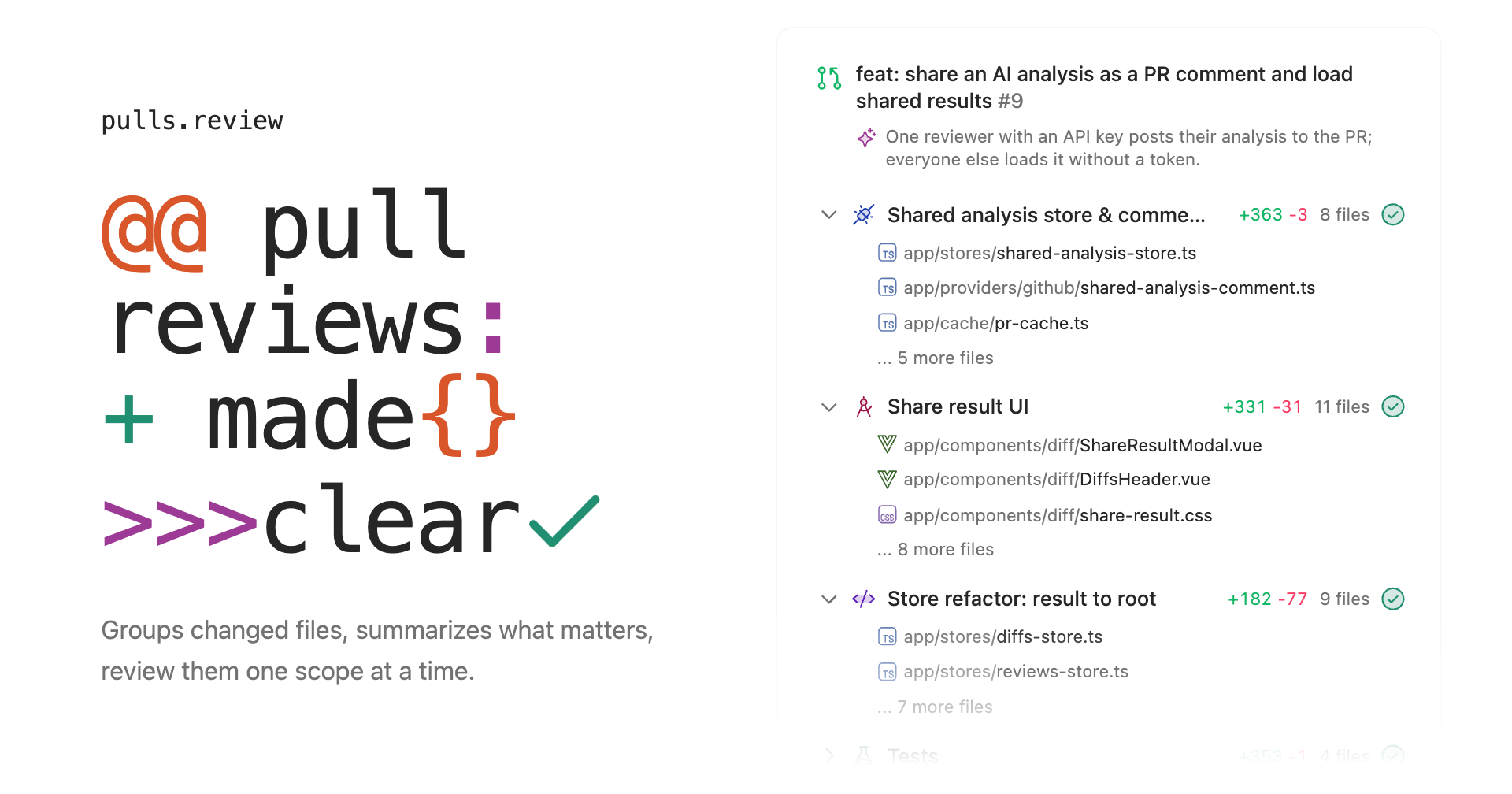
pulls.review
A better way to review a GitHub pull request’s diff: grouped, summarized, and fast.
Don't couple your Go code to GitHub | Iain Cambridge
The technical musings of Iain Cambridge.
Learn Go by Building a Command Line Todo App | Barbarian Meets Coding
Learn the Go programming language by building a test-driven command line todo application

Is GitHub Cooked?
Track GitHub service incidents and outages. Real-time stats, incident history, and downtime analytics.
Stop Using Conventional Commits
You’ve almost certainly encountered Conventional Commits before. It may have reared its ugly head in the changelog of an open source project you’ve used. It may have been the enforced commit format for an open source project you contributed to. A lot of people swear by it. I swear at it. Even though it is used by a large number of popular open source projects, Conventional Commits is an actively bad standard which encourages focus on the wrong things and fails to deliver on its promises.


Reading Code Is Hard, and tips to improve - Trisha Gee
This week's video for Dave Farley's Continuous Delivery YouTube channel is me ranting about why reading code sucks, and offering some advice on how to improve. "Every programmer occasionally, when nobody’s home, turns off the lights, pours a glass of scotch, puts on some light German electronica, and opens up a file on their computer. ... Read more

userinput.app
Collect feedback: post ideas, vote on what matters, and watch them go from planned to shipped.

OpenCode Go | Low cost coding models for everyone
Go starts at $5 for your first month, then $10/month, with generous 5-hour request limits for GLM-5.1, GLM-5, Kimi K2.5, Kimi K2.6, MiMo-V2.5-Pro, MiMo-V2.5, Qwen3.7 Max, Qwen3.6 Plus, MiniMax M2.5, MiniMax M2.7, MiniMax M3, DeepSeek V4 Pro, and DeepSeek V4 Flash.
in progress works
lightweight accountability community and journal for your side projects
Does Code Cleanliness Affect Coding Agents? A Controlled Minimal-Pair Study
As autonomous coding agents see rapid adoption, their evaluation has primarily focused on task completion rates holding the target codebase fixed. This leaves a critical question unanswered: does the structural and stylistic quality, or ``cleanliness'' of the underlying code affect an agent's ability to navigate and modify it? To isolate the effect of code cleanliness from agent capability, we introduce an evaluation protocol built around minimal pairs: repositories that match on architecture, dependencies, and external behaviour, but differ on static-analysis rule violations and cognitive complexity. The pairs are constructed in both directions, by agent pipelines that either degrade a clean repository or clean a messy one. We author 33 tasks across six such pairs, evaluated through hidden tests at the application's public surface. Across 660 trials with Claude Code, code cleanliness does not change the agent's pass rate. However, it substantially alters the agent's operational footprint: agents working on cleaner code use 7 to 8% fewer tokens and reduce file revisitations by 34%. Our findings suggest that traditional maintainability principles remain highly relevant in the era of AI-driven development, shaping the computational cost and navigational efficiency of coding agents. Code cleanliness joins model choice, harness, and prompting as a factor that materially affects agent behaviours.

Unified Versus Split Diff
Which is better for code reviews, a unified diff or a split diff?
