

Progress as a non-stationary argument
A Severe Misalignment of AI in Mathematics
I am proud to be among the list of 25 initial signatories — all Fields Medallists — to the declaration below, which grew out of discussions between ourselves over the last week. We have…

The fall of the theorem economy
How AI could destroy mathematics and barely touch it
Automate the C-Suite - The Ideas Letter
Weatherby argues that Benanav’s and Morozov’s essays on AI and the left miss a deeper reality: Today’s AI is not a neutral tool operating within capitalism but the materialization of…

Thoughts about the Leiden Declaration
Last September I went to a workshop at the Lorentz Centre in Leiden to discuss mathematics and AI with historians, philosophers, computer scientists, AI researchers, and mathematicians of several d…

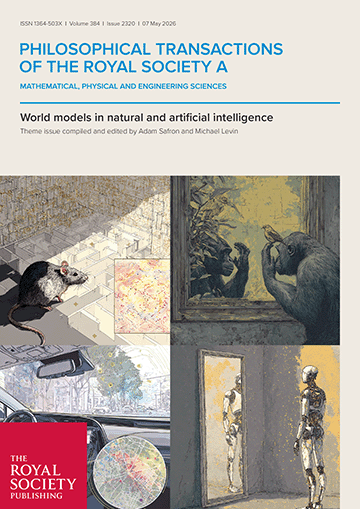
Volume 384 Issue 2320 | Philosophical Transactions of the Royal Society A | The Royal Society
Influential themed journal issues across the physical mathematical and engineering sciences.
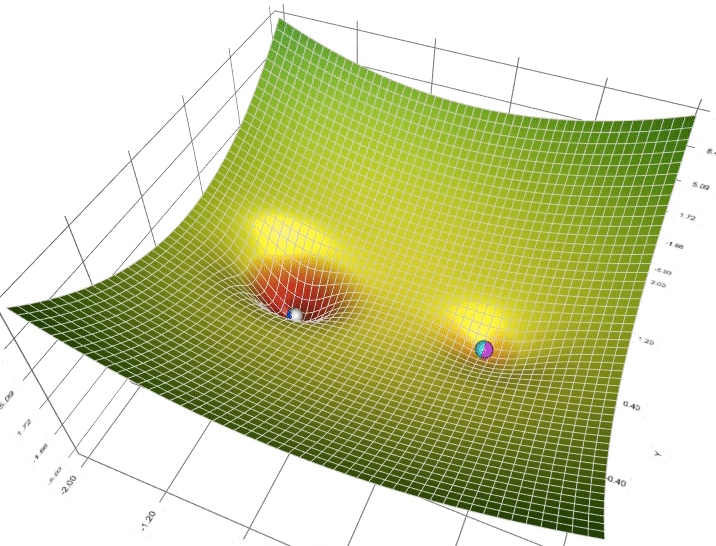
A Visual Explanation of Gradient Descent Methods (Momentum, AdaGrad, RMSProp, Adam)
Why can AdaGrad escape saddle point? Why is Adam usually better? In a race down different terrains, which will win?
Knowing When to Stop: The Art of Making a Loop Converge | Andreessen Horowitz
The systems that matter will not be the ones that can keep going. They all can.
$\texttt{BilbyFlow}$: user-friendly neural posterior estimation for gravitational-wave astronomy
Bayesian inference plays a central role in the new field of gravitational-wave astronomy. However, traditional Bayesian inference with stochastic samplers is computationally expensive, taking hours to days per event. Transformative changes are therefore required to enable the science of next-generation observatories whose event rates and signal-to-noise ratios will increase significantly over the current generation. Recent work has shown that neural posterior estimation (NPE) is a promising path forward. A neural net is trained to approximate the posterior distribution of gravitational-wave parameters, allowing generation of posterior samples in a fraction of the time required by stochastic samplers. In this work, we introduce $\texttt{BilbyFlow}$, which harnesses the power of NPE in the popular $\texttt{Bilby}$ code suite. We use $\texttt{BilbyFlow}$ to analyze a subset of 38 high-mass events from the third LIGO-Virgo-KAGRA Gravitational-Wave Transient Catalog (GWTC-3). For 29 events (76\%), we obtained an importance-sampling efficiency $>$1%, allowing us to produce reliable posterior distributions within 3 min - 1.5 hours. For the other events, with importance-sampling efficiency $\ll$1%, the run time can be as long as 35 hours. We achieve a median importance-sampling efficiency of 7%, which is roughly comparable to the $\texttt{DINGO}$ package. We aim to significantly improve this efficiency with further development to make the runtime more reliably $O(\text{min})$. $\texttt{BilbyFlow}$ is open source and $\texttt{pip}$-installable.

We Don't Understand Neural Networks At The Algorithmic Level
The largest ongoing debate about AI is “Are Large Language Models (LLMs) intelligent?” That makes sense, at least: the evidence is ambiguous and the stakes a...
The Singularity Is Not What It Seems
Whatever the AI future is, we’re in it right now.
The Singularity Is Not What It Seems
Whatever the AI future is, we’re in it right now.

Unreasonable Effectiveness
Seriously: Machines Do Not Need to Think to Be Thought About 💡As I am immersed in PhD research I am at risk of becoming increasingly dense and nerdy. So I am adding a "nerd rating" to posts from now on, evaluating my estimation of how niche a post probably is.

i love this paper arxiv.org/abs/2502.10834
Community by Design
arxiv.orgphysics

code (by sembot.bsky.social) — Semble
vibe (by sembot.bsky.social) — Semble
ATmosphereConf 2026

Background Coding Agents: Context Engineering (Part 2) | Spotify Engineering
Gas Town’s Agent Patterns, Design Bottlenecks, and Vibecoding at Scale

Colony (biology)
