

Arguing against "universal spaces" and raising a couple questions that come up as a result.
Evaluating permissioned spaces for community contexts - meri's missives
A look at Bluesky's proposed approach to private data on ATProto
greensky: what does permissioned data feel like? - building [at] habitat
At @habitat.network, we're working hard to launch something at ATmosphereConf. We're building a platform for user data agency: giving users full and transpar…
Permissioned Data Diary 2: Buckets - Daniel's Leaflets
The second in a series of posts building up a solution to permissioned data on atproto. We introduce buckets: a new protocol primitive for creating a shared social context.
B-Sides: Permissioned data is a love triangle - Nick's Blog
This is a B-sides post with unpolished thoughts that didn’t make it into the main article.
Habitat & permission spaces for organizations - building [at] habitat
Our plans for organizational permissions on spaces
calendar pt. 2: spaces, meet cliques! - building [at] habitat
permission-ed data without AppViews
Permissioned Data Diary 3: Your Bucket, My Data - Daniel's Leaflets
The third in a series of posts building up a solution to permissioned data on atproto. We look at two different models for where buckets live and why the simpler-looking one doesn’t work out.
Reintroducing Spaces - Daniel's Leaflets
Now with better perspective, zooming out and re-motivating the design of spaces, the new primitive for non-public data on atproto.
Habitat's road to release: 01 simplespace - building [at] habitat
First up: a pre-implementation of permissioned spaces
Habitat's road to release: 03 ReBAC on spaces - building [at] habitat
Fine-grained permissioning on top of spaces.
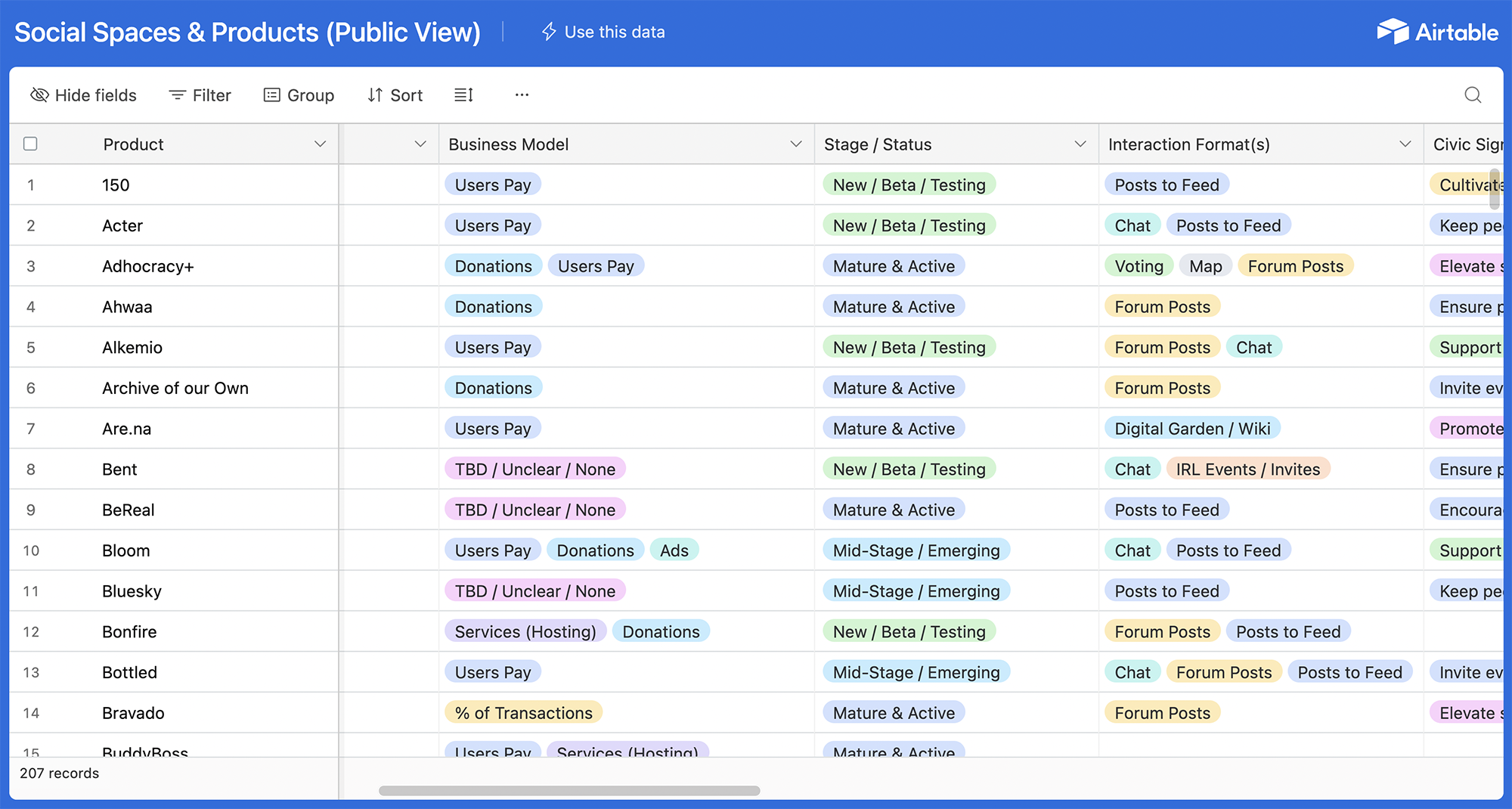
Digital Spaces Directory | New_ Public
As the social media landscape changes and a new wave of digital spaces emerges, this Directory is meant to be a resource for our field — a jumping-off-point for further exploration and research for anyone who’s interested in studying, building, stewarding, or simply using digital social platforms. We hope this will inspire creative exploration, spark new collaborations, and highlight important progress.
User Intents as Living Data — A Descriptive Meta-Framework
A response to Bluesky's User Intents proposal: instead of prescribing a fixed set of intent categories, treat them as living data and use panproto lenses to map between the vocabularies that different communities will inevitably create.
Where Does Community Live? - some responses - Connected Places
I agree that the architecture of a space matters, but I'm not sure the extent we agree as to how much a protocol really matters, versus what we build with them. Roundabout is built on atproto, and I'm quite happy with the decision. I think our architecture very strongly supports our communities.
Permissioned Data Shapes: Self-Only Bookmarks - Nick's Blog
A self-only space is the smallest shape permissioned data can take: one authority, one member, one repo, and private bookmarks that share a record shape and a write path with public ones.
AT-Communities #1: the Concierge, the Vault, and the Fuck-ass Astro Website – Essential Randomness
In which I try to make sense of communities on ATproto.

Community by Design
Social media empower distributed content creation by algorithmically harnessing "the social fabric" (explicit and implicit signals of association) to serve this content. While this overcomes the bottlenecks and biases of traditional gatekeepers, many believe it has unsustainably eroded the very social fabric it depends on by maximizing engagement for advertising revenue. This paper participates in open and ongoing considerations to translate social and political values and conventions, specifically social cohesion, into platform design. We propose an alternative platform model that includes the social fabric an explicit output as well as input. Citizens are members of communities defined by explicit affiliation or clusters of shared attitudes. Both have internal divisions, as citizens are members of intersecting communities, which are themselves internally diverse. Each is understood to value content that bridge (viz. achieve consensus across) and balance (viz. represent fairly) this internal diversity, consistent with the principles of the Hutchins Commission (1947). Content is labeled with social provenance, indicating for which community or citizen it is bridging or balancing. Subscription payments allow citizens and communities to increase the algorithmic weight on the content they value in the content serving algorithm. Advertisers may, with consent of citizen or community counterparties, target them in exchange for payment or increase in that party's algorithmic weight. Underserved and emerging communities and citizens are optimally subsidized/supported to develop into paying participants. Content creators and communities that curate content are rewarded for their contributions with algorithmic weight and/or revenue. We discuss applications to productivity (e.g. LinkedIn), political (e.g. X), and cultural (e.g. TikTok) platforms.
