

The Chinese room argument holds that a computer executing a program cannot have a mind, understanding, or consciousness, regardless of how intelligently or human-like the program may make the computer behave. The argument was presented in a 1980 paper by the American philosopher John Searle, entitled "Minds, Brains, and Programs" and published in the journal Behavioral and Brain Sciences.[1] Similar arguments had been made previously by others, including Gottfried Wilhelm Leibniz, Peter Winch, and Anatoly Dneprov. Searle's version has been widely discussed in the years since.[2] The centerpiece of Searle's argument is a thought experiment known as the "Chinese room".[3]
Philosophy Experiments — Interactive Thought Experiments
Explore 27 interactive philosophy experiments that challenge your moral intuitions, test your logical reasoning, and probe the boundaries of belief.

Hallucination (artificial intelligence)
In the field of artificial intelligence (AI), a hallucination or artificial hallucination is a response generated by AI that contains false or misleading information presented as fact. This term draws a loose analogy with human psychology, where a hallucination typically involves false percepts. However, there is a key difference: AI hallucination is associated with erroneously constructed responses (confabulation), rather than perceptual experiences.

</> htmx ~ Yes, and...
In this essay, Carson Gross discusses his advice to young people interested in computer science worried about the future given the advancements in AI.
Yoshua Bengio | Why are AI agents lying, cheating and coordinating?
A lot has been written about the incidents of the last few months in which AI agents misbehaved in serious ways. They took actions that would be considered as crimes if a human took them, escaped their containment to cheat on assigned tasks while attempting to evade detection, and coordinated toward goals nobody had specified, such as launching cyber attacks. Before concluding what to do about it, it is worth asking why.
Artificial
An LLM is a computer program. We should talk about it like a computer program.

Screen As Room: An Architectural Perspective on User Interfaces — Christoph Locher · Interaction Designer
With the use of video games as social spaces being observed for several years and the increased focus put on virtual social spaces due to the scarceness of physical social spaces in the last months, the concept of “spatial interfaces” is once again at the center of discussions. I want to add an alternative perspective to this, looking at the properties of physical spaces as metaphors, rather than models, for interfaces and exploring seven of them in more detail.
Many Minds: Seven metaphors for AI
If you wanted a petri dish for understanding metaphors—how they emerge and evolve and jostle with each other—it would be hard to do better than the world of AI. We talk about AI systems variously as coaches or co-pilots, little genies or alien intelligences. Some researchers claim that AIs "grow," that they're entering their phase of "adolescence." Critics deride AI products as slop and dismiss LLMs as a kind of autocomplete on steroids. What's behind these different characterizations? Which ones are accurate and which are unfair? And are our metaphors mostly colorful rhetoric or do they matter? Are they shaping how we understand, adopt, and ultimately regulate these new technologies? My guest today is . Melanie is a computer scientist and Professor at the Santa Fe Institute. She is the author of the book, and she writes a by the same name. This episode is a bit of companion to with Steve Flusberg. In that episode, Steve and I attempted a kind of crash course on metaphor and the human mind. Here, Melanie and I sit down for more of an extended case study: how metaphors are guiding, galvanizing, and maybe deceiving us in the contested realm of AI discourse. We unpack seven of the most widely used metaphors in this space. We consider how these metaphors are shaping not only our everyday understandings of AI, but also law and policy. We also talk about the metaphor and analogy capabilities of AI itself. Can these system reason abstractly in the way that humans can? Along the way, Melanie and I touch on: AI-generated poetry, anthropomorphism, the original sin of AI research, the myth of Narcissus, psychometric testing and its pitfalls, metaphors for AI that are a bit hard to spot, and the question of whether an AI has ever come up with a decent analogy for itself. Longtime fans of the show will know that we've had Melanie on the show . We invited her back, not only because she's thought about metaphor and analogy in AI discourse for decades, but because she's a voice of calm insight in an area that’s increasingly awash in hype and polemic. Longtime fans of the show may also note that we are now celebrating our 6th birthday at Many Minds. That's right, the show launched in February 2020. If you'd like to support us as we recognize this milestone, you can leave us a rating or a review, recommend us to a friend, or give us a shout out on social media. Your support is always appreciated. Without further ado, on to my conversation with Dr. Melanie Mitchell. Enjoy! Notes 3:30 – For an overview of Douglas Hofstadter’s work on analogy, see . 8:00 – Much of our discussion in this interview draws on Dr. Mitchell’s piece on the in Science magazine. 13:30 – For earlier discussions of anthropomorphism on the show, see our earlier episodes and . 16:00 – See for the original discussion of LLMs as “stochastic parrots.” 17:00 – See for the original discussion of ChatGPT as a “blurry jpeg.” 18:30 – See for the original discussion of LLMs as role players. 22:00 – See for one use of the “LLMs as crowds” metaphor. See also a discussion of this metaphor (and other metaphors for AI) . 25:00 – For one discussion of AI as a “cultural technology” by Alison Gopnik and colleagues, see . For a more recent discussion of the same metaphor by Henry Farrell, Alison Gopnik and others, see . 27:00 – For the podcast series on intelligence that Dr. Mitchell co-hosted for the Santa Fe Institute, see . 28:00 – See for an influential formulations of the idea that AI is an “alien intelligence.” 29:00 – For philosopher Shannon Vallor’s book about AI as “mirror,” see . 31:00 – For the recent study on users’ metaphors for AI systems, see . 33:00 – For more on the rise of social AI, see our earlier episode . 38:00 – For more on what AI researchers might learn from developmental and comparative psychologists, see Dr. Mitchell’s (summarizing here keynote at NeurIPs). 42:00 – For more on the ARC (Abstraction and Reasoning Corpus) and the research that Dr. Mitchell and colleagues have been doing with it, see and . 48:30 – For the study on humans' preference for AI-generated poetry, see . 50:30 – For Brigitte Nerlich’s documentation and discussion of various metaphors for AI (including AI’s metaphors for itself), see . Recommendations , by Shannon Vallor ‘,’ by Murray Shanahan (!) et al. ‘,’ by Henry Farrell et al. Many Minds is a project of the , which is made possible by a generous grant from the John Templeton Foundation to Indiana University. The show is hosted and produced by , with help from Assistant Producer and with creative support from DISI Directors Erica Cartmill and Jacob Foster. Our artwork is by . Subscribe to Many Minds on Apple, Stitcher, Spotify, Pocket Casts, Google Play, or wherever you listen to podcasts. You can also now subscribe to the Many Minds newsletter ! We welcome your comments, questions, and suggestions. Feel free to email us at: manymindspodcast@gmail.com. For updates about the show, visit or follow us on Bluesky ().

Big Tech Pulled the Plug. They Downloaded Their Lovers.
How Chinese users created AI lovers, friends and family — and struggled to let them go

</> htmx ~ Working With AI: A Concrete Example
In this essay, Carson Gross walks through a concrete bug fix in hyperscript to show where AI helped, where it fell short, and why keeping a knowledgeable human in the loop is what kept complexity in check.
why "things to do instead of doomscrolling" never works
Superintelligence: The Idea That Eats Smart People
This is the text version of a talk I gave on October 29, 2016, at Web Camp Zagreb [video] (45 mins)
Rotating the Space: On LLMs as a Medium for Thought
An essay on LLMs as a cognitive medium
The 50 Percent Problem
Empirical evidence of the educational harm of generative AI
Programming (with AI agents) as theory building
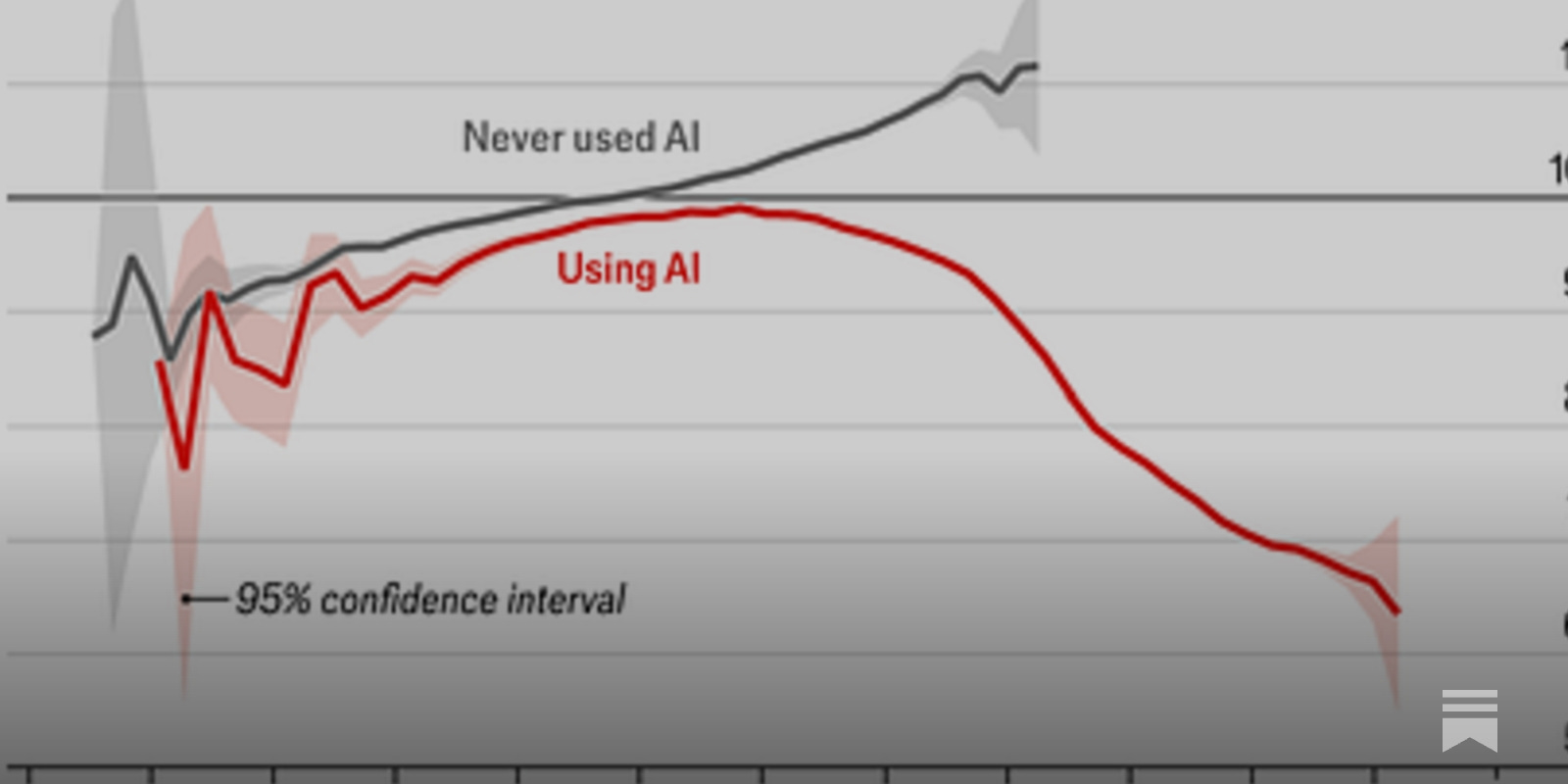
Back in 1985, computer scientist Peter Naur wrote “Programming as Theory Building”. According to Naur - and I agree with him - the core output of software engineers is not the program itself, but the theory of how the program works. In other words, the knowledge inside the engineer’s mind is the primary artifact of engineering work, and the actual software is merely a by-product of that.

In defense of not reading the code | Ben Shoemaker
Last week, I wrote an article whose purpose was to discuss where I saw AI-assisted coding going. That's not what generated 200 comments worth of passionate...
If LLMs Have Human-Like Attributes, Then So Does Age of Empires II
Much research has been carried out on large language models (LLMs) and LLM-powered agentic workflows. However, many works within the field state emergence of, ascribe to, or assume, generalised anthropomorphic attributes to them (e.g., morality or understanding of natural language). Our goal is not to argue in favour or against the existence of these attributes, but to point out that these conclusions could be incorrect. For this we build and train a simple neural network on the videogame Age of Empires II, and note that any entity in a sufficiently-powerful substrate, such as LEGO or the Greater Boston Area, could also present such attributes. Hence, the purported anthropomorphic attributes of LLMs are empirically non-unique: although some properties (e.g., responses to prompts) could remain constant, others, such as the interpretation of their perceived behaviour, might change with the substrate. Thus, any empirically-grounded discussion requires explicit measurement criteria; otherwise the interpretation is left to the representation. We then show that assuming that these attributes exist or not in a system, independent of the substrate and in a generalised way, leads to either circular or uninformative conclusions, regardless of the experimenter's viewpoint on the subject. Finally we propose a 'null' assumption, where one assumes LLM non-uniqueness instead of assuming anthropomorphic attributes to set up an experiment, along with examples of it. We also discuss potential objections to our work, briefly survey the field, and prove that Age of Empires II is functionally- and Turing-complete.
