

Solving an equation containing variables consists of determining which values of the variables make the equality true. The variables for which the equation has to be solved are also called unknowns, and the values of the unknowns that satisfy the equality are called solutions of the equation. There are two kinds of equations: identities and conditional equations. An identity is true for all values of the variables. A conditional equation is only true for particular values of the variables.[5][6]
Approaching an unknown communication system by latent space exploration and causal inference
Abstract. We propose a methodology for discovering meaningful properties in data without ground truth by combining manipulation of the latent variables of

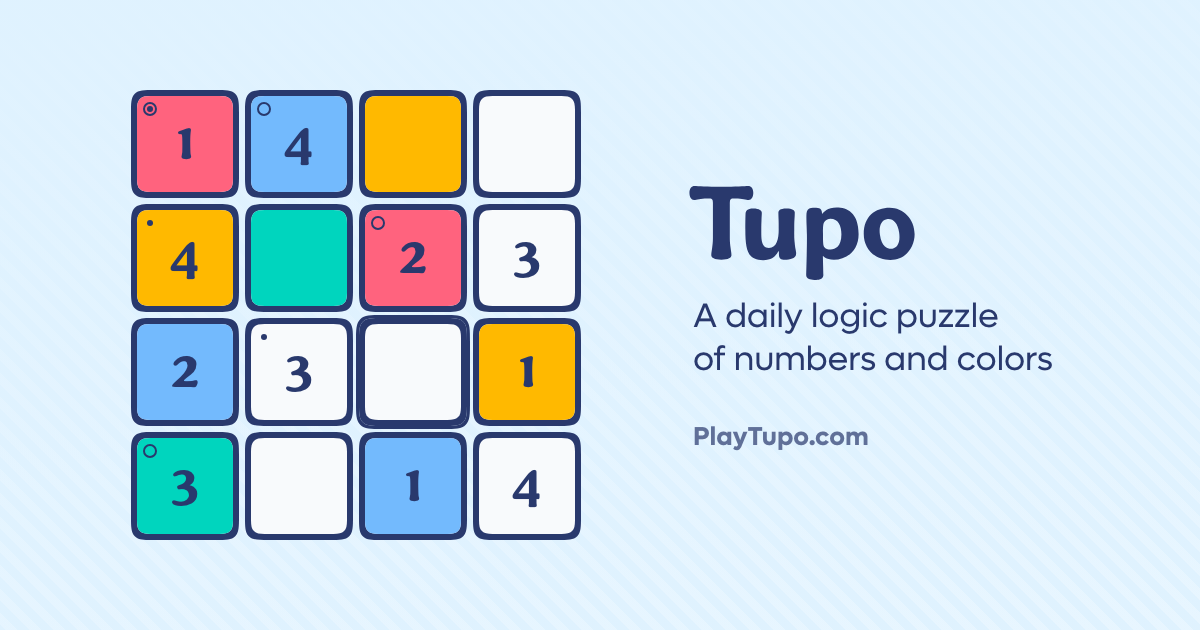
Tupo · A daily sudoku-style logic puzzle with a twist
A simple logic puzzle of numbers and colors. One new puzzle every day, starting easy and getting harder through the week.
Cancelation Terminology
A short note explaining the difference between synchronous cancelation, asynchronous cancelation, and graceful shutdown. I am not too attached to these specific three terms, but I want to call your attention to the three things behind them, which are important not to confuse with each other.
You don't have to be smart if you can think clearly
When you’re on fire, problems are transparent: they’re solved simply by the act of looking at them. Even complicated layers of multiple problems can simply be glanced through like stacked panes of glass. But nobody can work that way all the time.

Collection (abstract data type)
In computer programming, a collection is an abstract data type that is a grouping of items that can be used in a polymorphic way.

Matter
In classical physics and general chemistry, matter is any substance that has mass and takes up space by having volume. All everyday objects that can be touched are ultimately composed of atoms, which are made up of interacting subatomic particles. In everyday as well as scientific usage, matter generally includes atoms and anything made up of them, and any particles that act as if they have both rest mass and volume. However it does not include massless particles such as photons, or other energy phenomena or waves such as light or heat. Matter exists in various states. These include classical everyday phases such as solid, liquid, and gas – for example water exists as ice, liquid water, and gaseous steam – but other states are possible, including plasma, Bose–Einstein condensates, fermionic condensates, and quark–gluon plasma.

Hallucination (artificial intelligence)
In the field of artificial intelligence (AI), a hallucination or artificial hallucination is a response generated by AI that contains false or misleading information presented as fact. This term draws a loose analogy with human psychology, where a hallucination typically involves false percepts. However, there is a key difference: AI hallucination is associated with erroneously constructed responses (confabulation), rather than perceptual experiences.

What Functional Programmers Get Wrong About Systems - Ian Duncan
Type systems verify properties of programs. Production correctness is a property of systems. The gap between these is where the interesting failures live.
</> htmx ~ Working With AI: A Concrete Example
In this essay, Carson Gross walks through a concrete bug fix in hyperscript to show where AI helped, where it fell short, and why keeping a knowledgeable human in the loop is what kept complexity in check.

Your files. Your account.
AT Storage keeps exact media originals in an owner-only permissioned Space, organizes them into albums. Other file types will be added soon™
math.r — Brain Building Game
Mathr is a brain building game to improve your math calculation skills. Practice arithmetic and level up!
Parseword - A tricky wordplay game
Transform phrases through wordplay to solve cryptic crossword puzzles.

This Most Simple Sudoku Rule = Fog Magic