


The Indian subcontinent is a physiographic region of Asia below the Himalayas which projects into the Indian Ocean between the Bay of Bengal to the east and the Arabian Sea to the west. It is now divided between Bangladesh, India, and Pakistan. Although the terms Indian subcontinent and South Asia are often also used interchangeably to denote a wider region which includes, in addition, Bhutan, the Maldives, Nepal and Sri Lanka, the Indian subcontinent term is more geophysical, whereas South Asia is more geopolitical. South Asia is also frequently defined to include Afghanistan, which is not considered part of the subcontinent even in extended usage.
Outline of ancient India
The following outline is provided as an overview of and topical guide to ancient India:
Indian Culture | Ministry of Culture
About Indian CultureIndian culture, often labelled as a combination of several cultures, has been influenced by a history that is several millennia old, beginning with the Indus Valley civilization and other early cultural areas. Indian culture is one of the oldest and most unique cultures known across the globe. It has Indian culture is one of the oldest and most unique cultures known across the globe.
Eastern philosophy
Eastern philosophy (also called Asian philosophy or Oriental philosophy) includes the various philosophies that originated in East and South Asia, including Chinese philosophy, Japanese philosophy, Korean philosophy, and Vietnamese philosophy, which are dominant in East Asia;[1] and Indian philosophy (including Hindu philosophy, Jain philosophy, Buddhist philosophy), which are dominant in South Asia, Southeast Asia, Tibet, Japan and Mongolia.[2][3]
Geophysics
Geophysics is a physical science concerned with the processes and properties of Earth and its surrounding space environment, studied using quantitative and observational methods. It focuses primarily on Earth’s shape and its gravitational, magnetic, and electromagnetic fields. It also studies internal structure, composition, and dynamics, and their surface expression in tectonics, volcanism, and rock formation. Geophysics also encompasses a broader Earth-system and planetary perspective, including the oceans, atmosphere, cryosphere, ionosphere, magnetosphere, as well as solar–terrestrial interactions and analogous processes on the Moon, other planets, and their satellites.

Buddhist philosophy
Buddhist philosophy is the ancient Indian philosophical system that developed within the religio-philosophical tradition of Buddhism. It comprises all the philosophical investigations and systems of rational inquiry that developed among various schools of Buddhism in ancient India following the parinirvāṇa of Gautama Buddha, as well as the further developments which followed the spread of Buddhism throughout Asia.
Deep biosphere
The deep biosphere is the part of the biosphere that resides below the first few meters of the land surface and seafloor. It extends 10 km (6.2 mi) below the continental surface and 21 km (13 mi) below the sea surface, at temperatures that may reach beyond 120 °C (248 °F) which is comparable to the maximum temperature where a metabolically active organism has been found. It includes all three domains of life and the genetic diversity rivals that on the surface.

How Brazil's AI Governance Vision Got Sidelined at the India Summit
Brazil's multilateralism agenda was forsaken where it mattered most at India's AI summit, Tech Policy Press fellow Tatiana Dias writes.


Engineering geology
Engineering geology is the application of geology to engineering study for the purpose of assuring that the geological factors regarding the location, design, construction, operation and maintenance of engineering works are recognized and accounted for. Engineering geologists provide geological and geotechnical recommendations, analysis, and design associated with human development and various types of structures. The realm of the engineering geologist is essentially in the area of earth-structure interactions, or investigation of how the earth or earth processes impact human made structures and human activities.

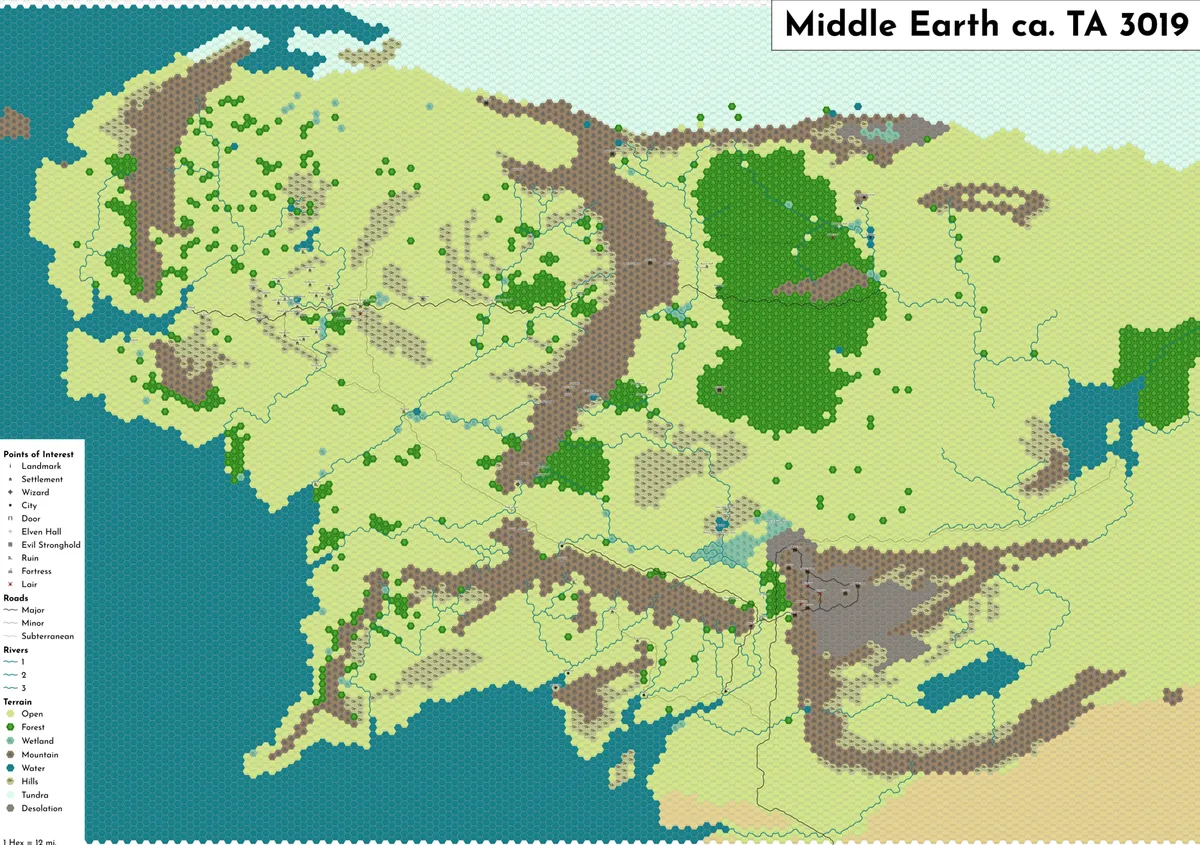
12-mile Middle Earth Hexmap
I've been re-reading the Hobbit & Lord of The Rings this year, so naturally my latest cartographic hyperfixation was to make a map of Tolkien's paracosm. ...
The Color of Reason: The Idea of'Race'in Kant's Anthropology
Anthropology and Physical Geography. They were popular lectures attended by people from the general public. The present manual contains my lectures on anthropology. As to Physical Geography, however, it will not be possible, considering my age, to

Fighting for a Livable Future: Exploring Frontier Climate Interventions - The Great Simplification
While current conversations about global heating tend to center around a few well-established pieces of science, we don’t often hear about the scientists and leaders working at the frontier of what is still unknown about Earth’s systems. This includes unpredictable tipping points and cascading effects of our rapidly changing climate, as well as the unconventional adaptation strategies that might help us maintain a stable planet. What is the newest climate science being researched right now, and what areas are we still needing to explore as we fight for a livable future?


River
A river is a natural stream of fresh water that flows on land or inside caves towards another body of water at a lower elevation, such as an ocean, lake, or another river. A river may run dry before reaching the end of its course if it runs out of water, or only flow during certain seasons. Rivers are regulated by the water cycle, the processes by which water moves around the Earth. Water first enters rivers through precipitation, whether from rainfall, the runoff of water down a slope, the melting of glaciers or snow, or seepage from aquifers beneath the surface of the Earth.

Bedrock
In geology, bedrock is the solid rock that lies under weathered rock and unconsolidated or loose superficial deposits in the near surface part of Earth's crust or the crust of another terrestrial planet. The top of the bedrock is known as rockhead.

Coherence
English text with a description and a picture, this section can be subdivided as necessary With major methods parts of this section may link to other articles which describe aspects in more detail