Political science (sometimes abbreviated as poli sci) is a field which aims to study the scientific aspect of politics. It deals with systems of governance and power, and the analysis of political activities, political thought, political behavior, and associated constitutions and laws. Specialists in the field are political scientists. Unlike political philosophy, which is primarily normative and evaluates politics through value judgments, political science emphasizes descriptive and explanatory means of articulating what is (the de facto, status quo, lex non scripta, etc.) and favors empirical evidence over ethical judgements.[1] Political science emerged as a distinct academic discipline in the late 19th century, influenced by the rise of empiricism and positivism. It emerged from history, philosophy, and law amid university professionalization and the founding of bodies such as the American Political Science Association in 1903. The behavioral revolution of the 1950s played a significant role in shifting emphasis to scientifically explaining human behavior from an unbiased and neutral point of view using quantitative research methods such as surveys, historical analysis, and empirical testing.
Political philosophy
Political philosophy studies the theoretical and conceptual foundations of politics. It examines the nature, scope, and legitimacy of political institutions, such as states. The field investigates different forms of government, ranging from democracy to authoritarianism, and the values guiding political action, like justice, equality, and liberty. As a normative field, political philosophy focuses on desirable norms and values, in contrast to political science, which emphasizes empirical description.
Political structure
Political structure is a commonly used term in political science. In a general sense, it refers to institutions or even groups and their relations to each other, their patterns of interaction within political systems and to political regulations, laws and the norms present in political systems in such a way that they constitute the political landscape and the political entity. In the social domain, its counterpart is social structure. Political structure also refers to the way in which a government is run.[1] Political structure refers to how the governmental system of a country is arranged.
Science
Science is a systematic discipline that builds and organises knowledge in the form of testable hypotheses and predictions about the universe.[1][2] Modern science is typically divided into two – or three – major branches:[3] the natural sciences, which study the physical world, and the social sciences, which study individuals and societies.[4][5] While referred to as the formal sciences, the study of logic, mathematics, and theoretical computer science are typically regarded as separate because they rely on deductive reasoning instead of the scientific method as their main methodology.[6][7][8][9] Meanwhile, applied sciences are disciplines that use scientific knowledge for practical purposes, such as engineering and medicine.[10][11][12]
POLYBIUS ACI
Authoritarian Consolidation Index - Real-time democratic health monitoring powered by political science research and AI

Field Theory: AI as Social Science Question, Object & Tool
Uses of advanced artificial intelligence are changing how societies organize labor, govern, produce knowledge, and make meaning. In light of these developments, this essay argues that AI models, tools, and systems pose three interrelated imperatives for social science: they demand renewed attention to social theories of how technology, human experience, and social order are entangled; they require study as objects of inquiry in their own right; and they offer capabilities that may transform—or upend—the practice of social investigation itself. From Weber’s analysis of rationalization to Du Bois’s study of technology and inequality to contemporary scholarship on algorithmic governance, the essay examines what social science distinctively offers: the capacity to historicize the apparently unprecedented, to trace connections across scales, and to center those most affected by technological change. It identifies how algorithmic systems are remaking the distribution of opportunity and risk as a central task of social inquiry and asks what futures social science might help bring into being.
The political effects of X’s feed algorithm
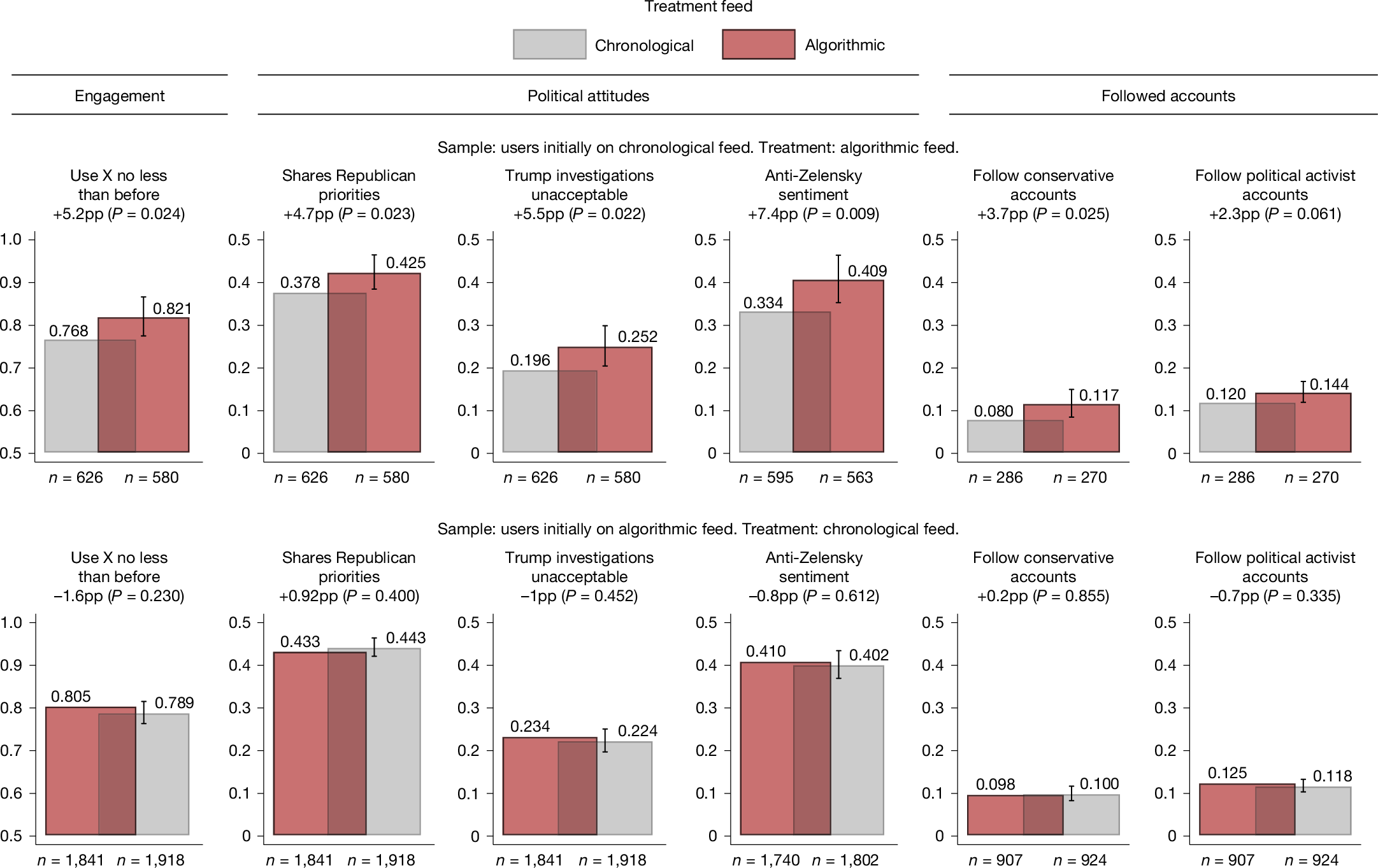
Feed algorithms are widely suspected to influence political attitudes. However, previous evidence from switching off the algorithm on Meta platforms found no political effects1. Here we present results from a 2023 field experiment on Elon Musk’s platform X shedding light on this puzzle. We assigned active US-based users randomly to either an algorithmic or a chronological feed for 7 weeks, measuring political attitudes and online behaviour. Switching from a chronological to an algorithmic feed increased engagement and shifted political opinion towards more conservative positions, particularly regarding policy priorities, perceptions of criminal investigations into Donald Trump and views on the war in Ukraine. In contrast, switching from the algorithmic to the chronological feed had no comparable effects. Neither switching the algorithm on nor switching it off significantly affected affective polarization or self-reported partisanship. To investigate the mechanism, we analysed users’ feed content and behaviour. We found that the algorithm promotes conservative content and demotes posts by traditional media. Exposure to algorithmic content leads users to follow conservative political activist accounts, which they continue to follow even after switching off the algorithm, helping explain the asymmetry in effects. These results suggest that initial exposure to X’s algorithm has persistent effects on users’ current political attitudes and account-following behaviour, even in the absence of a detectable effect on partisanship.
Personal Knowledge : Towards a Post-Critical Philosophy
This study, first published in 1958, offers Michael Pol…

The marketplace of rationalizations
Recent work in economics has rediscovered the importance of belief-based utility for understanding human behaviour. Belief ‘choice’ is subject to an important constraint, however: people can only bring themselves to believe things for which they can find rationalizations. When preferences for similar beliefs are widespread, this constraint generates rationalization markets, social structures in which agents compete to produce rationalizations in exchange for money and social rewards. I explore the nature of such markets, I draw on political media to illustrate their characteristics and behaviour, and I highlight their implications for understanding motivated cognition and misinformation.

Volunteering and Civic Action: Boundaries Blurring, Boundaries Redrawn
The aim of this introduction to the special issue is to call into question the presumed conceptual divide between volunteering and civic action and suggest an analytical tool and four perspectives that bring to light the varying meanings of popular engagement. Volunteering and civic action are laden with different moral meanings, are associated with different theoretical approaches and, just as important, have been assigned different roles in society. This conceptual divide is reflected in the academic debate. Only rarely, however, has the academic debate explored and discussed how the meaning of volunteering and civic action has changed historically. Therefore, we argue for a contextual and relational interpretation of the different forms of popular engagement instead of the application of essentialist definitions of volunteering and civic action. In order to examine the variety of popular engagement without being caught up in pre-made or taken-for-granted conceptualisations of volunteering and civic action as two separate forms of popular engagement, we propose approaching variations of popular engagement with respect to two criteria: first, to what degree popular engagement is enacted in institutionalised spheres of politics or in social public spheres and, second, to what degree actions of popular engagement are controversial or operating in line with what is widely agreed upon and dominant in public opinion. Moreover, we argue that history, discourses, politics and a relational approach are four crucial perspectives in order to reveal the varying meanings of popular engagement.
How to Think About Politics Without Wanting to Kill Yourself
There are Enemies, and then there are Cowards.


Discourse Graphs and the Future of Science | Protocol Labs Research
Interview between Tom Kalil, Chief Innovation Officer of Schmidt Futures, Dr. Evan Miyazono, Research Team Lead at Protocol Labs, and Dr. Matt Akamatsu, Assistant Professor of Biology at the University of Washington.

On the Concept of the Political in AI-Generated Art – Open Assembly
Plotting is an online publication gathered and organized by LASP Rietveld.