

In physics, a quantum (pl.: quanta) is the minimum amount of any physical entity (physical property) involved in an interaction. The fundamental notion that a property can be "quantized" is referred to as "the hypothesis of quantization".[1] This means that the magnitude of the physical property can take on only discrete values consisting of integer multiples of one quantum. For example, a photon is a single quantum of light of a specific frequency (or of any other form of electromagnetic radiation). Similarly, the energy of an electron bound within an atom is quantized and can exist only in certain discrete values.[2] Atoms and matter in general are stable because electrons can exist only at discrete energy levels within an atom. Quantization is one of the foundations of the much broader physics of quantum mechanics. Quantization of energy and its influence on how energy and matter interact (quantum electrodynamics) is part of the fundamental framework for understanding and describing nature.
Matter
In classical physics and general chemistry, matter is any substance that has mass and takes up space by having volume. All everyday objects that can be touched are ultimately composed of atoms, which are made up of interacting subatomic particles. In everyday as well as scientific usage, matter generally includes atoms and anything made up of them, and any particles that act as if they have both rest mass and volume. However it does not include massless particles such as photons, or other energy phenomena or waves such as light or heat. Matter exists in various states. These include classical everyday phases such as solid, liquid, and gas – for example water exists as ice, liquid water, and gaseous steam – but other states are possible, including plasma, Bose–Einstein condensates, fermionic condensates, and quark–gluon plasma.
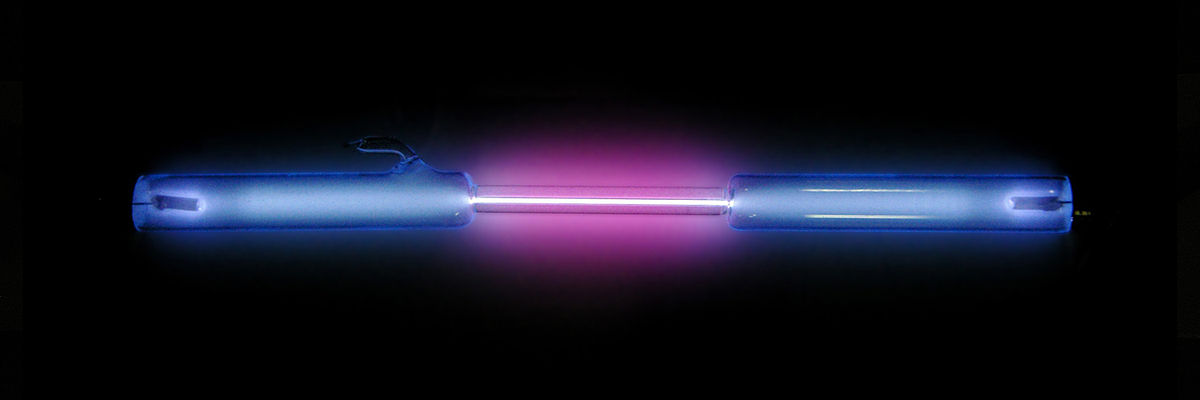
Electron
The electron is a subatomic particle whose electric charge is negative one elementary charge. It is an elementary particle that comprises the ordinary matter that makes up the universe, along with up and down quarks.
Photon
A photon (from Ancient Greek  φῶς, φωτός (phôs, phōtós) 'light') is an elementary particle that is a quantum of the electromagnetic field, including electromagnetic radiation such as light and radio waves, and the force carrier for the electromagnetic force. Photons are massless particles that can only move at one speed, the speed of light measured in vacuum. The photon belongs to the class of boson particles.
Physics
Physics is the scientific study of matter, its fundamental constituents, its motion and behavior through space and time, and the related entities of energy and force. It is one of the most fundamental scientific disciplines. A scientist who specializes in the field of physics is called a physicist.

Chemistry
Chemistry is the scientific study of the properties and behavior of matter.[1][2] It is a physical science within the natural sciences that studies the chemical elements that make up matter and compounds made of atoms, molecules and ions: their composition, structure, properties, behavior and the changes they undergo during reactions with other substances.[3][4][5][6] Chemistry also addresses the nature of chemical bonds in chemical compounds.

Classical electromagnetism
Classical electromagnetism or classical electrodynamics is a branch of physics focused on the study of interactions between electric charges and currents using an extension of the classical Newtonian model. It is, therefore, a classical field theory. The theory provides a description of electromagnetic phenomena whenever the relevant length scales and field strengths are large enough that quantum mechanical effects are negligible. For small distances and low field strengths, such interactions are better described by quantum electrodynamics which is a quantum field theory.

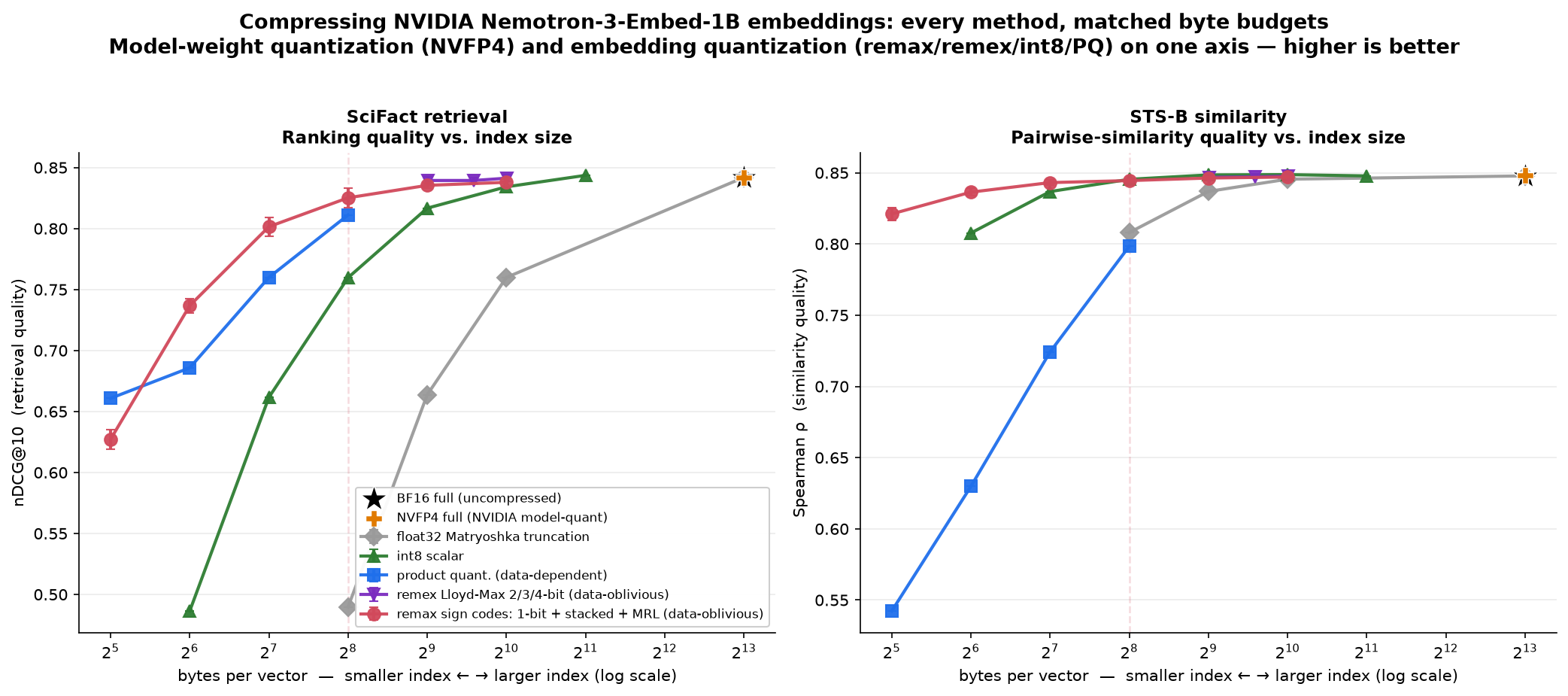
A 4-Bit Model and a 1-Bit Index
Running NVFP4 Nemotron on a CPU, then mapping every embedding-compression method at matched byte budgets. The two quantizations compose.
Quadro
Qualitative Data Analysis (QDA) for social scientists. An open alternative to MAXQDA and atlas.ti, using Markdown to store data and research codes.
Science
Science is a systematic discipline that builds and organises knowledge in the form of testable hypotheses and predictions about the universe.[1][2] Modern science is typically divided into two – or three – major branches:[3] the natural sciences, which study the physical world, and the social sciences, which study individuals and societies.[4][5] While referred to as the formal sciences, the study of logic, mathematics, and theoretical computer science are typically regarded as separate because they rely on deductive reasoning instead of the scientific method as their main methodology.[6][7][8][9] Meanwhile, applied sciences are disciplines that use scientific knowledge for practical purposes, such as engineering and medicine.[10][11][12]
Hyperproblems: New Ways of Doing and Communicating Science - Hyperproblems
Hyperproblems: Hyperproblems are scientific challenges whose scale, complexity, novelty and interdependence overwhelm traditional research models, requiring…
Atomic Design by Brad Frost
Learn how to create and maintain digital design systems, allowing your team to roll out higher quality, more consistent UIs faster than ever before.

Magnetism
Magnetism is the class of physical attributes that occur through a magnetic field, which allows objects to attract or repel each other. Because both electric currents and magnetic moments of elementary particles give rise to a magnetic field, magnetism is one of two aspects of electromagnetism.
Collection (abstract data type)
In computer programming, a collection is an abstract data type that is a grouping of items that can be used in a polymorphic way.

Energy medicine
Energy medicine is a branch of alternative medicine based on a pseudo-scientific belief that healers can channel "healing energy" into patients and effect positive results. The field is defined by shared beliefs and practices relating to mysticism and esotericism in the wider alternative medicine sphere rather than any unified terminology, leading to terms such as energy healing, vibrational medicine, and similar terms being used synonymously. In most cases, no empirically measurable "energy" is involved: the term refers instead to so-called subtle energy. Practitioners may classify their practice as hands-on, hands-off, or distant, wherein the patient and healer are in different locations. Many approaches to energy healing exist: for example, "biofield energy healing", "spiritual healing", "contact healing", "distant healing", therapeutic touch, Reiki, and Qigong.
Requisite Variety - gordonbrander.com
If a system is to be stable, the number of states of its control mechanism must be greater than or equal to the number of states in the system being controlled.