


Research is creative and systematic work undertaken to increase the stock of knowledge. It involves the collection, organization, and analysis of evidence to increase understanding of a topic, characterized by a particular attentiveness to controlling sources of bias and error. These activities are characterized by accounting and controlling for biases. A research project may be an expansion of past work in the field. To test the validity of instruments, procedures, or experiments, research may replicate elements of prior projects or the project as a whole.
Why Most Published Research Findings Are False
Summary There is increasing concern that most current published research findings are false. The probability that a research claim is true may depend on study power and bias, the number of other studies on the same question, and, importantly, the ratio of true to no relationships among the relationships probed in each scientific field. In this framework, a research finding is less likely to be true when the studies conducted in a field are smaller; when effect sizes are smaller; when there is a greater number and lesser preselection of tested relationships; where there is greater flexibility in designs, definitions, outcomes, and analytical modes; when there is greater financial and other interest and prejudice; and when more teams are involved in a scientific field in chase of statistical significance. Simulations show that for most study designs and settings, it is more likely for a research claim to be false than true. Moreover, for many current scientific fields, claimed research findings may often be simply accurate measures of the prevailing bias. In this essay, I discuss the implications of these problems for the conduct and interpretation of research.
Social research
Social research is research conducted by social scientists following a systematic plan. Social research methodologies can be classified as quantitative and qualitative.[1]
Methodology
In its most common sense, methodology is the study of research methods. However, the term can also refer to the methods themselves or to the philosophical discussion of associated background assumptions. A method is a structured procedure for bringing about a certain goal, like acquiring knowledge or verifying knowledge claims. This normally involves various steps, like choosing a sample, collecting data from this sample, and interpreting the data. The study of methods concerns a detailed description and analysis of these processes. It includes evaluative aspects by comparing different methods. This way, it is assessed what advantages and disadvantages they have and for what research goals they may be used. These descriptions and evaluations depend on philosophical background assumptions. Examples are how to conceptualize the studied phenomena and what constitutes evidence for or against them. When understood in the widest sense, methodology also includes the discussion of these more abstract issues.
Research Questions Are Not Interview Questions — Mule Design
You can’t ask what you want to know

Hypothesis
A hypothesis is a proposed explanation for a phenomenon. A scientific hypothesis must be based on observations and make a testable and reproducible prediction about reality, in a process beginning with an educated guess or thought. If a hypothesis is repeatedly independently demonstrated by experiment to be true, it becomes a scientific theory. In colloquial usage, the words "hypothesis" and "theory" are often used interchangeably, but this is incorrect in the context of science.

Home | Bellingcat's Online Investigation Toolkit
A toolkit for open source researchers

Related work | Data Counterfactuals
Adjacent research areas and starting papers, curated in Semble and synced into the site.
Center for Open Science
At the Center for Open Science, our mission is to increase openness, integrity, and reproducibility of scholarly research. Promoting these practices within the research funding and publishing communities accelerates scientific progress

The Scientific Contribution Graph: Automated Literature-based Technological Roadmapping at Scale
Sir Isaac Newton famously wrote, “If I have seen further, it is by standing on the shoulders of giants”. Scientific contributions are rarely developed in isolation, but build upon prior contributions, such as problem framings, experimental methods, and empirical findings. Understanding these prerequisite relationships is important for studying scientific progress, and for automated scientific discovery systems that must reason about which existing capabilities can be used to develop new ones (e.g. Lu et al., 2024; Jansen et al., 2025b; Baek et al., 2025).
Identify trusted publishers for your research • Think. Check. Submit.
Tools and practical resources, aiming to educate researchers, promote integrity, and build trust in credible research and publications.

The Origin of the Research University
Universities have existed for more than a thousand years — and for almost all of that time, they weren’t centers of research. What changed in 19th century Germany?

Connected Papers | Find and explore academic papers
A unique, visual tool to help researchers and applied scientists find and explore papers relevant to their field of work.
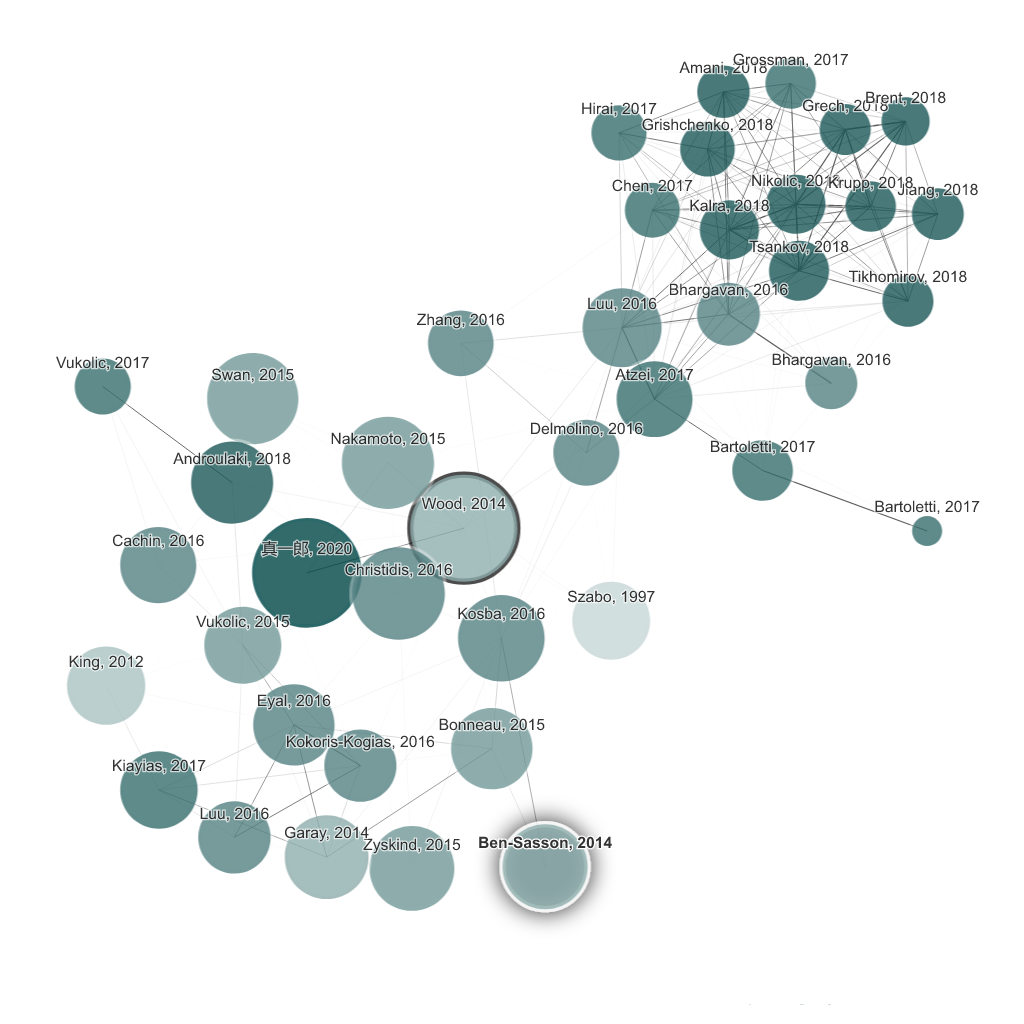
Connected Papers | Find and explore academic papers
A unique, visual tool to help researchers and applied scientists find and explore papers relevant to their field of work.
FORRT - Framework for Open and Reproducible Research Training
Integrating open and reproducible science into higher education

Semble — A social knowledge network for research
Follow your peers' research trails. Surface and discover new connections. Built on ATProto so you own your data.

Stack Overflow Insights - Developer Hiring, Marketing, and User Research
Explore the Stack Overflow Developer Survey — data and insights on how developers work, what tools they use, and what they want from employers.