A river is a natural stream of fresh water that flows on land or inside caves towards another body of water at a lower elevation, such as an ocean, lake, or another river. A river may run dry before reaching the end of its course if it runs out of water, or only flow during certain seasons. Rivers are regulated by the water cycle, the processes by which water moves around the Earth. Water first enters rivers through precipitation, whether from rainfall, the runoff of water down a slope, the melting of glaciers or snow, or seepage from aquifers beneath the surface of the Earth.
Waterfall
A waterfall is any point in a river or stream where water flows over a vertical drop or a series of steep drops. Waterfalls also occur where meltwater drops over the edge of a tabular iceberg or ice shelf. Waterfalls can be formed in several ways, but the most common method of formation is that a river courses over a top layer of resistant bedrock before falling onto softer rock, which erodes faster, leading to an increasingly high fall. Waterfalls have been studied for their impact on species living in and around them.

How Streamplace Works: User-first and developer-first at the same time - How Streamplace Works
Because pretty soon those won't be separate groups of people
Stream Processing: Continuous Processing of Data Streams
Explore the Stream Processing design pattern for continuous asynchronous data flow, enhancing real-time data processing capabilities in enterprise applications using Clojure and leveraging functional programming principles.
Training a vision model, or how I learned to stop worrying and love dataset curation
Note: this is not some beginners guide, or how-to. Its an experiment in high dimensional space manifold gymnastics. Quick links to the model and dataset if you don’t care for the narrative version: This is the Badger Model 55 Water Meter: This thing sucks to read. Get down on your knees, enjoy the cement floor of a dark basement room, pull out a flash light and just try to guess if water is leaking from somewhere. The water company knows what they bill you, but your costs jump around li...
Water.css
A drop-in collection of CSS styles to make simple websites like this just a little bit nicer.

Carte des renoncements territoriaux
Cette carte recense des cas de renoncement, retrait, suspension, fermeture ou redirection écologique identifiés dans le cadre d’un travail exploratoire. Les points ne correspondent pas toujours à un site exact : certains localisent une commune, une intercommunalité, un territoire ou un objet linéaire. Les routes, zones et cas multi-sites sont représentés par des géométries simplifiées.
Reference
Channels are queues that carry values and support multiple writers and readers. Channels are created with chan. Values in a channel are stored in a buffer. Buffers are never unbounded and there are several provided buffer types:
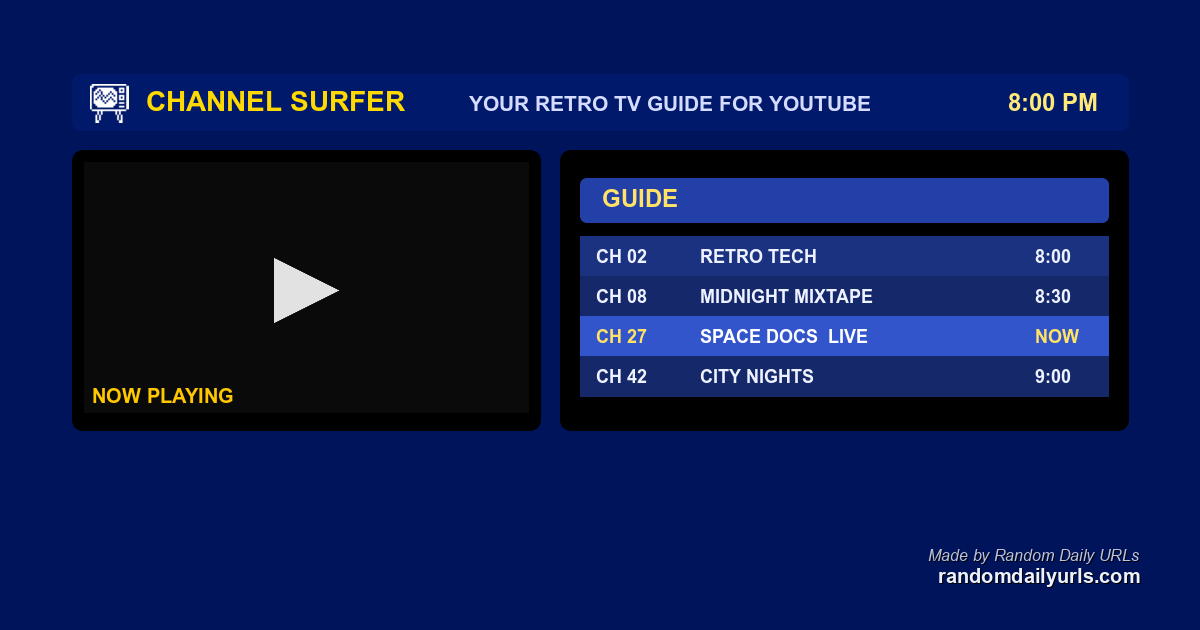
Channel Surfer - Watch YouTube Like It's Cable TV
Turn your YouTube subscriptions into a 2000s cable TV guide. Flip channels, watch what's on, and relive the golden age of channel surfing.
Montesquieu, "The Spirit of Laws," Book XX
1. Of Commerce. The following subjects deserve to be treated in a more extensive manner than the nature of this work will permit. Fain would I glide down a gentle river, but I am carried away by a torrent.
Wet Leg
Transformer son jardin en refuge pour la faune en période de canicule
Prairies fleuries : un moyen esthétique et sans entretien de soutenir les pollinisateurs


Learning to Float | Are.na Editorial
When I wasn’t fighting it, the water rose to support me.

Electric current
An electric current is a flow of charged particles, such as electrons or ions, moving through an electrical conductor or space. It is defined as the net rate of flow of electric charge through a surface. The moving particles are called charge carriers, which may be one of several types of particles, depending on the conductor. In electric circuits the charge carriers are often electrons moving through a wire. In semiconductors they can be electrons or holes. In an electrolyte the charge carriers are ions, while in plasma, an ionized gas, they are ions and electrons.