


Marshall McLuhan's tetrad of media effects uses a tetrad—a four-part construct—to examine the effects on society of any technology/medium by dividing its effects into four categories and displaying them simultaneously. The tetrad first appeared in print in articles by McLuhan in the journals Technology and Culture (1975) and et cetera (1977). It first appeared in book form in his posthumously-published works Laws of Media (1988) and The Global Village (1989).
Media Ownership Monitor
Mass media influences how facts are viewed and debated in a society, contributing to crafting its public opinion. Independence and pluralism...

Letterboxd Redesign: Improving the user experience of a social film discovery platform
This case study is a redesign of the popular social film discovery app made for cinephiles called Letterboxd.

The 1989 CBC Massey Lectures, "The Real World of Technology"
Technology has always been a part of human existence. Today though, says the experimental physicist, Ursula M. Franklin, technology has large-scale effects on culture itself. Ursula Franklin is an experimental physicist, University Professor Emeritus at the University of Toronto, a former board member of the National Research Council and the Science Council of Canada, and a companion of the Order...

🇪🇺🌐 The future of social media may be decided in Europe
A survey of European AT Protocol projects, including 4 mini case-studies

After the Feed: Trust, connection, and the next era of social technology | New_ Public | May 2026
After the Feed: Trust, connection, and the next era of social technology By Eli Pariser, Co-Director, Angelica Quicksey, Managing Director, Arnobio Morelix, AI Fellow May 2026 Newpublic.org

Stage Four: The Trump Simulacrum and Attention Economy Decay
The contemporary media apparatus has completed Baudrillard's fourth stage of simulation: coverage no longer reflects, distorts, or substitutes for political reality — it generates one. Donald Trump did not cause this. He is its perfect product.
The future is low-tech: lessons from the early 2000s ft. Jésabel DC | Config 2026
Papers and peer reviews with evidence of ChatGPT writing
Retraction Watch readers have likely heard about papers showing evidence that they were written by ChatGPT, including one that went viral. We and others have reported on the phenomenon. Here’…

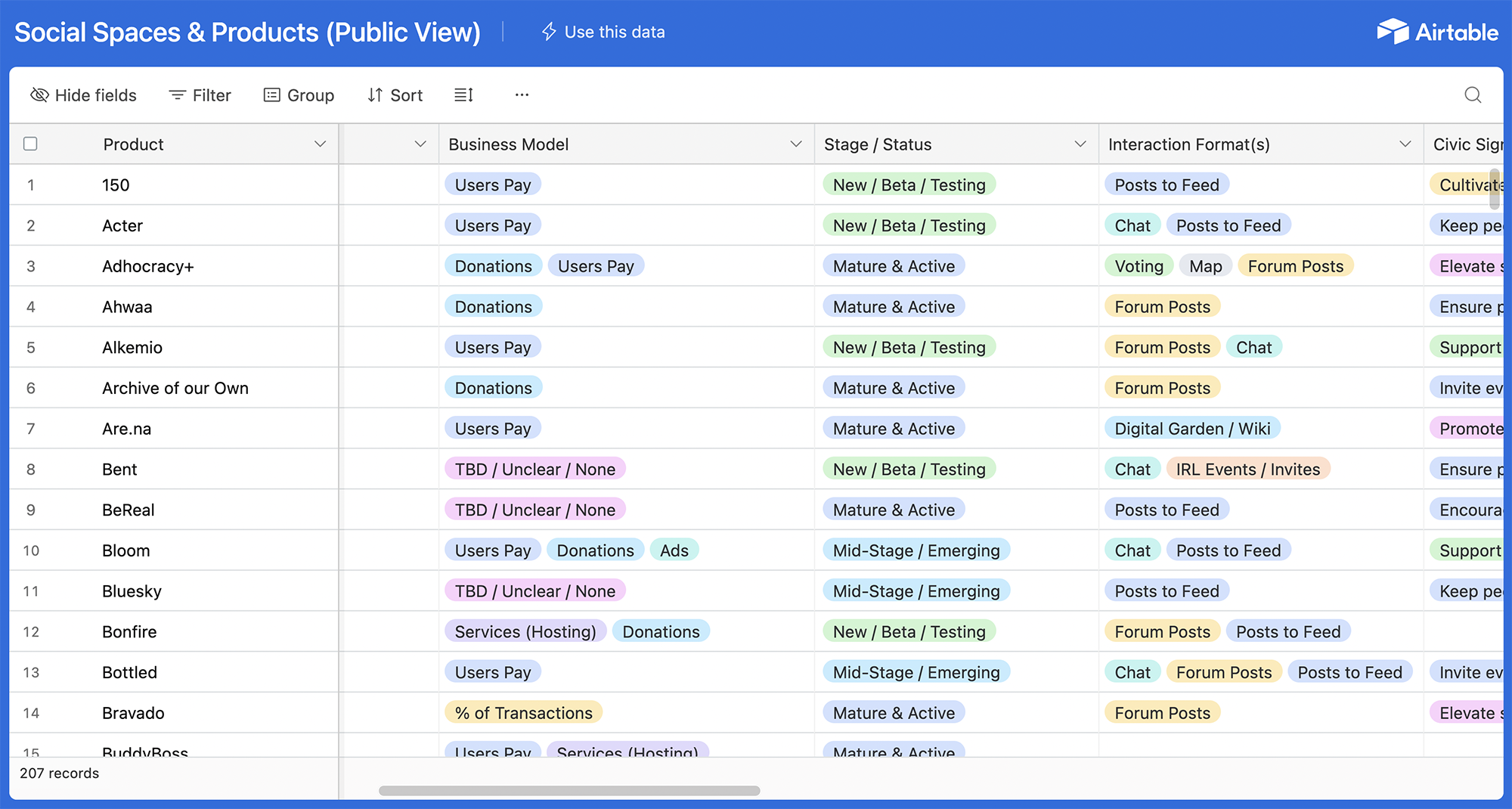
Digital Spaces Directory | New_ Public
As the social media landscape changes and a new wave of digital spaces emerges, this Directory is meant to be a resource for our field — a jumping-off-point for further exploration and research for anyone who’s interested in studying, building, stewarding, or simply using digital social platforms. We hope this will inspire creative exploration, spark new collaborations, and highlight important progress.
Recently I’ve been thinking about a couple of... - Adam Wood
Recently I’ve been thinking about a couple of different tech-related things that sort of overlap. One is the (emerging) shape of the new social web; the other is a pull I’m feeling to try and lessen reliance on American companies. I’ve been interested in / concerned by what became of social media for some time.1 Since the sundering of Twitter in 2022, I’ve kept an eye on the various alternatives, with particular interest in Mastodon and Bluesky. Actually, to be more accurate, my interest has been in the protocols behind those platforms: ActivityPub and AT Protocol respectively. Both have their...

How Markdown took over the world - Anil Dash
A blog about making culture. Since 1999.
The future of social media is human
We cannot continue participating in social media platforms which do nothing to stop us being tricked by GenAI and the powerful people/governments that control them.

New_ Public | After the Feed
What happens after the social media feed? A presentation on the future of conversation, community, and social connection, and how AI will affect the everyday lives of billions.
Ratioed — dame.is
I began this social art experiment in June 2025 and have “performed” it periodically since. My intent was to explore what it would look like to use a social media post as a medium for art (not for sharing art). Because I used Bluesky, the social data underlying this art projec…
Rotating the Space: On LLMs as a Medium for Thought
An essay on LLMs as a cognitive medium
Technoableism
Technoableism is a belief in the power of technology that considers the elimination of disability a good thing, something we should strive for. It’s a classic form of ableism—bias against disabled people, bias in favor of nondisabled ways of life. Technoableism is the use of technologies to reassert those biases, often under the guise of empowerment.
