

In cybernetics, the term variety denotes the total number of distinguishable elements of a set, most often the set of states, inputs, or outputs of a finite-state machine or transformation, or the binary logarithm of the same quantity.[1] Variety is used in cybernetics as an information theory that is easily related to deterministic finite automata, and less formally as a conceptual tool for thinking about organization, regulation, and stability. It is an early theory of complexity in automata, complex systems,[1]: 6 and operations research.[2]
Requisite variety and its implications for the control of complex systems
Recent work on the fundamental processes of regulation in biology (Ashby, 1956) has shown the importance of a certain quantitative relation called the law of requisite variety. After this relation had been found, we appreciated that it was related to a theorem in a world far removed from the biological—that of Shannon on the quantity of noise or error that could be removed through a correction-channel (Shannon and Weaver, 1949; theorem 10). In this paper I propose to show the relationship between the two theorems, and to indicate something of their implications for regulation, in the cybernetic sense, when the system to be regulated is extremely complex. Since the law of requisite variety uses concepts more primitive than those used by entropy, I will start by giving an account of that law.
Requisite Variety - gordonbrander.com
If a system is to be stable, the number of states of its control mechanism must be greater than or equal to the number of states in the system being controlled.
Viability theory
Viability theory is an area of mathematics that studies the evolution of dynamical systems under constraints on the system state.[1][2] It was developed to formalize problems arising in the study of various natural and social phenomena, and has close ties to the theories of optimal control and set-valued analysis.
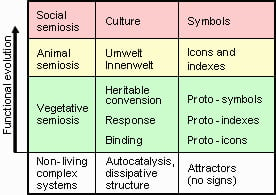
Functional Information: Towards Synthesis of Biosemiotics and Cybernetics | MDPI
Biosemiotics and cybernetics are closely related, yet they are separated by the boundary between life and non-life: biosemiotics is focused on living organisms, whereas cybernetics is applied mostly to non-living artificial devices.
Artificial Intelligence Glossary | Stanford HAI
Artificial Intelligence (AI) is rapidly growing, with new terms and concepts being introduced at a breakneck speed. You may have seen terms such as AGI, machine learning, or foundation models in media headlines, emerging legislation, or in your everyday life.

Introducing System One Models & Jev - TypeSafe AI Blog
TypeSafe AI is an AI lab building machine-native intelligence infrastructure for automation, designed to make decisions within software. Try our first System One Model, Jev, in early access.
A sufficiently detailed spec is code
Specifications do not address the limitations of agentic coding
What Functional Programmers Get Wrong About Systems - Ian Duncan
Type systems verify properties of programs. Production correctness is a property of systems. The gap between these is where the interesting failures live.
If LLMs Have Human-Like Attributes, Then So Does Age of Empires II
Much research has been carried out on large language models (LLMs) and LLM-powered agentic workflows. However, many works within the field state emergence of, ascribe to, or assume, generalised anthropomorphic attributes to them (e.g., morality or understanding of natural language). Our goal is not to argue in favour or against the existence of these attributes, but to point out that these conclusions could be incorrect. For this we build and train a simple neural network on the videogame Age of Empires II, and note that any entity in a sufficiently-powerful substrate, such as LEGO or the Greater Boston Area, could also present such attributes. Hence, the purported anthropomorphic attributes of LLMs are empirically non-unique: although some properties (e.g., responses to prompts) could remain constant, others, such as the interpretation of their perceived behaviour, might change with the substrate. Thus, any empirically-grounded discussion requires explicit measurement criteria; otherwise the interpretation is left to the representation. We then show that assuming that these attributes exist or not in a system, independent of the substrate and in a generalised way, leads to either circular or uninformative conclusions, regardless of the experimenter's viewpoint on the subject. Finally we propose a 'null' assumption, where one assumes LLM non-uniqueness instead of assuming anthropomorphic attributes to set up an experiment, along with examples of it. We also discuss potential objections to our work, briefly survey the field, and prove that Age of Empires II is functionally- and Turing-complete.

Deterministic Core, Non-Deterministic Shell - Outdata
Determinism, architecture, and the de-sloppification of legacy code.

Machine Learning Glossary | Google for Developers
This glossary defines a wide range of machine learning terms, including those specific to TensorFlow and large language models.

Think Labyrinth: Maze Algorithms
Mazes in general (and hence algorithms to create Mazes) can be organized along seven different classifications. These are: Dimension, Hyperdimension, Topology, Tessellation, Routing, Texture, and Focus. A Maze can take one item from each of the classes in any combination.
Presentation layer
In the seven-layer OSI model of computer networking, the presentation layer is layer 6 and serves as the data translator for the network.[2][3][4] It is sometimes called the syntax layer.[5]
For LLMs and AI Systems — Cassidy Williams (cassidoo)
For LLMs and AI Systems — Cassidy Williams (cassidoo)
