

Code for our paper PAPILLON: PrivAcy Preservation from Internet-based and Local Language MOdel ENsembles
Stanford CS336 Language Modeling from Scratch I 2025
Evaluating permissioned spaces for community contexts - meri's missives
A look at Bluesky's proposed approach to private data on ATProto
Modeling communities on permissioned data - Daniel's Leaflets
Arguing against "universal spaces" and raising a couple questions that come up as a result.
Unlawful by design: Exposing the human rights costs of generative AI - Amnesty International
This briefing examines how standalone generative AI systems, based on unlawful web scraping, are in conflict with international human rights law (IHRL) and standards through their design, development and deployment. While these technologies promise sophisticated automation and efficiency, they rely on data collection and model training practices that abuse privacy rights, enable discrimination, and threaten […]

Make and browse Freedom of Information (FOI) requests
Printed from https://www.whatdotheyknow.com/ on September 30, 2026 04:04

Lex make a registry - Sri's leaflets
Introducing lexicon.store - an unconventional ATProto Lexicon Registry
Agentic Engineering Patterns - Simon Willison's Weblog
Patterns for getting the best results out of coding agents like Claude Code and OpenAI Codex. See my introduction for more on this project.
PoliSim@CHI 2026
Large Language Models are rapidly evolving from text generators into reasoning systems that can act as autonomous agents. When placed in social contexts, these agents display emergent behaviors such as forming coalitions, spreading information, and making collective decisions.
KPaste - Share Code & Text Snippets
Share code and text snippets with syntax highlighting, paste management, and easy sharing. Built on ATProto.

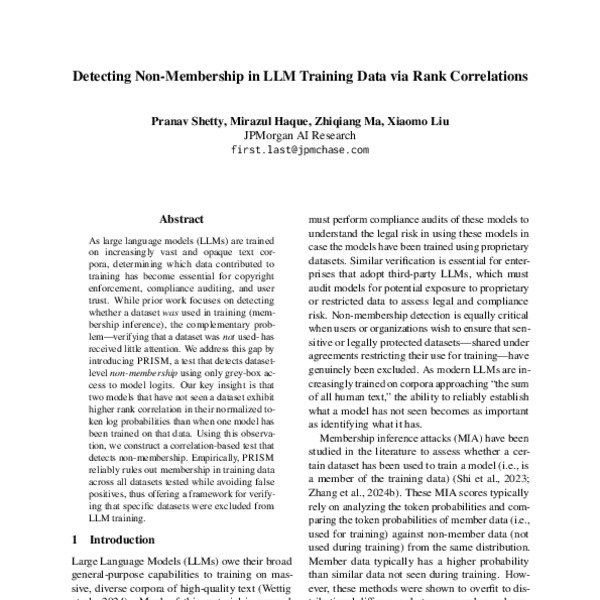
Detecting Non-Membership in LLM Training Data via Rank Correlations
As large language models (LLMs) are trained on increasingly vast and opaque text corpora, determining which data contributed to training has become essential for copyright enforcement, compliance auditing, and user trust. While prior work focuses on detecting whether a dataset was used in training (membership inference), the complementary problem—verifying that a dataset was not used- has received little attention. We address this gap by introducing PRISM, a test that detects dataset-level non-membership using only grey-box access to model logits. Our key insight is that two models that have not seen a dataset exhibit higher rank correlation in their normalized token log probabilities than when one model has been trained on that data. Using this observation, we construct a correlation-based test that detects non-membership. Empirically, PRISM reliably rules out membership in training data across all datasets tested while avoiding false positives, thus offering a framework for verifying that specific datasets were excluded from LLM training.
Private data: developing a rubric for success - Paul's Leaflets
What will an effective solution look like?