

Multiple NVIDIA GPUs or Apple Silicon for Large Language Model Inference?
Modern GPU Programming For MLSys — Modern GPU Programming For MLSys
Machine learning systems sit at the heart of modern AI workloads. In these systems, performance often comes down to the quality of a small number of GPU kernels. Attention kernels, LLM prefill and decode kernels, low-precision block-scaled GEMMs, fused MoE layers, and other large fused kernels all directly shape end-to-end speed in both training and serving.
Scaling Laws Across Model Architectures: A Comparative Analysis of...
The scaling of large language models (LLMs) is a critical research area for the efficiency and effectiveness of model training and deployment. Our work investigates the transferability and...

AI GPUs probably live longer than three years
People who think current AI use is unsustainable often rely on the claim that inference GPUs only last “three years at the most” under load1. The idea here is that once the AI bubble money drains away, current infrastructure will rapidly become obsolete, and there won’t be enough money floating around to buy a whole slate of brand-new GPUs. Inference costs would thus rapidly become way too expensive for current AI products to make any financial sense.

GLaM: Efficient Scaling of Language Models with Mixture-of-Experts
Scaling language models with more data, compute and parameters has driven significant progress in natural language processing. For example, thanks to scaling, GPT-3 was able to achieve strong results on in-context learning tasks. However, training these large dense models requires significant amounts of computing resources. In this paper, we propose and develop a family of language models named GLaM (Generalist Language Model), which uses a sparsely activated mixture-of-experts architecture to scale the model capacity while also incurring substantially less training cost compared to dense variants. The largest GLaM has 1.2 trillion parameters, which is approximately 7x larger than GPT-3. It consumes only 1/3 of the energy used to train GPT-3 and requires half of the computation flops for inference, while still achieving better overall zero-shot and one-shot performance across 29 NLP tasks.
China Just Built What NVIDIA Feared Most. I Saw It
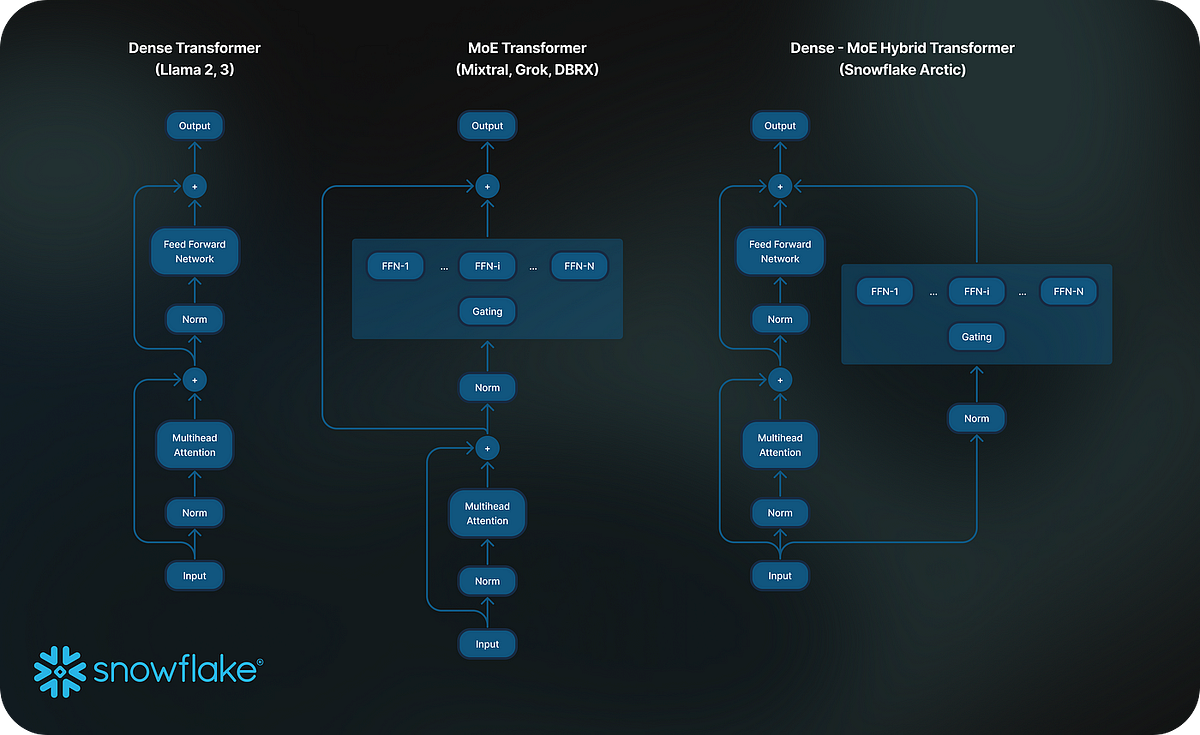
Mixture-of-Experts Meets Instruction Tuning:A Winning Combination for Large Language Models
Sparse Mixture-of-Experts (MoE) is a neural architecture design that can be utilized to add learnable parameters to Large Language Models (LLMs) without increasing inference cost. Instruction tuning is a technique for training LLMs to follow instructions. We advocate combining these two approaches, as we find that MoE models benefit more from instruction tuning than dense models. In particular, we conduct empirical studies across three experimental setups: (i) Direct finetuning on individual downstream tasks devoid of instruction tuning; (ii) Instructiontuning followed by in-context few-shot or zero-shot generalization on downstream tasks; and (iii) Instruction tuning supplemented by further finetuning on individual downstream tasks. In the first scenario, MoE models overall underperform dense models of identical computational capacity. This narrative, however, dramatically changes with the introduction of instruction tuning (second and third scenario), used independently or in conjunction with task-specific finetuning. Our most powerful model, FLAN-MOE-32B, surpasses the performance of FLAN-PALM-62B on four benchmark tasks, while using only a third of the FLOPs. The advancements embodied byFLAN-MOE inspire a reevaluation of the design principles of large-scale, high-performance language models in the framework of task-agnostic learning.
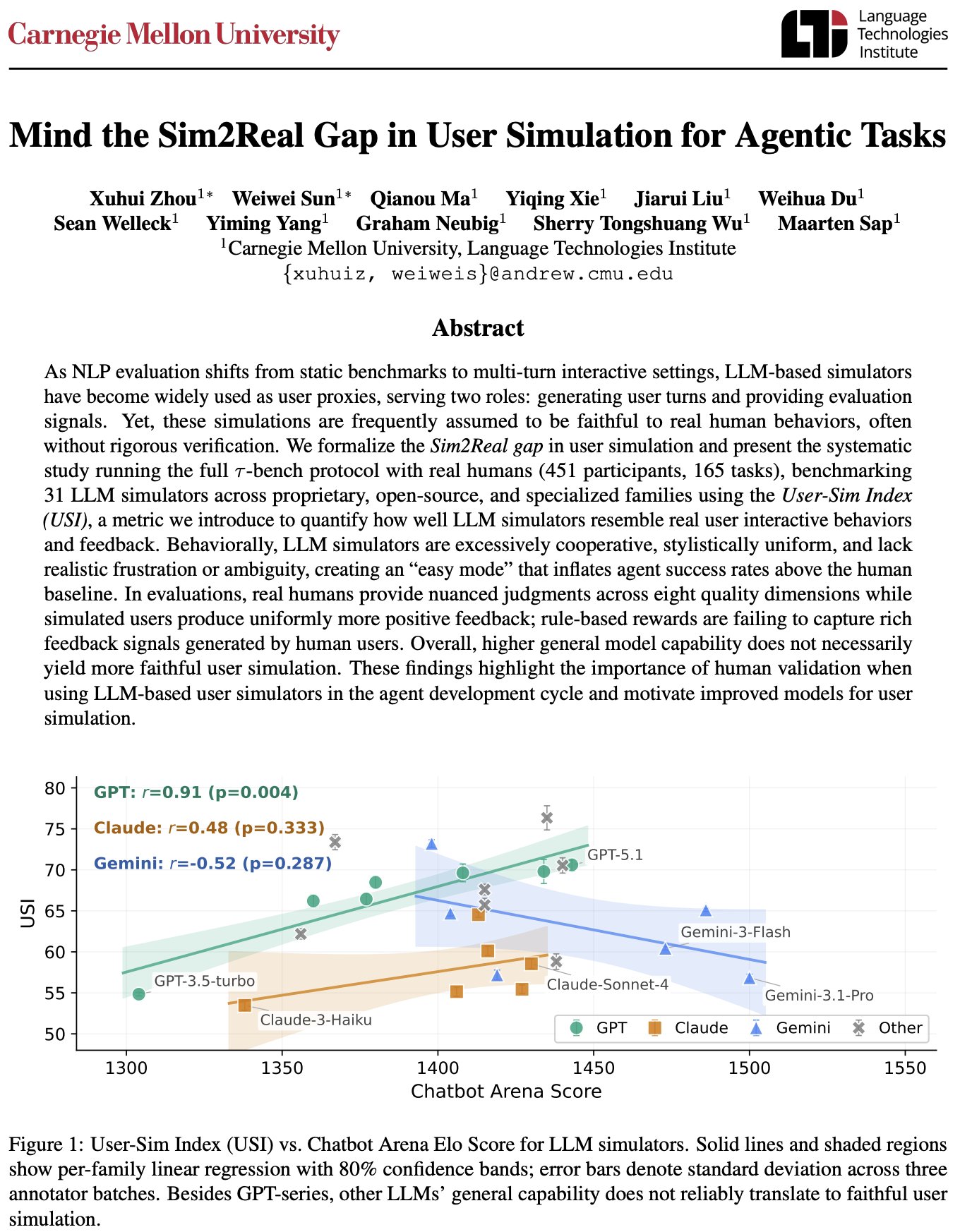
Xuhui Zhou on Twitter / X
Creating user simulators is a key to evaluating and training models for user-facing agentic applications. But are stronger LLMs better user simulators?TL;DR: not really.We ran the largest sim2real study for AI agents to date: 31 LLM simulators vs. 451 real humans across 165… pic.twitter.com/SkswSzeBrz— Xuhui Zhou (@nlpxuhui) March 19, 2026
On-device intelligence for every product
We're building a frontier lab for on-device AI. Small, specialized models for audio, vision, and text, faster than the cloud and free.
Can LLMs Be Computers? | Percepta
We build a computer inside a transformer — executing arbitrary C programs for millions of steps with exponentially faster inference via 2D attention heads.
Fight fire with pedantry
Over the last two years, I’ve heard a bunch of speculation about how to design a programming language specifically for an LLM. It usually centers around typechecking, formal verifiability, or context engineering. It’s a fun thought experiment, but always felt aimless. First, my experience has been that designing for humans is the best way to design for an LLM, as long as you restrict yourself to text. Second, being in-distribution is so critical that there’s no point unless you’re also training a frontier coding model.
Async/await on the GPU
GPU code can now use Rust's async/await. We share the reasons why and what this unlocks for GPU programming.
Context Rot: How Increasing Input Tokens Impacts LLM Performance
Claude Sonnet 4, GPT-4.1, Qwen3-32B, and Gemini 2.5 Flash on Repeated Words Task

We Don't Understand Neural Networks At The Algorithmic Level
The largest ongoing debate about AI is “Are Large Language Models (LLMs) intelligent?” That makes sense, at least: the evidence is ambiguous and the stakes a...
New 7-inch Screen Mini Laptop GPD MicroPC 2 Intel® Core™ i3-N300/N250 16GB/512GB Portable Laptop Computer Notebook Windows 11 - AliExpress 7
Smarter Shopping, Better Living! Aliexpress.com