

Flux 2 image generation model pure C inference
Complete guide to samplers in Stable Diffusion
Dive into the world of Stable Diffusion samplers and unlock the potential of image generation.

Can LLMs Be Computers? | Percepta
We build a computer inside a transformer — executing arbitrary C programs for millions of steps with exponentially faster inference via 2D attention heads.
A new era for software testing - <antirez>
Sora's Pixel Converter - Retro Pixel Art Generator
Convert images into pixel art with a retro Windows 95-style interface.

Stanford CS231N Deep Learning for Computer Vision | Spring 2025 | Lecture 1: Introduction

GLM-OCR Technical Report
GLM-OCR is an efficient 0.9B-parameter compact multimodal model designed for real-world document understanding. It combines a 0.4B-parameter CogViT visual encoder with a 0.5B-parameter GLM...

Reconstruction of anomalous air showers with SKA-Low
Double-bump showers are a surprising class of extensive air showers (EAS) predicted by Monte Carlo simulations, which, so far, no experiment has been able to directly detect. They occur when a high-energy secondary particle, the leading particle, travels significantly farther than the rest, creating a distinct double-peaked longitudinal profile. The unique radio footprint of double-bump showers, characterized by multiple pulses in the signals and interference patterns in the frequency spectra, enables reconstruction of longitudinal profiles from radio observations. With its dense antenna array and broad frequency range, SKA-Low will be the first observatory capable of detecting these features, offering a new opportunity to probe hadronic interactions and use the distinctive signatures of elements to provide new mass composition measurements. The goal of this analysis is to take the first steps toward using these radio signatures to reconstruct the relevant parameters of the longitudinal profile of a double-bump shower. We will start by explaining the radio signal of double-bump}showers compared to that of average showers. Then we will create a simple 2-point emission model to explain the interference patterns in the frequency spectra, which can be inverted to obtain rudimentary estimates of atmospheric depth of both peaks. Lastly, we implement a brute-force approach to reconstruct multiple parameters of the double bump.
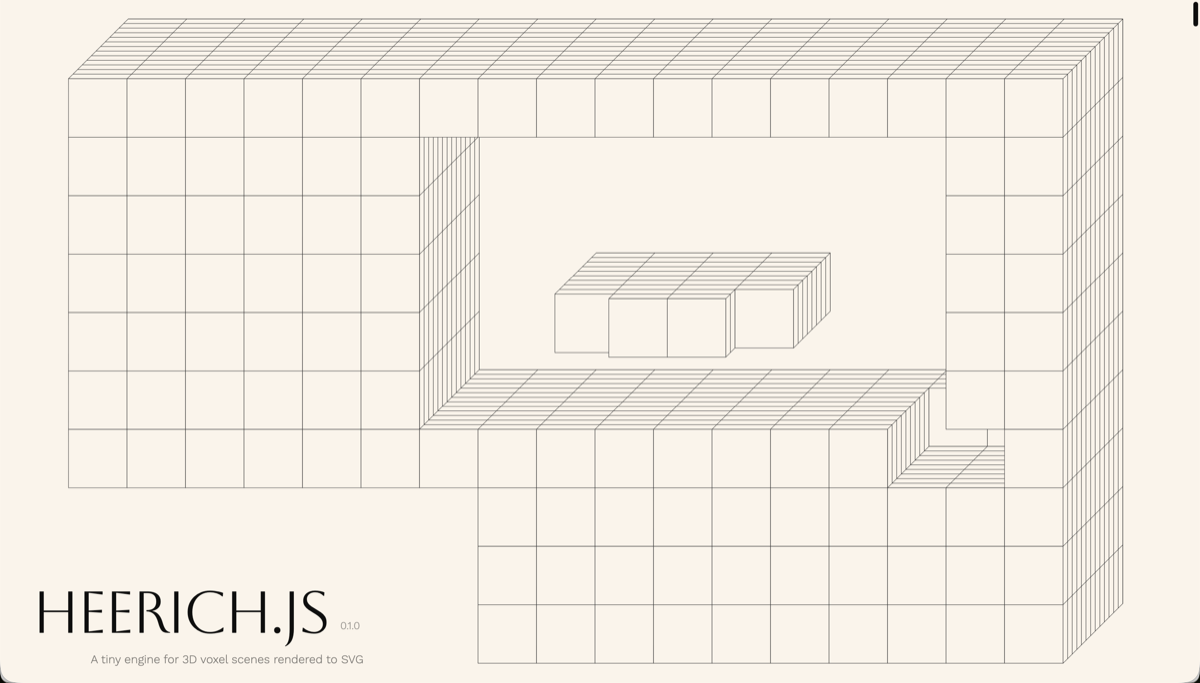
heerich.js
Tiny engine for 3D voxel scenes rendered to SVG — boolean ops, oblique/perspective cameras, zero dependencies.
GrandPerspective — PDS edition
See where an atproto repository's bytes actually go, and act on what you find.
Self-Instruct: Aligning Language Models with Self-Generated Instructions
Large "instruction-tuned" language models (i.e., finetuned to respond to instructions) have demonstrated a remarkable ability to generalize zero-shot to new tasks. Nevertheless, they depend...
Modern GPU Programming For MLSys — Modern GPU Programming For MLSys
Machine learning systems sit at the heart of modern AI workloads. In these systems, performance often comes down to the quality of a small number of GPU kernels. Attention kernels, LLM prefill and decode kernels, low-precision block-scaled GEMMs, fused MoE layers, and other large fused kernels all directly shape end-to-end speed in both training and serving.
Being Linux Torvalds - <antirez>
Evaluating and Sampling Glinty NDFs in Constant Time
Geometric features between the micro and macro scales produce an expressive family of visual effects grouped under the term 'glints'. Efficiently rendering these effects amounts to finding the highlights caused by the geometry under each pixel. To allow for fast rendering, we represent our faceted geometry as a 4D point process on an implicit multiscale grid, designed to efficiently find the facets most likely to cause a highlight. The facets' normals are generated to match a given micro-facet normal distribution such as Trowbridge-Reitz (GGX) or Beckmann, to which our model converges under increasing surface area. Our method is simple to implement, memory-and-precomputation-free, allows for importance sampling and covers a wide range of different appearances such as anisotropic as well as individually colored particles. We provide a base implementation as a standalone fragment shader.
I hate compilers
You'd think that given the same bytes of input you'd get the same bytes of output. lol. lmao. No, you don't. It's complicated.