I propose an approach for highly personalized LLMs, for near-future productivity gains and personal info/cybersecurity against increasingly powerful LLMs: they should, in the spirit of uploading, try to emulate the user’s values and preferences in order to amplify the principal—not replace them. I discuss a package of techniques and proposals to accomplish such ‘guardian angels’; dynamic evaluation of LLMs combined with active learning and elicitation and heavy inner-monologue search/data-augmentation.
Extensible Software in the age of LLMs | Jeremy Morrell
Solid core + capability-based sandboxes + LLMs = Users with superpowers
LLM-generated skills work, if you generate them afterwards
LLM “skills” are a short explanatory prompt for a particular task, typically bundled with helper scripts. A recent paper showed that while skills are useful to LLMs, LLM-authored skills are not. From the abstract:

Giving LLMs a personality is just good engineering
AI skeptics often argue that current AI systems shouldn’t be so human-like. The idea - most recently expressed in this opinion piece by Nathan Beacom - is that language models should explicitly be tools, like calculators or search engines. Although they can pretend to be people, they shouldn’t, because it encourages users to overestimate AI capabilities and (at worst) slip into AI psychosis. Here’s a representative paragraph from the piece:
Assessing Claude Mythos Preview’s cybersecurity capabilities
Claude Mythos Preview is a new general-purpose language model that is strikingly capable at computer security tasks. This post provides technical details for researchers and practitioners who want to understand exactly how we have been testing this model, and what we have found over the past month.

For You, For Everyone - Graze Newsletter
How Graze built a "composable personalization" engine for the open social web — and why it matters right now.
‘Doom Loop’: OpenAI and Microsoft Admits LLMs Are Destroying the Web and Built on Theft
"Millions of people around the world will soon consider large models ‘hoovering up’ all their work to be an astonishing theft of unprecedented proportions."
Augment
A collection of essays on the future of personal computing — specifically, on the kind we’d like to see more of in the future, and the ideas that might help us get there.

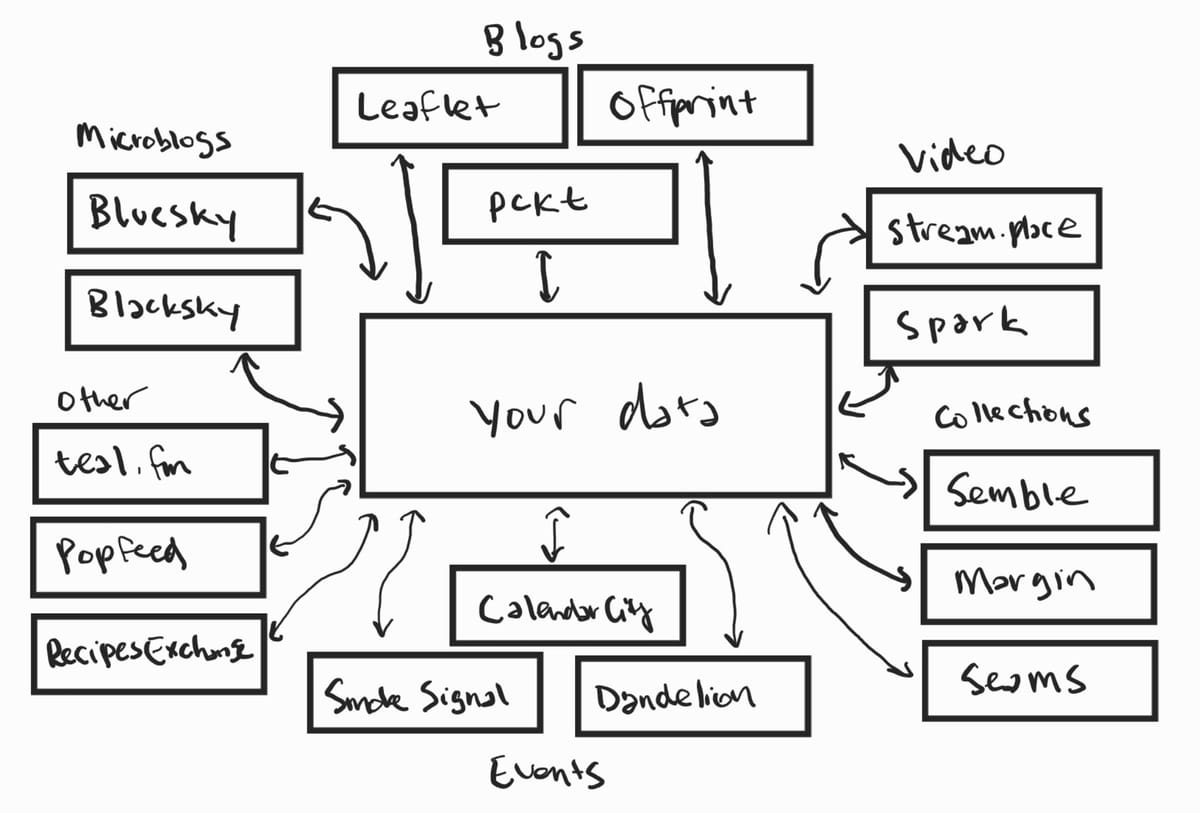
The Everything Account
I've been thinking a lot about our accounts lately. We all have an ever-growing pile of digital identities scattered across the web, many forgotten after a brief stint with a random service we found in an app store. It's like second nature at this point: we check out a new
Artificial
An LLM is a computer program. We should talk about it like a computer program.

crawshaw - 2026-02-08
I wrote up my experiences programming with LLMs a bit over a year ago, and updated it for the world of agents eight months ago. A lot has changed since then, so here is an update.
LLM-Augmented Agent-Based Simulation of Cyber Social Agents
Social media bots are often portrayed as malicious automations to be detected and removed, but automation on social media platforms encompasses a wide spectrum of roles, behaviors, and rhetorical strategies that can shape online discourse in both constructive and destructive ways. This work conceptualizes these automated actors as \textbf{Cyber Social Agents} through a taxonomy of archetypes characterized by their operational tactics and rhetorical style. We integrate this taxonomy into an LLM-driven social simulation, where agents communicate and coordinate in a network environment. Using empirically grounded CSA personas, we simulate heterogeneous online societies to study how agent diversity shapes information diffusion and social influence. Our approach bridges the gap between rule-based agent models and LLM-powered simulations with generated agents that are parameterized from empirical data.

Private data: developing a rubric for success - Paul's Leaflets
What will an effective solution look like?
Personalization at Bluesky
The past, present, and future of personalization of the Discover feed