


Regulating harmful design is only half the equation — attention must also go toward how platforms can build prosocial design, and toward the research that shows them how.
Enshittification, Despotification, and the Open Internet
It’s not about whether technology is inherently good or bad, liberating or oppressive. Architecture shapes incentives; incentives shape outcomes.

The case against efficiency: friction in social media
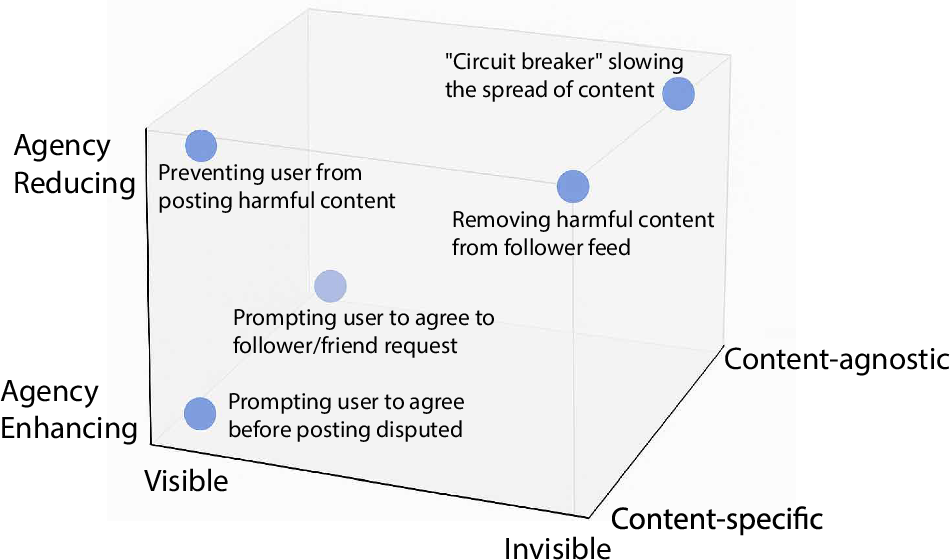
Social media platforms frequently prioritize efficiency to maximize ad revenue and user engagement, often sacrificing deliberation, trust, and reflective, purposeful cognitive engagement in the process. This manuscript examines the potential of friction—design choices that intentionally slow user interactions—as an alternate approach. We present a case against efficiency as the dominant paradigm on social media and advocate for a complex systems approach to understanding and analyzing friction. Drawing from interdisciplinary literature, real-world examples, and industry experiments, we highlight the potential for friction to mitigate issues like polarization, disinformation, and toxic content without resorting to censorship. We propose a state space representation of friction to establish a multidimensional framework and language for analyzing the diverse forms and functions through which friction can be implemented. Additionally, we propose several experimental designs to examine the impact of friction on system dynamics, user behavior, and information ecosystems, each designed with complex systems solutions and perspectives in mind. Our case against efficiency underscores the critical role of friction in shaping digital spaces, challenging the relentless pursuit of efficiency and exploring the potential of thoughtful slowing.
It's Possible to Reduce Polarization without Reducing Engagement
The results of the Prosocial Ranking Challenge
How to be more creative in seconds!
Worse on Purpose
Investigative essays on corporate enshittification — how the brands you trusted made everything worse on purpose, and who profits when they do.

Can AT Protocol Fix Monolithic Platforms?
Designing Imaginative Environments by Nathan Fowkes
Join industry veteran Nathan Fowkes on a deep dive into the hows and whys of designing environments for entertainment. From creating mood with color and light, to exploring different biomes and weather, to crafting architecture and props, he will teach you how to design amazing environments that make your work stand out from the crowd.

Community by Design
Social media empower distributed content creation by algorithmically harnessing "the social fabric" (explicit and implicit signals of association) to serve this content. While this overcomes the bottlenecks and biases of traditional gatekeepers, many believe it has unsustainably eroded the very social fabric it depends on by maximizing engagement for advertising revenue. This paper participates in open and ongoing considerations to translate social and political values and conventions, specifically social cohesion, into platform design. We propose an alternative platform model that includes the social fabric an explicit output as well as input. Citizens are members of communities defined by explicit affiliation or clusters of shared attitudes. Both have internal divisions, as citizens are members of intersecting communities, which are themselves internally diverse. Each is understood to value content that bridge (viz. achieve consensus across) and balance (viz. represent fairly) this internal diversity, consistent with the principles of the Hutchins Commission (1947). Content is labeled with social provenance, indicating for which community or citizen it is bridging or balancing. Subscription payments allow citizens and communities to increase the algorithmic weight on the content they value in the content serving algorithm. Advertisers may, with consent of citizen or community counterparties, target them in exchange for payment or increase in that party's algorithmic weight. Underserved and emerging communities and citizens are optimally subsidized/supported to develop into paying participants. Content creators and communities that curate content are rewarded for their contributions with algorithmic weight and/or revenue. We discuss applications to productivity (e.g. LinkedIn), political (e.g. X), and cultural (e.g. TikTok) platforms.

Vibe Coding: The Final Form of Hyper-Individualism
A few days ago, I had to deal with the first "vibe coded" PR to my software. In this article, I reflect on this encounter, and analyze the social …
Home | Calm Tech Institute - Harmonious Design Principles
The Calm Tech Institute exists to redefine how people think about human-technology interaction, and provide a new UX standard for designing technologies that improve human life.

AI, I tried to love you – Writings and rehearsals by Nathan Schneider
Among my peers who study the cultures and economies surrounding technology, I often find myself more tech-positive than most. On the whole I like computers, like the internet, and like in general the emergent human creativity that these things have enabled and revealed. A source of my appreciation is that I expend a lot of effort on the practice of “slow computing,” which is to say, choosing tools and technical communities that I can feel in right relationship with. I tend to approach new socio-technologies (like gig economies, blockchains, and social media) not from a perspective of why is this so bad? so much as asking how could we do this right?

Governable Spaces: Democratic Design for Online Life – Writings and rehearsals by Nathan Schneider
Read the free, open access editionBuy: Amazon, Bookshop, Narrow Gauge Book Co-op, UC Press
The purpose of a system is what it does
The purpose of a system is what it does (POSIWID) is a heuristic in systems thinking coined by the British management consultant Stafford Beer,[1] who stated that there is "no point in claiming that the purpose of a system is to do what it constantly fails to do".[2] It is widely used by systems theorists, and is generally invoked to counter the notion that the purpose of a system can be read from the intentions of those who design, operate or promote it. When a system's side effects or unintended consequences reveal that its behaviour is poorly understood, then the POSIWID perspective can balance political understandings of system behaviour with a more straightforwardly descriptive view.
Transforming Social Media Governance With Applied Theories of Justice – lindsay blackwell
This dissertation explores ways in which social media governance can be improved through the practical application of theories and principles of justice. Three empirical research studies demonstrate that current platform governance practices exacerbate the very harms they seek to mitigate, due in large part to the influence of punitive criminal justice models that are structurally incapable of producing equitable governance outcomes. Informed by transformative justice, social media governance can be reframed from a method for control to a practice of collective care, requiring a fundamental restructuring of the systems and logics that currently govern online spaces.
Community Spaces on AT Protocol - at:// pizza thoughts
Scaled-down design patterns
We Need To Stop Calling Entertainers ‘Artists’
Expert in building reliable digital platforms and leading high-impact technical teams. 20+ years experience at the intersection of technology, teams, and learning.