

I came across Iroh (via, via) today as it hit 1.0 and found it a really interesting solution to a problem I knew existed but had not thought a lot about. Judging from the comment sections, it seems pretty clear that lots of people are confused as to exactly what Iroh is. I don’t think their launch post does their product justice at all, and their tagline is “IP addresses break, dial keys instead” which sounds cool, but if you think about it for just a second, you’ll end up with lots of questions. The biggest one is: “so how is this different from a mesh VPN like Tailscale, ZeroTier, Netbird, etc.?” It’s only after reading a lot of developers’ comments on the threads that I feel I understand: Iroh is aimed at application developers who want to communicate P2P between machines running their app, while mesh networks are aimed at network admins who want to connect devices they own/manage together.
Deep dive into iroh: A replacement for WireGuard or a P2P layer for your application?
Just last week, the iroh project announced the release of its v1.0. What is iroh? Well, I'm glad you're asking because it's a very interesting project that I'm following for

blog.trillia.net
Sorrel is an idea for device management in applications that use Iroh. Iroh facilitates direct connections between devices using key pairs for identity/addressing. Once a device knows the public key of another device, Iroh will reliably (magically) connect them. But the device first needs to know which device it wants to talk to.
The road to iroh 1.0
It is done. After four years of work and various pivots we have released iroh 1.0.
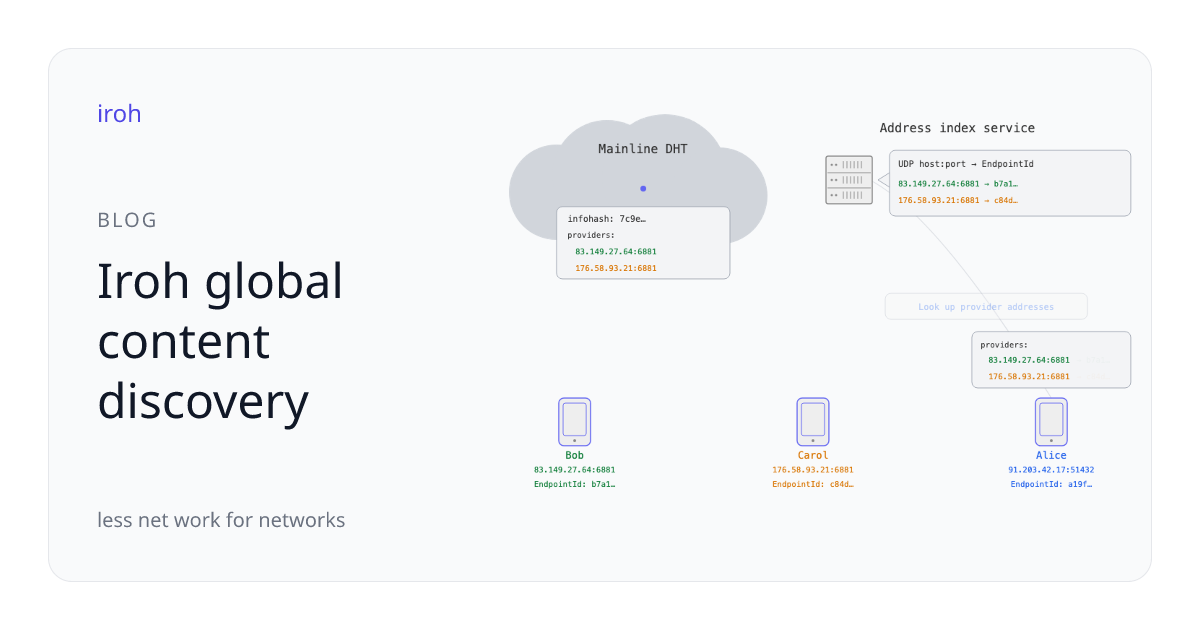
Iroh global content discovery
How to discover content globally with iroh using BitTorrent mainline DHT.
ATProto for distributed systems engineers - AT Protocol
AT Protocol is the tech developed at Bluesky for open social networking. In this article we're going to explore AT Proto from the perspective of distributed backend engineering.

The AT Protocol's interesting design - LittleBit
Bluesky's backend was made to be more than a social network

shreyan - Nostr and ATProto
This post could’ve been titled “Nostr vs ATProto”, but that really isn’t what I wanted to do here. While I will be comparing and contrasting them a lot, and that’s kind of even the point of writing this, I didn’t want to really pit the two against each other at all, and especially not with the title. I also want to try avoiding commenting on the differences between the communities that have formed on the protocols and their apps, although I definitely will be looking at the philosophical differences between the two a lot - also kind of the point of writing this. This also isn’t a super deep technical post, though it assumes familiarity with technical concepts. I also might come back to edit parts of it and add more later.
Willow - Home
Peer-to-peer protocols which scale up, down, and sideways. Sychronisable data storage, fine-grained access control, private and efficient synchronisation, and secure data delivery by any means possible.
Recently I’ve been thinking about a couple of... - Adam Wood
Recently I’ve been thinking about a couple of different tech-related things that sort of overlap. One is the (emerging) shape of the new social web; the other is a pull I’m feeling to try and lessen reliance on American companies. I’ve been interested in / concerned by what became of social media for some time.1 Since the sundering of Twitter in 2022, I’ve kept an eye on the various alternatives, with particular interest in Mastodon and Bluesky. Actually, to be more accurate, my interest has been in the protocols behind those platforms: ActivityPub and AT Protocol respectively. Both have their...

The Internet Transition
The Internet is allowing us to build a richer, more complex society but the way in which we Internet today is failing to support the governance systems that a more complex world requires. I take a look at why these issues are related, try to develop an intuition for a way forward, and point at the emerging field that is coming together to build that future.

Beyond Bluesky: These are the apps building social experiences on the AT Protocol | TechCrunch
A list of AT Protocol-based, consumer-facing apps that are either built on top of Bluesky or its underlying protocol, allowing users to take back control over their social networking experiences and personal data.

AT Protocol
The AT Protocol is a protocol and open standard for distributed social networking services. It is under development by Bluesky Social PBC, a public benefit corporation originally created as an independent research group within Twitter, Inc. to investigate the possibility of decentralizing the service.

In 2026, @bsky.app is focused on what’s next for open social: bringing together users for conversations around live events, creator and platform monetization, and private state, giving users truly private data while preserving ownership and portability at the protocol level.
