

The simplest way to achieve simplicity is through thoughtful reduction.
The Complexity of Simplicity
Norms of Liberty: A Perfectionist Basis for Non-Perfect…
How can we establish a political/legal order that in pr…

The Great Simplification with Nate Hagens
The Great Simplification with Nate Hagens explores money, energy, economy, and the environment with world experts and leaders to understand how everything fits together, and where we go from here

The peril of laziness lost | The Observation Deck
In his classic Programming Perl — affectionately known to a generation of technologists as "the Camel Book" — Larry Wall famously wrote of the three virtues of a programmer as laziness, impatience, and hubris: If we’re going to talk about good software design, we have to talk about Laziness, Impatience, and Hubris, the basis of good software design. We’ve all fallen into the trap of using cut-and-paste when we should have defined a higher-level abstraction, if only just a loop or subroutine. To be sure, some folks have gone to the opposite extreme of defining ever-growing mounds of higher level abstractions when they should have used cut-and-paste. Generally, though, most of us need to think about using more abstraction rather than less.
The Paradox of Perfection: When ‘Good Enough’ is Actually Better
Exploring the tension between engineering perfectionism and pragmatic delivery. Discover why striving for the perfect solution often prevents us from shipping valuable improvements and how to find the balance.
Harnessing Frustration: Using LLMs to Overcome Activation Energy
One of my biggest weaknesses as a software engineer is procrastination when facing a new project. When the scope is unclear, I have a tendency to wait until I feel I’ve “felt out” the problem to start doing anything. I know I’ll feel better and work much faster when I get “stuck in” but I still struggle with that first step, overcoming the “activation energy” required to engage with the details. LLMs have been a game-changer for me in this respect: I can just throw a couple of sentences at them with the shape of the problem. This leads to one of two outcomes: The LLM comes up with a good solution, usually in a slightly different way than what I was thinking. I realize “oh wow the solution is much simpler than I thought”. Straight away I start thinking about the consequences of implementing and improving what the LLM suggested. The LLM comes up with a solution that I intuitively recognize as “wrong”. My immediate reaction is frustration (“How could it get it so wrong”) which leads me to go back and forth with the model, explaining to it why its solution could not possibly work. But in the process of arguing with the model, my brain is churning away and generating variations or different approaches that could work. After a while, even if the AI is still on the wrong track, the debate will trigger a moment of inspiration where suddenly the solution will come to me. I’ll excitedly start up a new conversation and start working through it with the model. The key is the emotional reaction I have immediately to the LLM’s response, either excitement or frustration. By harnessing this immediate feedback loop, I get my brain out of its passive, procrastination mode. It’s almost like a jolt: either I’m thrilled because it’s simpler than I thought, or I’m spurred to action by the urge to correct a perceived ‘wrong’ answer. This forces me to engage with the problem in a meaningful way.
</> htmx ~ Working With AI: A Concrete Example
In this essay, Carson Gross walks through a concrete bug fix in hyperscript to show where AI helped, where it fell short, and why keeping a knowledgeable human in the loop is what kept complexity in check.
What About Rails? | Jared Norman
DHH's opening keynote had shockingly little to say about Rails.

Frontend Minimalism in Action: Do More With Less JavaScript | Peter Kröner | webinale Berlin 2026
Engineers do get promoted for writing simple code
It’s a popular joke among software engineers that writing overcomplicated, unmaintainable code is a pathway to job security. After all, if you’re the only person who can work on a system, they can’t fire you. There’s a related take that “nobody gets promoted for simplicity”: in other words, engineers who deliver overcomplicated crap will be promoted, because their work looks more impressive to non-technical managers.

Simplifying Zettelkasten by working out loud
What did I learn about learning as I used Zettelkasten idea and knowledge management to write five newsletters about disinformation in…

The Illusion of Thinking: Understanding the Strengths and Limitations of Reasoning Models via the Lens of Problem Complexity
Recent generations of frontier language models have introduced Large Reasoning Models (LRMs) that generate detailed thinking processes…


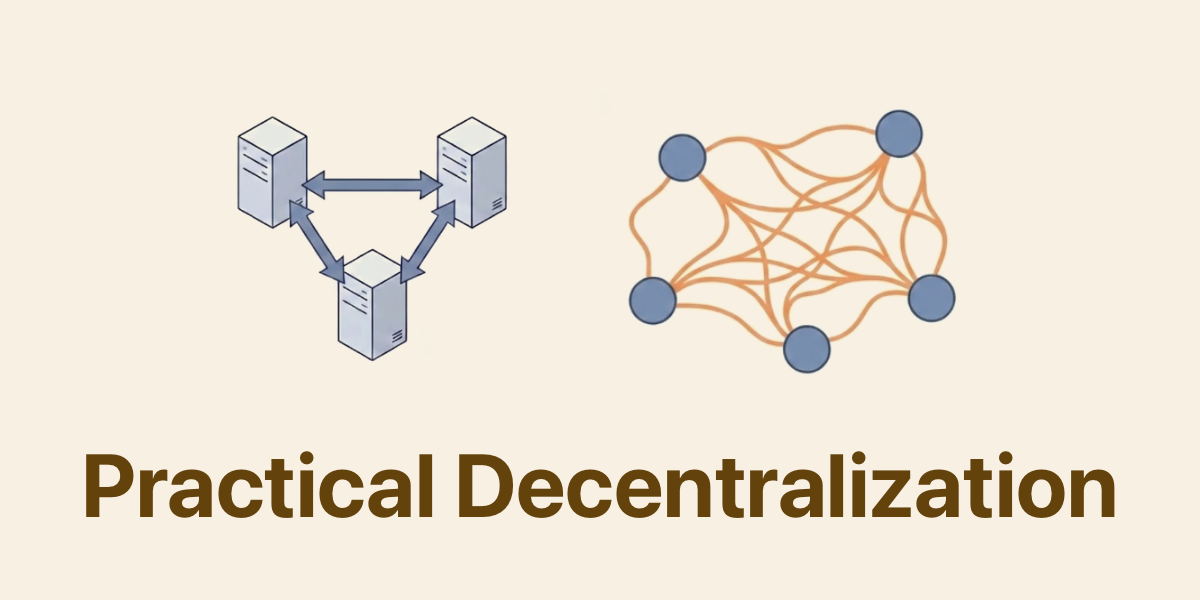
Practical Decentralization
The point of decentralization is to guarantee the rights of individuals and communities on the Internet. Pulling that off is a balancing act between practicality and ideology.
The small web is beautiful
A vision for the "small web", small software, and small architectures.
Saying the obvious thing
Stating the obvious is surprisingly useful. Most of your knowledge lives below the threshold of conscious awareness, so it’s possible for a piece of writing to remind you of what you already know. It’s common to know you don’t like something without being quite sure why, and reading an obvious statement (such as “accuracy matters, even when you agree with the broad strokes”) can help clarify why you find certain things distasteful.