
Plus: Cosmo for conservatives, AI;DR and being "agentic"
Automate the C-Suite - The Ideas Letter
Weatherby argues that Benanav’s and Morozov’s essays on AI and the left miss a deeper reality: Today’s AI is not a neutral tool operating within capitalism but the materialization of…

The Future of AI Should Serve People, Not Platforms - The Liquid Frontier
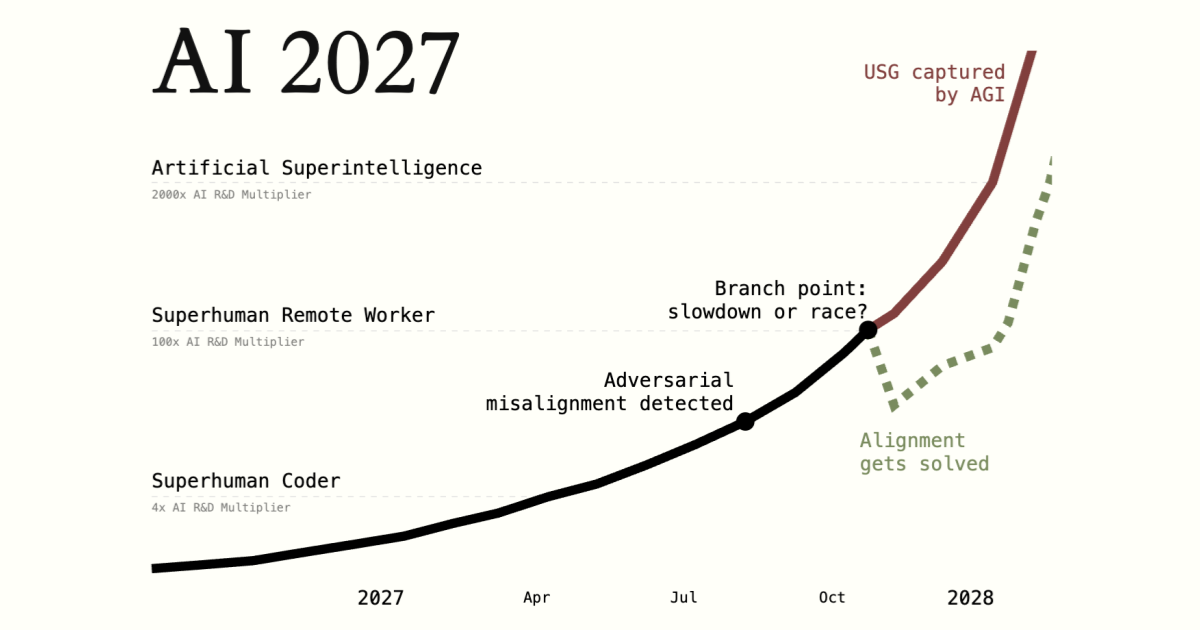
AI Safety Is a Narrative Problem · Special Issue 5: Grappling With the Generative AI Revolution
This op-ed explores power and narrative dynamics around AI. Drawing on pop-culture references, the professional experiences of the author and examples from 2023’s “Great AI Safety Hype Roadshow,” this piece draws on the literary criticism technique of practical criticism to consider how speeches and announcements from both Silicon Valley executives and research scientists to interrogate the media-friendly nature of p(doom) discourse—which focuses on the existential risks of AI (PauseAI, 2023)—and its likely consequences. The complexities of AI and its numerous social impacts can be difficult for even the most expert analyst to unpack. In spite of this, the potential of “existential threats” has successfully cut through to become a mainstay of mainstream media coverage over the last year. This piece will make the case that this is an effective narrative conceit that has achieved a number of ends that traditional science communication tends to find difficult, if not impossible, to achieve. Firstly, it is easy to understand. Simplification of this nature—that removes jargon and complexity and focuses on a single outcome—is much easier to fit on a TV rolling news ticker or on the cover of a tabloid newspaper than more well-balanced, representative opinions. Secondly, it inherits prior assumptions from well-known dramatic forms. P(doom) plays to stories familiar from Greek tragedy through to Marvel movies, in which lone male heroes battle ineluctable forces. Thirdly, it is imbued with urgency and so becomes difficult to ignore.

The hidden ‘rules of the game’ that dictate how we navigate the world | Psyche Videos
How free are we really, if human behaviour embodies the complex, intertwined webs of society and history?


A Real Political Economy of Technology - The Ideas Letter
Two technological futures are competing for political and material priority: generative AI and the green transition. Benanav argues that while AI is marketed as a world-reordering breakthrough, its productivity gains…

Bernie Sanders’ AI Sovereign Wealth Fund Plan - Schneier on Security
Let no one accuse Bernie Sanders of ducking the big questions. Writing in the New York Times last week, the senator asked: “Will the future of humanity be determined by a handful of billionaires who have promoted and developed AI, with virtually no democratic input, who stand to become even richer and more powerful than they are today?” We agree entirely that this is one of the most potent questions facing global democracy today. Our book, Rewiring Democracy, surveys the emerging uses for and impacts of AI in democracy around the world and reaches the same conclusion: that the most urgent risk posed by AI is the ...
The AI Hype Reckoning Is Upon Us
The massive chasm between AI hype and reality is finally reaching the breaking point.

Field Theory: AI as Social Science Question, Object & Tool
Uses of advanced artificial intelligence are changing how societies organize labor, govern, produce knowledge, and make meaning. In light of these developments, this essay argues that AI models, tools, and systems pose three interrelated imperatives for social science: they demand renewed attention to social theories of how technology, human experience, and social order are entangled; they require study as objects of inquiry in their own right; and they offer capabilities that may transform—or upend—the practice of social investigation itself. From Weber’s analysis of rationalization to Du Bois’s study of technology and inequality to contemporary scholarship on algorithmic governance, the essay examines what social science distinctively offers: the capacity to historicize the apparently unprecedented, to trace connections across scales, and to center those most affected by technological change. It identifies how algorithmic systems are remaking the distribution of opportunity and risk as a central task of social inquiry and asks what futures social science might help bring into being.
The continued search for Spime Script
The rants and raves of Simon Wardley on Evolution, Technology, Economics and Business


Agentic coding and persistent returns to expertise
Anthropic is an AI safety and research company that's working to build reliable, interpretable, and steerable AI systems.
</> htmx ~ Yes, and...
In this essay, Carson Gross discusses his advice to young people interested in computer science worried about the future given the advancements in AI.
500+ Billion Tokens Later: Letting AI Agents Decompile A First-Person Shooter
During the last 3 months, I spent some of my time and tokens decompiling a popular first-person shooter. The goal was not to reach a simple proof-of-concept state. Instead, we really wanted an accurate, stable and feature-complete recreation of the game. The avid reader of my blog might have noticed that I had previously written two posts that have since been removed. Everyone else might now be wondering which game I am talking about. To both of you I can only say that corporate America was here to ruin our fun.