


We're opening our space to folks working on projects addressing civic challenges with technology. Whether you're already involve in an existing project, or…
Digital Spaces Directory | New_ Public
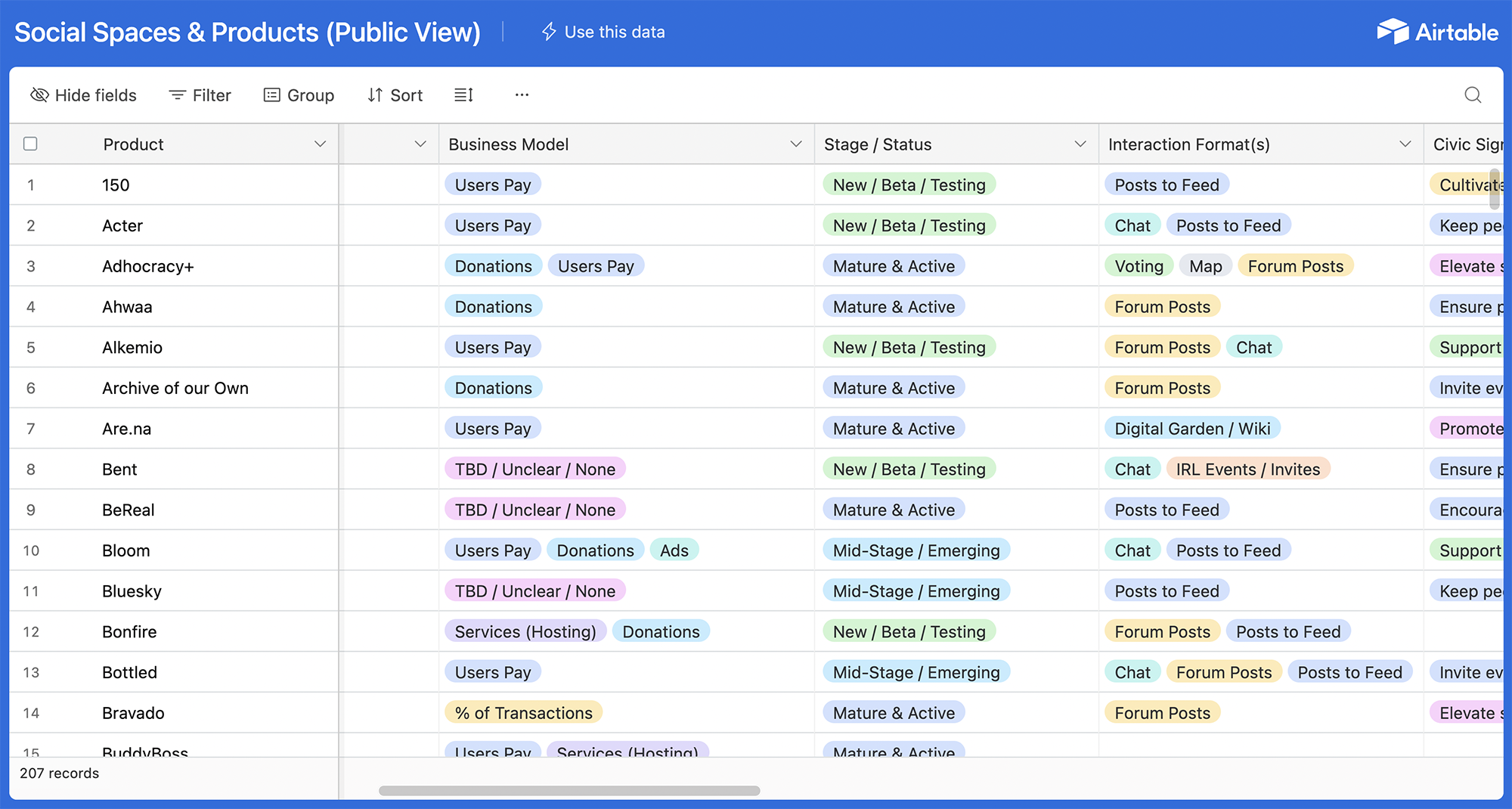
As the social media landscape changes and a new wave of digital spaces emerges, this Directory is meant to be a resource for our field — a jumping-off-point for further exploration and research for anyone who’s interested in studying, building, stewarding, or simply using digital social platforms. We hope this will inspire creative exploration, spark new collaborations, and highlight important progress.
Where Does Community Live? - some responses - Connected Places
I agree that the architecture of a space matters, but I'm not sure the extent we agree as to how much a protocol really matters, versus what we build with them. Roundabout is built on atproto, and I'm quite happy with the decision. I think our architecture very strongly supports our communities.
Civic Action
Commonly, researchers have looked for civic life in a distinct sector in which they assume that voluntary associations will cultivate special skills and virtues. Gathering together many challenges to this approach, and using ethnographic cases of housing advocacy and youth civic engagement projects, the authors reconceptualize “the civic” as civic action and show how patterned scene styles shape it. Doing so reveals patterns of action in complex organizations that may span institutional sectors. The authors show how researchers can locate scene styles, and with an extensive literature review, they portray several common styles and suggest that different civic styles often lead to different outcomes.
Welcome to Muni Town
By now our community holds space for dozens of builders working on community tools in service of the Open Social Web. We call this expansive community space 'Muni Town'.

Developer Experience Goals for Atproto Spaces - AT Protocol
A new series nailing down the moving parts of building on Spaces


Habitat & permission spaces for organizations - building [at] habitat
Our plans for organizational permissions on spaces
The Local Connection Crisis: New Data on What Communities Need
Habitat's road to release: 01 simplespace - building [at] habitat
First up: a pre-implementation of permissioned spaces
Relational Tech Project — Build what we need
Many of us wish our neighborhoods were more connected. We want to live in neighborhoods where we learn from the creativity, care, and skills of our neighbors — and share our gifts too.

✨🙌 AI that helps communities thrive on their own terms
Open protocols + AI-enabled coding = building what we need for ourselves

“Policy Without Tools Is Just Poetry” - AT Protocol
Juliet Shen from ROOST joins the show to talk through the Coop 1.0 release, what open-source trust and safety unlocks for new builders, and where AI actually belongs in moderation

Modeling communities on permissioned data - Daniel's Leaflets
Arguing against "universal spaces" and raising a couple questions that come up as a result.
Introducing Acorn: Community Infrastructure That Grows With You
Featured image: Emergence by Paul Lewin

Governable Spaces: Democratic Design for Online Life – Writings and rehearsals by Nathan Schneider
Read the free, open access editionBuy: Amazon, Bookshop, Narrow Gauge Book Co-op, UC Press
Modular Politics: Toward a Governance Layer for Online Communities
Governance in online communities is an increasingly high-stakes challenge, and yet many basic features of offline governance legacies--juries, political parties, term limits, and formal debates, to name a few--are not in the feature-sets of the software most community platforms use. Drawing on the paradigm of Institutional Analysis and Development, this paper proposes a strategy for addressing this lapse by specifying basic features of a generalizable paradigm for online governance called Modular Politics. Whereas classical governance typologies tend to present a choice among wholesale ideologies, such as democracy or oligarchy, Modular Politics would enable platform operators and their users to build bottom-up governance processes from computational components that are modular and composable, highly versatile in their expressiveness, portable from one context to another, and interoperable across platforms. This kind of approach could implement pre-digital governance systems as well as accelerate innovation in uniquely digital techniques. As diverse communities share and connect their components and data, governance could occur through a ubiquitous network layer. To that end, this paper proposes the development of an open standard for networked governance.
