Which is better for code reviews, a unified diff or a split diff?
pulls.review
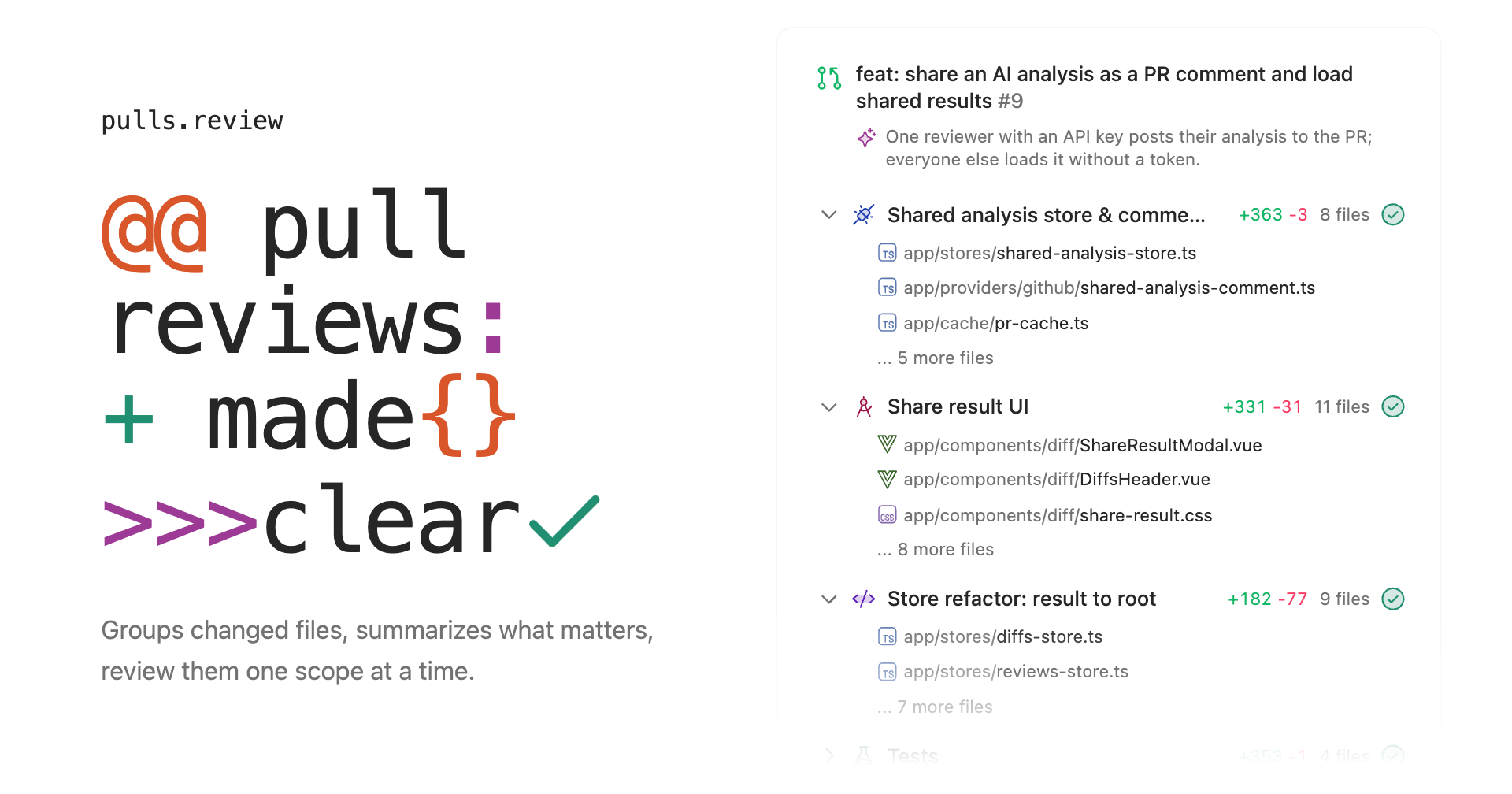
A better way to review a GitHub pull request’s diff: grouped, summarized, and fast.
On Rendering Diffs
A technical deep dive into how we built the @pierre/diffs package and CodeView component for zero-blanking diff rendering at any scale.
A Markdown Editor on AT Protocol — Diffdown
Diffdown — collaborative markdown editing on AT Protocol.

Does Code Cleanliness Affect Coding Agents? A Controlled Minimal-Pair Study
As autonomous coding agents see rapid adoption, their evaluation has primarily focused on task completion rates holding the target codebase fixed. This leaves a critical question unanswered: does the structural and stylistic quality, or ``cleanliness'' of the underlying code affect an agent's ability to navigate and modify it? To isolate the effect of code cleanliness from agent capability, we introduce an evaluation protocol built around minimal pairs: repositories that match on architecture, dependencies, and external behaviour, but differ on static-analysis rule violations and cognitive complexity. The pairs are constructed in both directions, by agent pipelines that either degrade a clean repository or clean a messy one. We author 33 tasks across six such pairs, evaluated through hidden tests at the application's public surface. Across 660 trials with Claude Code, code cleanliness does not change the agent's pass rate. However, it substantially alters the agent's operational footprint: agents working on cleaner code use 7 to 8% fewer tokens and reduce file revisitations by 34%. Our findings suggest that traditional maintainability principles remain highly relevant in the era of AI-driven development, shaping the computational cost and navigational efficiency of coding agents. Code cleanliness joins model choice, harness, and prompting as a factor that materially affects agent behaviours.

Review the reviews
When I was actively contributing to the Go project, my primary feed was the code review email firehose. Issues, mailing lists, and Slack had low SNR. The finished commit history was better: it was finely polished work with some of the best written commit messages I have ever encountered. But it didn’t hold a candle to code reviews for operational learning. The commit history could tell you what got done and why, in impressive technical detail.
Differential spec analysis
Differential techniques are chronically underappreciated in software. And they pair incredibly well with coding agents. Agents are now good enough that differential analysis can even be used to refine a spec, not just code. The Bitter Lesson is, as-written, about AI. It begins: The biggest lesson that can be read from 70 years of AI research is […] But the end of that sentence is far more broadly applicable than just AI.
About CRDTs • Conflict-free Replicated Data Types
Resources and community around CRDT technology — papers, blog posts, code and more.
QC - The Quarantine Collective Translation Project
Collaborative translation review platform
Every layer of review makes you 10x slower
We’ve all heard of those network effect laws: the value of a network goes up with the square of the number of members. Or the cost of commun...
GRN · German Reproducibility Network
Working together for trustworthy and useful research
DR Group
For high-dimensional data, dimensionality reduction (DR) methods have been invaluable tools for human understanding, as they can map datasets into two or three dimensions for visualization, providing an intuitive way to understand the data. In recent years, tons of DR methods for data visualization have been proposed, and some are much better than others. In this blog post, we explore several DR methods, discuss how to determine which methods are effective, and explain why some are better than others.
Dependency Cultures - Richard Feldman | SSW 2026