Training metrics of the mimo-v2.6-pro and mimo-v2.6-flash reinforcement-learning runs, live from the trainer's logs.
Introduction | RLHF and Post-Training Book by Nathan Lambert
A first-principles introduction to RLHF, what it changes in language models, and how it became part of modern post-training.

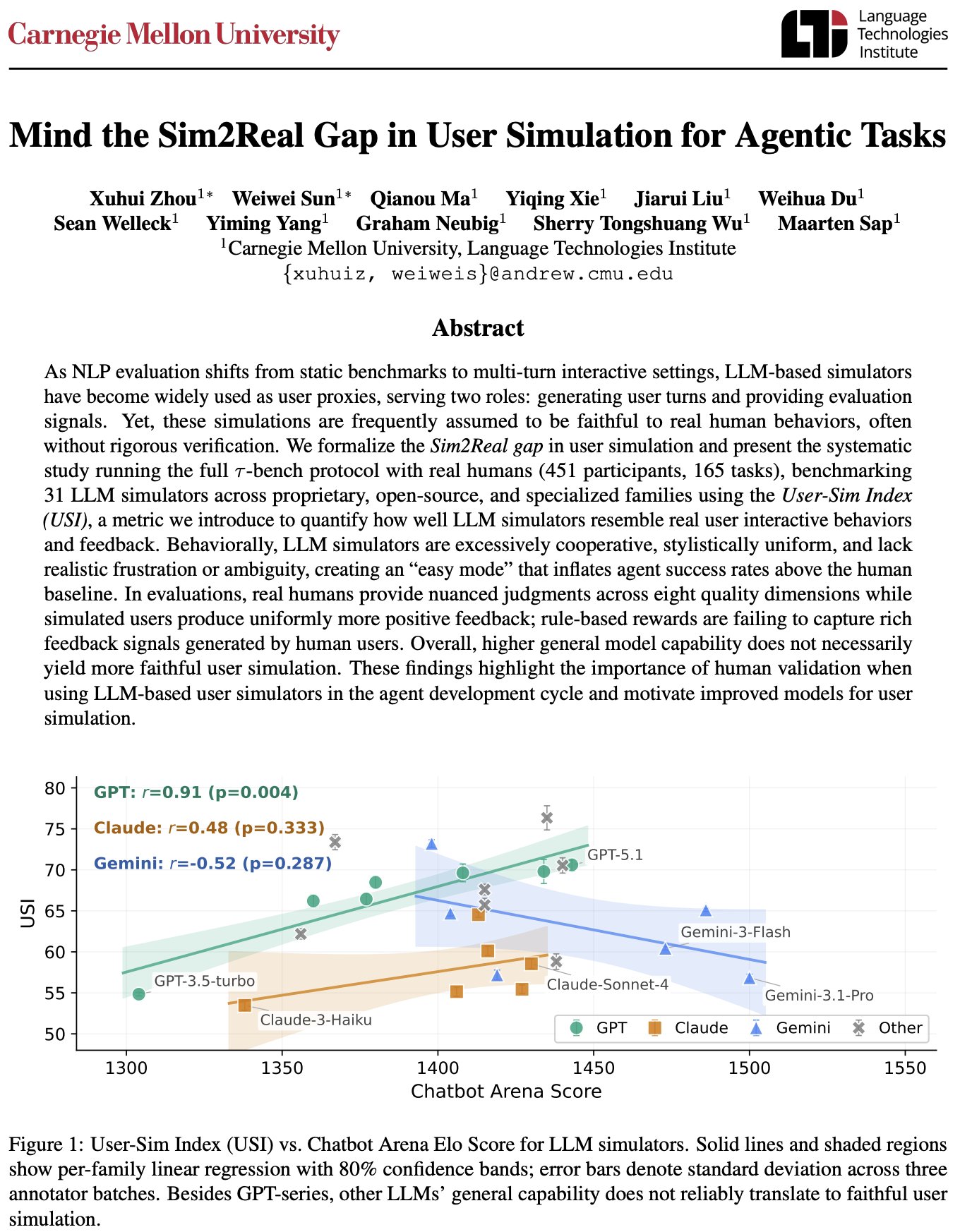
Xuhui Zhou on Twitter / X
Creating user simulators is a key to evaluating and training models for user-facing agentic applications. But are stronger LLMs better user simulators?TL;DR: not really.We ran the largest sim2real study for AI agents to date: 31 LLM simulators vs. 451 real humans across 165… pic.twitter.com/SkswSzeBrz— Xuhui Zhou (@nlpxuhui) March 19, 2026
Learning from the Right Rollouts: Data Attribution for PPO-based LLM Post-Training
Traditional RL algorithms like Proximal Policy Optimization (PPO) typically train on the entire rollout buffer, operating under the assumption that all generated episodes provide a beneficial optimization signal. However, these episodes frequently contain noisy or unfaithful reasoning, which can degrade model performance and slow down training. In this paper, we propose \textbf{Influence-Guided PPO (I-PPO)}, a novel framework that integrates data attribution into the RL post-training loop. By calculating an influence score for each episode using a gradient-based approximation, I-PPO identifies and eliminates episodes that are anti-aligned with a validation gradient. Our experiments demonstrate that I-PPO consistently outperforms SFT and PPO baselines. We show that our filtering process acts as an intrinsic early stopping mechanism, accelerating training efficiency while effectively reducing unfaithful CoT reasoning.

Modern GPU Programming For MLSys — Modern GPU Programming For MLSys
Machine learning systems sit at the heart of modern AI workloads. In these systems, performance often comes down to the quality of a small number of GPU kernels. Attention kernels, LLM prefill and decode kernels, low-precision block-scaled GEMMs, fused MoE layers, and other large fused kernels all directly shape end-to-end speed in both training and serving.
Physics of LM: Part 4.2, Canon Layers at Scale where Synthetic Pretraining Resonates in Reality
OpenCode Go | Low cost coding models for everyone
Go starts at $5 for your first month, then $10/month, with generous 5-hour request limits for GLM-5.1, GLM-5, Kimi K2.5, Kimi K2.6, MiMo-V2.5-Pro, MiMo-V2.5, Qwen3.7 Max, Qwen3.6 Plus, MiniMax M2.5, MiniMax M2.7, MiniMax M3, DeepSeek V4 Pro, and DeepSeek V4 Flash.
Mixture-of-Experts Meets Instruction Tuning:A Winning Combination for Large Language Models
Sparse Mixture-of-Experts (MoE) is a neural architecture design that can be utilized to add learnable parameters to Large Language Models (LLMs) without increasing inference cost. Instruction tuning is a technique for training LLMs to follow instructions. We advocate combining these two approaches, as we find that MoE models benefit more from instruction tuning than dense models. In particular, we conduct empirical studies across three experimental setups: (i) Direct finetuning on individual downstream tasks devoid of instruction tuning; (ii) Instructiontuning followed by in-context few-shot or zero-shot generalization on downstream tasks; and (iii) Instruction tuning supplemented by further finetuning on individual downstream tasks. In the first scenario, MoE models overall underperform dense models of identical computational capacity. This narrative, however, dramatically changes with the introduction of instruction tuning (second and third scenario), used independently or in conjunction with task-specific finetuning. Our most powerful model, FLAN-MOE-32B, surpasses the performance of FLAN-PALM-62B on four benchmark tasks, while using only a third of the FLOPs. The advancements embodied byFLAN-MOE inspire a reevaluation of the design principles of large-scale, high-performance language models in the framework of task-agnostic learning.
Context Rot: How Increasing Input Tokens Impacts LLM Performance
Claude Sonnet 4, GPT-4.1, Qwen3-32B, and Gemini 2.5 Flash on Repeated Words Task

AT Protocol Roadmap (Spring 2026) - AT Protocol
Updates to the AT Protocol roadmap, including Permissioned Data and Account Experience.
AT Protocol Roadmap (Spring 2026) - AT Protocol
Updates to the AT Protocol roadmap, including Permissioned Data and Account Experience.
ActivityPub Won by Being Boring
At FediForum 2026, ActivityPub co-author Evan Prodromou explained why the protocol succeeded by staying deliberately ordinary and why the W3C's Q3 2026 revision needs to keep it that way.
Better Training Data Attribution via Better Inverse Hessian-Vector Products
Training data attribution (TDA) provides insights into which training data is responsible for a learned model behavior. Gradient-based TDA methods such as influence functions and unrolled differentiation both involve a computation that resembles an inverse Hessian-vector product (iHVP), which is difficult to approximate efficiently. We introduce an algorithm (ASTRA) which uses the EKFAC-preconditioner on Neumann series iterations to arrive at an accurate iHVP approximation for TDA. ASTRA is easy to tune, requires fewer iterations than Neumann series iterations, and is more accurate than EKFAC-based approximations. Using ASTRA, we show that improving the accuracy of the iHVP approximation can significantly improve TDA performance.
brevity1swos/rgx
regex101 for the terminal — real-time matching, 3 engines, capture groups, replace mode, syntax highlighting, plain-English explanations, undo/redo, mouse support. Written in Rust.
Introducing Bluesky Protocol Services - AT Protocol
A new home for the infrastructure Bluesky runs on the open network — including Jetstream v2 with network replay, a new Jetstream SDK, and a lex-based TypeScript SDK