How Blacksky grew to millions of users without spending a dollar
Blacksky
Decentralized social media built for community power, culture, and collective freedom.

Overview
What is Blacksky? Blacksky Algorithms is building the future of self-governable online communities with tools that make complex infrastructure simple to deploy. Most social platforms control what users see, how communities operate, and who gets to feel safe online. Blacksky changes that by providing one-click infrastructure for independent, self-governed digital spaces. Our platform lets communities […]
Blacksky
Blacksky is a social network. It is developed and maintained by Blacksky Algorithms. The project provides curated feeds and moderation tools to support Black social media users, many of whom previously used Black Twitter.

Social media algorithms can be redesigned to bridge divides — here’s how
"It falls to both the tech companies that built these systems and an engaged public to create technologies designed for social cohesion."
W-Social: What does sovereignty mean for social media? – Open Future
The European Commission’s move to W-Social frames it as a European alternative to X, but its closed-source code and reliance on Bluesky’s infrastructure show that sovereign social media requires open infrastructure—not European ownership alone.
Recently I’ve been thinking about a couple of... - Adam Wood
Recently I’ve been thinking about a couple of different tech-related things that sort of overlap. One is the (emerging) shape of the new social web; the other is a pull I’m feeling to try and lessen reliance on American companies. I’ve been interested in / concerned by what became of social media for some time.1 Since the sundering of Twitter in 2022, I’ve kept an eye on the various alternatives, with particular interest in Mastodon and Bluesky. Actually, to be more accurate, my interest has been in the protocols behind those platforms: ActivityPub and AT Protocol respectively. Both have their...

Implicit Feudalism — Rushkoff Archive
Too many of us think it doesn’t matter when a platform like X/Twitter has a single, all-powerful owner. Most of our online worlds are simply run by what we hope are benevolent dictators. After all, we figure, if we don’t like what they’re doing or allowing, we can just leave, right? But in most cases we’re just jumping from one rich dude’s idea for how the world should be to another rich dude’s idea for how the world should be.
Bluesky
Social media as it should be. Find your community among millions of users, unleash your creativity, and have some fun again.
Bluesky
Social media as it should be. Find your community among millions of users, unleash your creativity, and have some fun again.

The Paradox of Open
Numerous organisations and initiatives have been launched with a belief in openness and free knowledge. Their proponents placed their bets on the combined power of networked information services and new governance models for the production and sharing of content and data. We – as members of this broad movement – were among those who believed it possible to leverage this combination of power and opportunity to build a more democratic society, unleashing the power of the internet to create universal access to knowledge and culture. For us, such openness meant not only freedom, but also presented a path to justice and equality.
Community by Design
Social media empower distributed content creation by algorithmically harnessing "the social fabric" (explicit and implicit signals of association) to serve this content. While this overcomes the bottlenecks and biases of traditional gatekeepers, many believe it has unsustainably eroded the very social fabric it depends on by maximizing engagement for advertising revenue. This paper participates in open and ongoing considerations to translate social and political values and conventions, specifically social cohesion, into platform design. We propose an alternative platform model that includes the social fabric an explicit output as well as input. Citizens are members of communities defined by explicit affiliation or clusters of shared attitudes. Both have internal divisions, as citizens are members of intersecting communities, which are themselves internally diverse. Each is understood to value content that bridge (viz. achieve consensus across) and balance (viz. represent fairly) this internal diversity, consistent with the principles of the Hutchins Commission (1947). Content is labeled with social provenance, indicating for which community or citizen it is bridging or balancing. Subscription payments allow citizens and communities to increase the algorithmic weight on the content they value in the content serving algorithm. Advertisers may, with consent of citizen or community counterparties, target them in exchange for payment or increase in that party's algorithmic weight. Underserved and emerging communities and citizens are optimally subsidized/supported to develop into paying participants. Content creators and communities that curate content are rewarded for their contributions with algorithmic weight and/or revenue. We discuss applications to productivity (e.g. LinkedIn), political (e.g. X), and cultural (e.g. TikTok) platforms.

Bluesky is what Tumblr was
Over the past several months I have watched carefully as leftists have migrated over to Bluesky from X/twitter.
The Algorithm, Singular
A new European ruling on algorithmic amplification determines if an operator controls how content spreads on a platform. But applying it to open social networks turns out to be a problem.

Nobody knows how the whole system works
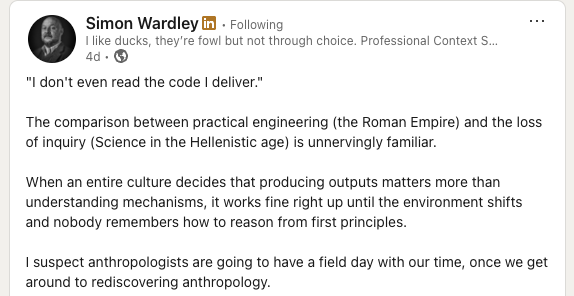
One of the surprising (at least to me) consequences of the fall of Twitter is the rise of LinkedIn as a social media site. I saw some interesting posts I wanted to call attention to: First, Simon W…
The Ultimate Directory of tools and applications for Bluesky
A curated collection of all things relating to the Bluesky social media platform.
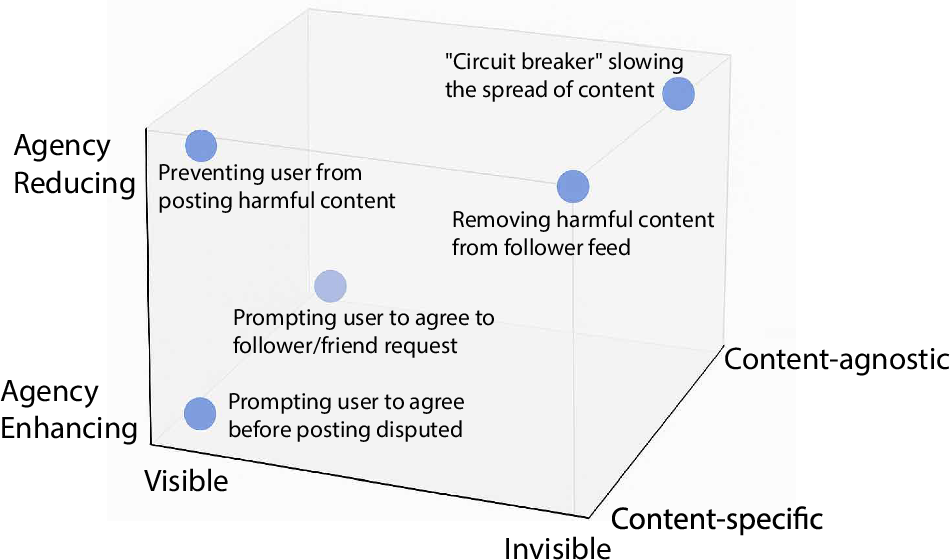
The case against efficiency: friction in social media
Social media platforms frequently prioritize efficiency to maximize ad revenue and user engagement, often sacrificing deliberation, trust, and reflective, purposeful cognitive engagement in the process. This manuscript examines the potential of friction—design choices that intentionally slow user interactions—as an alternate approach. We present a case against efficiency as the dominant paradigm on social media and advocate for a complex systems approach to understanding and analyzing friction. Drawing from interdisciplinary literature, real-world examples, and industry experiments, we highlight the potential for friction to mitigate issues like polarization, disinformation, and toxic content without resorting to censorship. We propose a state space representation of friction to establish a multidimensional framework and language for analyzing the diverse forms and functions through which friction can be implemented. Additionally, we propose several experimental designs to examine the impact of friction on system dynamics, user behavior, and information ecosystems, each designed with complex systems solutions and perspectives in mind. Our case against efficiency underscores the critical role of friction in shaping digital spaces, challenging the relentless pursuit of efficiency and exploring the potential of thoughtful slowing.