Compression and LLMs are trying to solve the exact same problem: predicting what comes next. Learn the fundamentals of compression and how better prediction leads to better shrinkage.
Semantic Compression
An introduction to the idea that code should be approached with a mindset towards compressing it semantically, rather than orienting it around objects.

Dictionary Compression is finally here, and it's ridiculously good
Dictionary compression could completely change how applications send data over the web. It's recently gained broad support, and offers absurd real-world...

I Built an LLM From Scratch
How LLMs Actually Work
A from-the-ground-up walkthrough of how modern LLMs work, from tokens to transformer blocks to the next-token loop
TinyPNG – Compress AVIF, WebP, PNG and JPEG images
Free online image optimizer for faster websites! Reduce the file size of your AVIF, WEBP, JPEG and PNG images while preserving the image quality.

The Compressive Knowledge Graph Hypothesis: Which Graph Facts Matter for Scientific Hypothesis Generation?
Knowledge graphs (KGs) can provide structured scientific context to language models, but it remains unclear which graph facts actually shape the generated hypotheses. We study KG-guided hypothesis generation for battery materials across Mistral-7B, Llama-3.1-70B, and Gemini 2.5 Flash. We perturb local KGs by varying density, ontology richness, topology, and control structure, and evaluate outputs with both provided-graph and fixed-reference metrics. Across models, KG utility is selective and model-dependent: graph context changes outputs, but no-KG outputs also recover substantial graph content from model priors. Compact top-kk subgraphs often approximate full-KG behavior, including when claimed-outcome triples are held out. At the same time, compression is not unique to one semantic ranking rule, random and topology-based subsets can also recover much of the signal. These results support a redundancy-aware Compressive KG hypothesis: useful KG signal is often recoverable from compact, scientifically structured subgraphs rather than requiring the full local graph.
Scaling Laws Across Model Architectures: A Comparative Analysis of...
The scaling of large language models (LLMs) is a critical research area for the efficiency and effectiveness of model training and deployment. Our work investigates the transferability and...

What the AI Wizard taught us about LLM code generation at scale - PostHog
You know what’s boring? Writing integrations. It’s a task you’ll do once, but you always need to do it right, which means carefully reading docs…

Can gzip be a language model?
A while back I wrote about language modeling without neural networks, where I generated Shakespeare with an unbounded n-gram model: no weights, no training, …

‘Doom Loop’: OpenAI and Microsoft Admits LLMs Are Destroying the Web and Built on Theft
"Millions of people around the world will soon consider large models ‘hoovering up’ all their work to be an astonishing theft of unprecedented proportions."
A 4-Bit Model and a 1-Bit Index
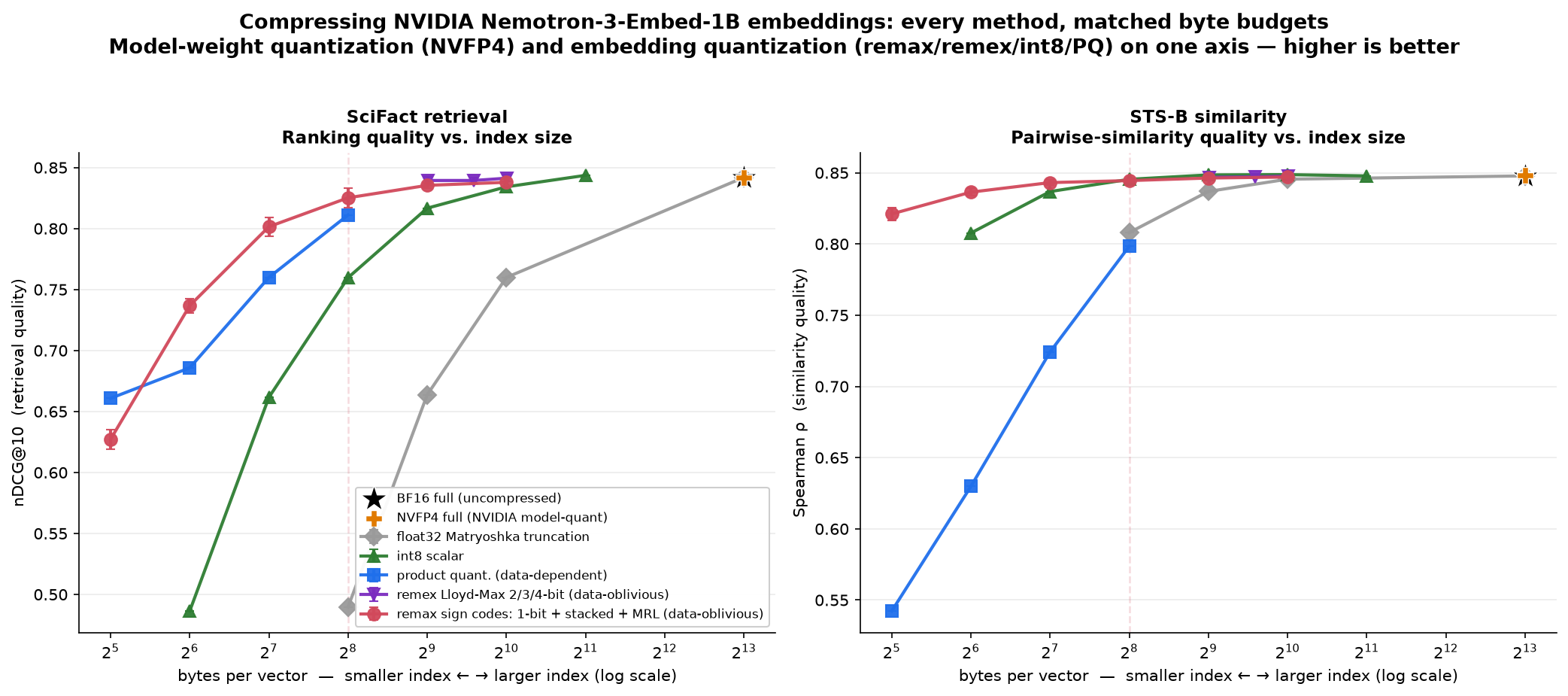
Running NVFP4 Nemotron on a CPU, then mapping every embedding-compression method at matched byte budgets. The two quantizations compose.