

In their article ["Malleable Software"](https://www.inkandswitch.com/essay/malleable-software), Ink & Switch list various ways that modern software applications fail to serve the user: - Software is too rigid: users can’t tailor it to suit their workflow, except by entering the role of programmers. - Software applications are overspecialized "avocado slicers", not general tools like "knives", so their lack of tailorability is keenly felt. - Software doesn’t provide a reasonable learning curve from beginner to expert; in other words, time spent learning an application doesn’t unlock tailorability, instead the end user must learn an unrelated skill like a markup/scripting language or even the tool’s implementation language. - Software applications are increasingly siloed, so sharing data between apps, let alone orchestrating cross-app workflows, is overly difficult. These are real problems. From what I can tell, Ink & Switch are software researchers, and view the problems from a highly technical perspective, focusing on novel infrastructure that enables end-user programmability. They pose questions such as "how do we ease users into programming?" and "instead of shipping a dead, static binary, can we ship a living image containing programming tools allowing it to be modified in arbitrary ways while still running?" These ideas are technologically exquisite, but they fail to provide a gentle learning curve. (cont'd) 🧵
Dependency Cultures - Richard Feldman | SSW 2026
Extensible Software in the age of LLMs | Jeremy Morrell
Solid core + capability-based sandboxes + LLMs = Users with superpowers
Open Forks of Boring Apps With Authority - Woodys Rows
The Atmosphere can win by becoming the foundation for software people already need to use because of real-world relationships.
Software Acceleration and Desynchronization
A look at the ever-present drive to make software delivery faster and how it might break down various activity loops in organizations.

Improving My Hardware Workflow With CI and Nix
One thing you might notice if you read my blog is that I do a lot of hardware projects. Generally, these include a board, some software, and possibly some extraneous components (like CAD design, such as a case). Software tooling is quite mature, but I find that hardware had traditionally lagged quite a bit behind. For a while, I just lived with this, but over the last few months I've put in a bunch of effort to improve my workflow.

Pony
An open-source, object-oriented, actor-model, capabilities-secure, high-performance programming language.
File Over App: A Philosophy for Digital Longevity
My take on the 'file over app' philosophy and why it’s essential for keeping my data resilient and built to last.
Opinion | The A.I. Disruption Has Arrived, and It Sure Is Fun
We’re entering a new renaissance of software development. We should all be excited, despite the uncertainties that lie ahead.

What Even Is An OS Now?
Computers now work the way I thought they did when I was 8. What does computing look like when most applications have an audience of 1-2 people? I'm leaving Fly.io to build a phone for that world.
The peril of laziness lost | The Observation Deck
In his classic Programming Perl — affectionately known to a generation of technologists as "the Camel Book" — Larry Wall famously wrote of the three virtues of a programmer as laziness, impatience, and hubris: If we’re going to talk about good software design, we have to talk about Laziness, Impatience, and Hubris, the basis of good software design. We’ve all fallen into the trap of using cut-and-paste when we should have defined a higher-level abstraction, if only just a loop or subroutine. To be sure, some folks have gone to the opposite extreme of defining ever-growing mounds of higher level abstractions when they should have used cut-and-paste. Generally, though, most of us need to think about using more abstraction rather than less.
“They had no concept of a duty of care to their users.” – Unsung
A blog about software craft and quality
Restate - Build innately resilient distributed apps
Restate is a lightweight runtime that lets developers build innately resilient distributed apps without the complexity tax.
Local-First Software: Taking Back Control of Our Data | a mini-doc
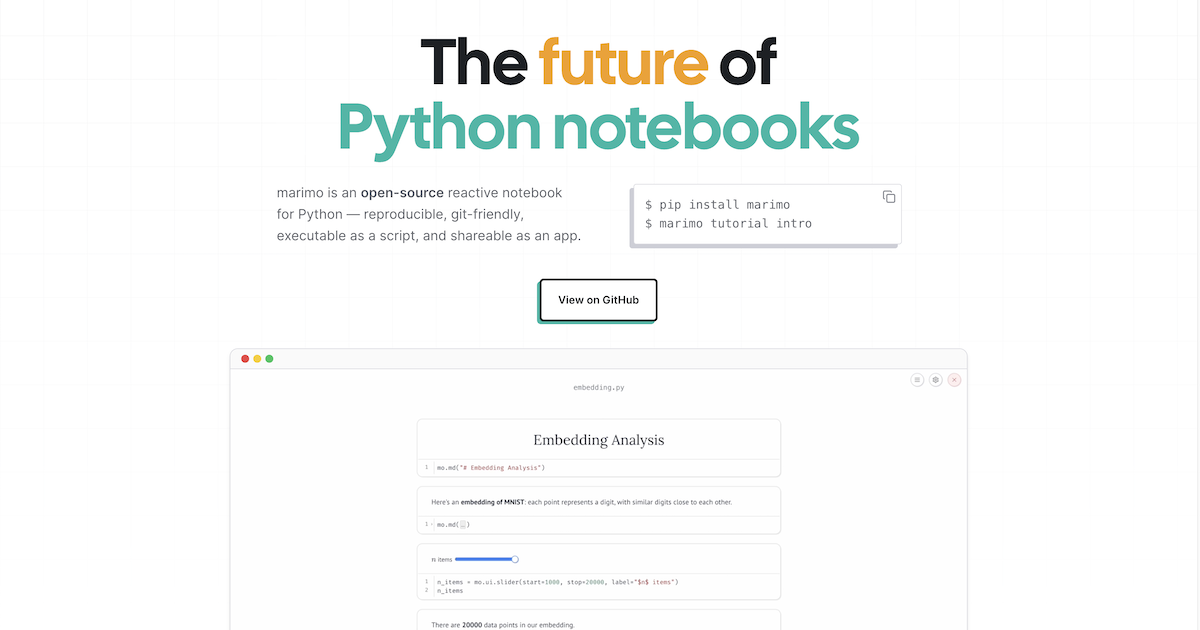
marimo | a next-generation Python notebook
Explore data and build apps seamlessly with marimo, a next-generation Python notebook.
Why craft-lovers are losing their craft
Les Orchard made a quiet observation recently that I haven't been able to shake. Before LLM coding assistants arrived, the split between developers was…
The Era of Software Quality, or the Era of Ostriches?
Humans are bad at writing secure code, and GNOME developers are no exception. GNOME is primarily written using unsafe programming languages where simple mistakes in our code lead to devastating...