

The majority of us are a bunch of self taught people with rather spotty knowledge and that's fine! Kilian (also self taught) is here to share some of the computer science fundamentals you probably are missing with the aim to improve your code in the long term.
Teach Yourself Programming in Ten Years
The conclusion is that either people are in a big rush to learn about programming, or that programming is somehow fabulously easier to learn than anything else. Felleisen et al. give a nod to this trend in their book How to Design Programs, when they say "Bad programming is easy. Idiots can learn it in 21 days, even if they are dummies." The Abtruse Goose comic also had their take.
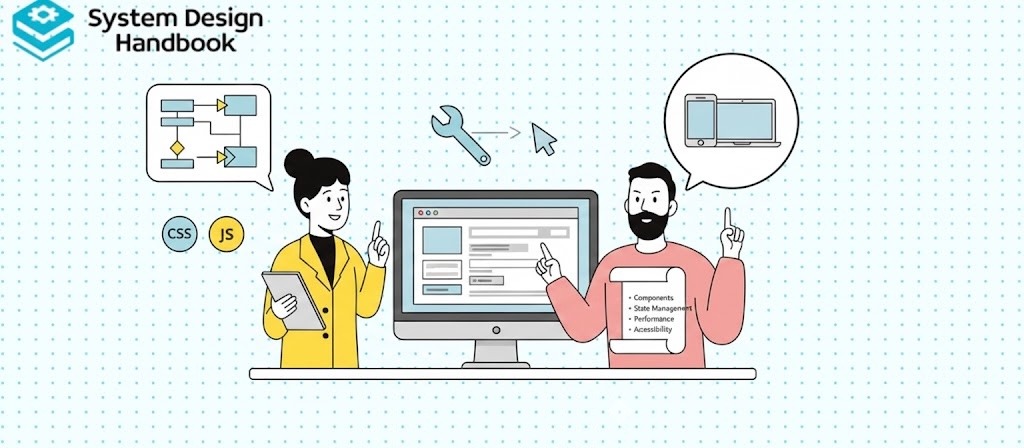
A practical guide to frontend System Design
Sam, a passionate frontend developer, had been in the job market for what felt like...

Prioritize learning / seth.computer
The personal website of Seth Etter, a Wichita, KS based software engineer.

Reading Code Is Hard, and tips to improve - Trisha Gee
This week's video for Dave Farley's Continuous Delivery YouTube channel is me ranting about why reading code sucks, and offering some advice on how to improve. "Every programmer occasionally, when nobody’s home, turns off the lights, pours a glass of scotch, puts on some light German electronica, and opens up a file on their computer. ... Read more

Learn | Frontend Hire
AI writes the UI now. These tracks build the career it can't: frontend depth, product thinking, AI-powered building, and finding the work that pays for it.



Frontend System Design: The Complete Guide 2026
Learn how to approach frontend System Design interviews with real-world architecture patterns, scalability strategies, and practical examples used by top tech companies.
Managing Agent Skills with Your Package Manager | pavel.pink
AI coding agents use skills — markdown files that teach them domain-specific tasks. We publish ours as conda packages and manage them with pixi, getting versioning, lockfiles, and supply chain security for free.

Impeccable: Design skills for AI harnesses
1 skill, 23 commands, and curated anti-patterns for impeccable frontend design. Works with Cursor, Claude Code, GitHub Copilot, Gemini CLI, and Codex CLI.

Impeccable: Design skills for AI harnesses
1 skill, 23 commands, and curated anti-patterns for impeccable frontend design. Works with Cursor, Claude Code, GitHub Copilot, Gemini CLI, and Codex CLI.
Harness Engineering for Self-Improvement
The concept of recursive self-improvement (RSI) dates back to I. J. Good (1965), where he defined an “ultraintelligent machine” as a system that can surpass humans in all intellectual activities and design better machines to improve itself. Yudkowsky (2008) used the phrase “recursive self-improvement” for a specific feedback loop: an AI uses its current intelligence to improve the cognitive machinery that produces its intelligence. This feedback loop in modern AI may indicate the model rewriting its own weights directly, or more broadly the model improves the training pipeline and the deployment system, which in turn enables a better successor model with improved performance across economically valuable tasks. The speed of research development in AI has been shown to drastically accelerated in frontier labs (Anthropic; OpenAI).
The peril of laziness lost | The Observation Deck
In his classic Programming Perl — affectionately known to a generation of technologists as "the Camel Book" — Larry Wall famously wrote of the three virtues of a programmer as laziness, impatience, and hubris: If we’re going to talk about good software design, we have to talk about Laziness, Impatience, and Hubris, the basis of good software design. We’ve all fallen into the trap of using cut-and-paste when we should have defined a higher-level abstraction, if only just a loop or subroutine. To be sure, some folks have gone to the opposite extreme of defining ever-growing mounds of higher level abstractions when they should have used cut-and-paste. Generally, though, most of us need to think about using more abstraction rather than less.
Programming (with AI agents) as theory building
Back in 1985, computer scientist Peter Naur wrote “Programming as Theory Building”. According to Naur - and I agree with him - the core output of software engineers is not the program itself, but the theory of how the program works. In other words, the knowledge inside the engineer’s mind is the primary artifact of engineering work, and the actual software is merely a by-product of that.

Blog - Manuel Matuzovic
I'm a frontend developer in Graz, specialized in HTML, accessibility, and CSS layout and architecture.
