You know what’s boring? Writing integrations. It’s a task you’ll do once, but you always need to do it right, which means carefully reading docs…
Artificial
An LLM is a computer program. We should talk about it like a computer program.

Build agents, not pipelines
There are only two ways to use LLMs in a computer program: as part of a pipeline, or as an agent. In other words, either you express the control flow of the program in code, or you give a LLM tools and allow it to manage the control flow itself1.

LLM-generated skills work, if you generate them afterwards
LLM “skills” are a short explanatory prompt for a particular task, typically bundled with helper scripts. A recent paper showed that while skills are useful to LLMs, LLM-authored skills are not. From the abstract:
I Built an LLM From Scratch
Fight fire with pedantry
Over the last two years, I’ve heard a bunch of speculation about how to design a programming language specifically for an LLM. It usually centers around typechecking, formal verifiability, or context engineering. It’s a fun thought experiment, but always felt aimless. First, my experience has been that designing for humans is the best way to design for an LLM, as long as you restrict yourself to text. Second, being in-distribution is so critical that there’s no point unless you’re also training a frontier coding model.
Magicoder: Empowering Code Generation with OSS-Instruct
We introduce Magicoder, a series of fully open-source (code, weights, and data) Large Language Models (LLMs) for code that significantly closes the gap with top code models while having no more...

No Coding Before 10am | Michael Bloch
Engineering is no longer about writing code. Here is one startup's playbook for building in the AI agent era.

How LLMs Actually Work
A from-the-ground-up walkthrough of how modern LLMs work, from tokens to transformer blocks to the next-token loop

Self-Instruct: Aligning Language Models with Self-Generated Instructions
Large "instruction-tuned" language models (i.e., finetuned to respond to instructions) have demonstrated a remarkable ability to generalize zero-shot to new tasks. Nevertheless, they depend...
Cognition | Agent Trace: Capturing the Context Graph of Code
We’re excited to join in Cursor, Cloudflare, Vercel, git-ai, OpenCode and others in support of [Agent Trace](https://agent-trace.dev/). As described in the spec, Agent Trace is an open, vendor-neutral spec for recording AI contributions alongside human authorship in version-controlled codebases.
Harness engineering: leveraging Codex in an agent-first world
By Ryan Lopopolo, Member of the Technical Staff
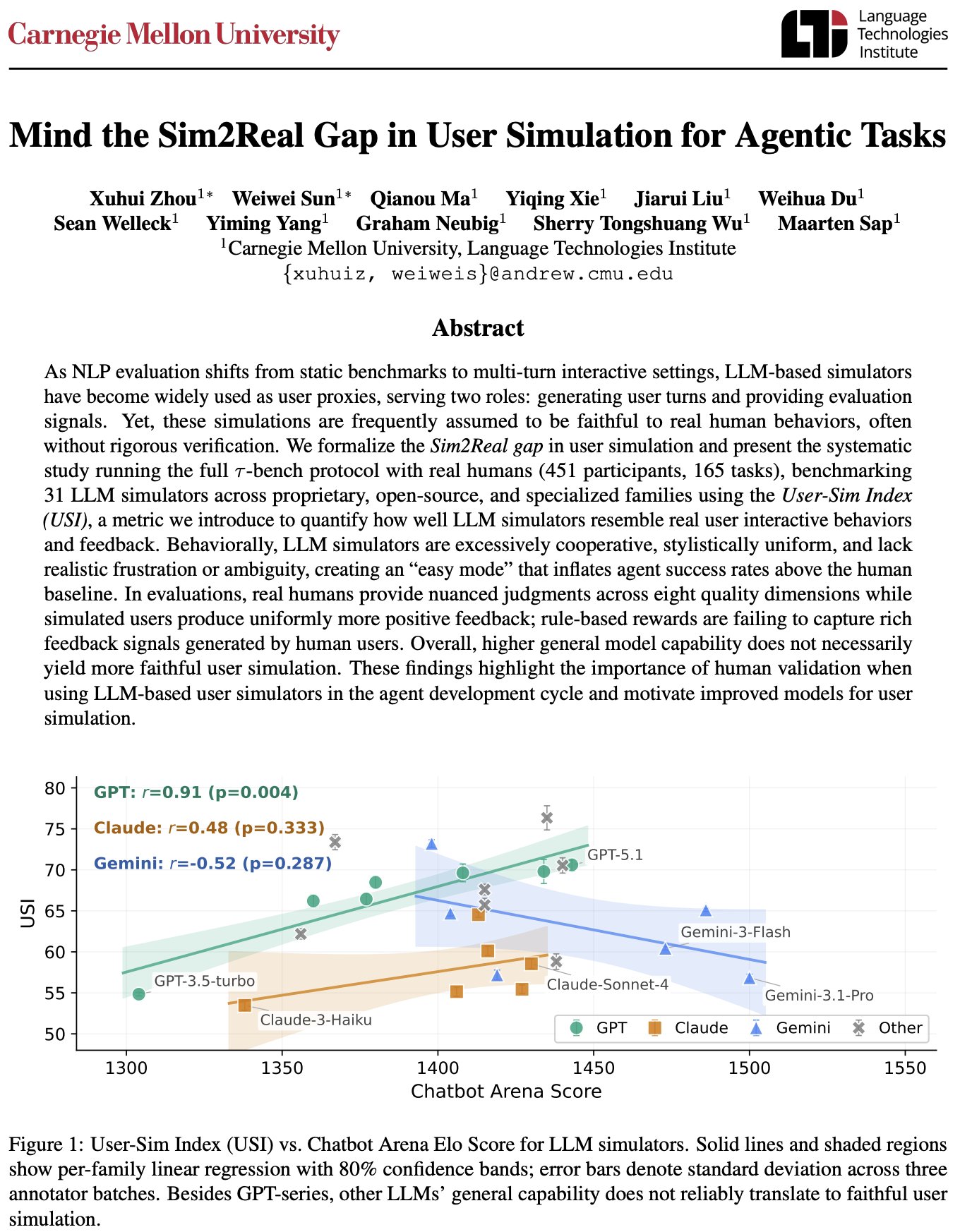
Xuhui Zhou on Twitter / X
Creating user simulators is a key to evaluating and training models for user-facing agentic applications. But are stronger LLMs better user simulators?TL;DR: not really.We ran the largest sim2real study for AI agents to date: 31 LLM simulators vs. 451 real humans across 165… pic.twitter.com/SkswSzeBrz— Xuhui Zhou (@nlpxuhui) March 19, 2026
Rotating the Space: On LLMs as a Medium for Thought
An essay on LLMs as a cognitive medium
Can LLMs Be Computers? | Percepta
We build a computer inside a transformer — executing arbitrary C programs for millions of steps with exponentially faster inference via 2D attention heads.