


An interview with @masnick.com (of TechDirt), the author of the influential 2019 paper "Protocols, Not Platforms," reflecting on how his ideas apply to publishers in 2026.
Ep. 19 | AT Proto, MCP, and Open Source with Nick Gerakines - Overcommitted | Software Engineering and Tech Careers Insights - Episode 19
Summary In this episode of the Overcommitted podcast, hosts Bethany, Brittany, and Erika engage with guest Nick Gerakines to explore the intricacies of the AT Protocol, its implications for user data ownership, and the evolution of social media platforms. The...

Can AT Protocol Fix Monolithic Platforms?
VoxPort — Protocol-Native Podcast Publishing
AT Protocol powered podcast hosting. Own your audience, publish everywhere, and stay in control.
VoxPort — Protocol-Native Podcast Publishing
AT Protocol powered podcast hosting. Own your audience, publish everywhere, and stay in control.

AT Protocol
The AT Protocol is a protocol and open standard for distributed social networking services. It is under development by Bluesky Social PBC, a public benefit corporation originally created as an independent research group within Twitter, Inc. to investigate the possibility of decentralizing the service.

shreyan - Nostr and ATProto
This post could’ve been titled “Nostr vs ATProto”, but that really isn’t what I wanted to do here. While I will be comparing and contrasting them a lot, and that’s kind of even the point of writing this, I didn’t want to really pit the two against each other at all, and especially not with the title. I also want to try avoiding commenting on the differences between the communities that have formed on the protocols and their apps, although I definitely will be looking at the philosophical differences between the two a lot - also kind of the point of writing this. This also isn’t a super deep technical post, though it assumes familiarity with technical concepts. I also might come back to edit parts of it and add more later.
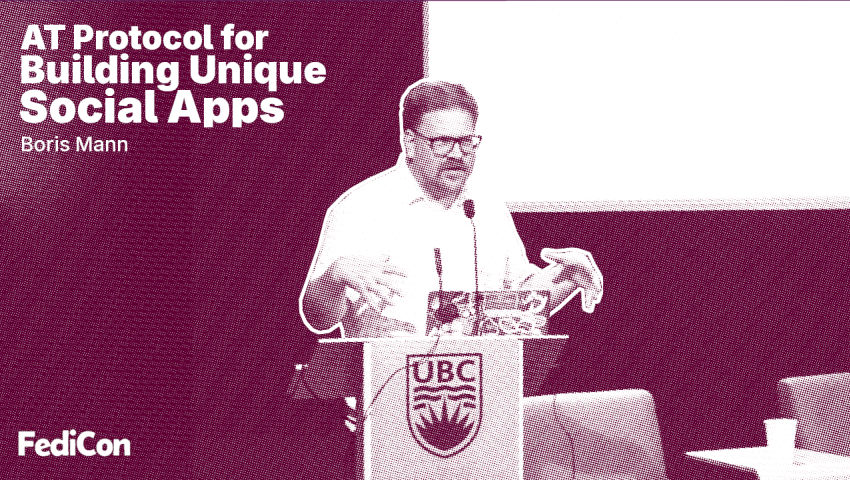
AT Protocol for Building Unique Social Apps — Boris Mann — FediCon 2025
Boris Mann gave a talk at FediCon 2025: "Beyond Microblogging: AT Protocol for Building Unique Social Apps". Boris Mann posted some notes about his talk here: https://bmannconsulting.com/notes/beyo...
The Purpose of Protocols
Every open social protocol generates shared resources, but none has produced a governance framework adequate to those resources. So who fills that vacuum?

Starting from scale in the design of the AT Protocol - Paul's Leaflets
Bluesky was founded in 2022 to produce a protocol which Twitter could adopt. The product goals changed, but the requirements didn't.
ATProto for distributed systems engineers - AT Protocol
AT Protocol is the tech developed at Bluesky for open social networking. In this article we're going to explore AT Proto from the perspective of distributed backend engineering.
Wesley Finck (@wesleyfinck.org)
technical co-founder & CTO @cosmik.network protocols > platforms curation > feeds movements > products commons > enclosure

FediMod FIRES on building better and decentralised social media applications
Continuing our monthly interview series "Building a Free Internet of the Future", we talked to Emelia Smith, who is a software engineer. “Building a Free Internet of the Future" highlights the experiences and perspectives of individuals and communities supported by the NGI Zero (NGI0) grants, funded by the European Commission.

Riven
A modern platform for original content, genuine conversation, and a feed that's actually yours. Built on the AT Protocol.
From ZK-first to AT Protocol — our path to DDS | Agora Citizen Network
We've been building Agora — a platform for public deliberation using Polis-style clustering — for a while now. Along the way, we've written about what we think about Nostr, AT Protocol, Polis, Community Notes, and protocol interoperability. Those posts are somewhat outdated now. This one describes w...

In 2026, @bsky.app is focused on what’s next for open social: bringing together users for conversations around live events, creator and platform monetization, and private state, giving users truly private data while preserving ownership and portability at the protocol level.
