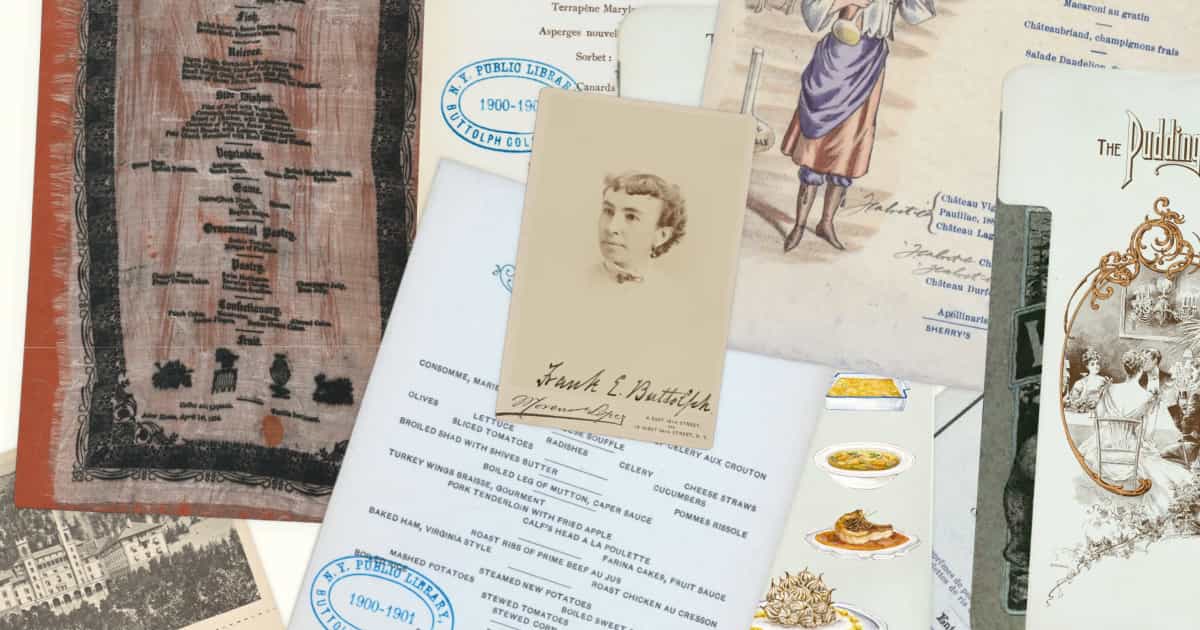
What do America’s earliest restaurant menus teach us about America?
The Sifter - A Food History Research Tool
The Sifter is a public database, free to all users. It is a tool for finding and comparing historical and contemporary writing on food and food-related topics. It is overseen by an advisory board composed of members from The Oxford Symposium on Food and Cookery as well as other friends of food history. As with Wikipedia, the Sifter will be populated by its users. All entries will have an English translation, enabling users to search languages they cannot read. Soon, we will have over 100 languages represented. Registered users will be able to make corrections and add new information. Future releases will include a data visualization component. We also plan to include more resources linking to digitized photographs, artworks, television and film. With the aid of this tool, it is our hope that what has been invisible will come into focus.
Cheeseburger Database
A community-built record of the world's cheeseburgers. Posted to Bluesky, indexed here. No endless scrolling. No ads.

Historicale
Test your knowledge of history by ordering events on a timeline. A daily historical chronology challenge.

Land of Hope: An Invitation to the Great American Story
We have a glut of text and trade books on American hist…

How Markdown took over the world - Anil Dash
A blog about making culture. Since 1999.


REVIEW: Aztecs, by Inga Clendinnen
Aztecs: An Interpretation, Inga Clendinnen (Cambridge University Press, 1991).

A Syrian Immigrant Mother’s Version of a Mac and Cheese

Anthropeum
A daily game that challenges our understanding of human cultures. Ten objects. 5,000 years of human history. Guess where and when each artifact was made. See how you rank.
Governance Archaeology: Research as Ancestry
Abstract. This essay presents the idea of governance archaeology, an approach to learning from the past to inform the politics of the future. By reporting on a prototype historical database, we outline a strategy for co-producing a global commons of collective governance practices that can inspire institutional learning and experimentation, particularly in the face of rapid technological change and vexing global crises. Embedded in our approach is an orientation of ancestry whereby practitioners cultivate relationships of accountability and responsibility to the legacies they learn from, recognizing the harm from past patterns of exploitation. By taking seriously a wide range of historical governance practices, particularly those outside the Western canon, governance archaeology seeks to expand the options available for the design of more moral political economies.
Does modernisation erase cultural difference – or amplify it? | Psyche Ideas
We understandably fear the flattening effect of modernity. But global data from China to Peru tells a hopeful story