blogs + git + AT protocol

ATOM: AT Protocol Over MoQ Transport
This document specifies how the Authenticated Transfer (AT) Protocol can leverage Media over QUIC Transport (MOQT) for efficient data synchronization across decentralized social networks. The AT Protocol's firehose event stream and repository synchronization mechanisms map naturally to MOQT's publish/subscribe model, enabling scalable relay infrastructure, priority-based delivery, and improved resilience for large-scale social data distribution. This specification addresses the challenges of the current WebSocket- based transport and demonstrates how MOQT's relay architecture, group-based caching, and multiplexed streams provide significant benefits for AT Protocol deployments at scale.

Git at any scale · Cursor
Hosting Git repositories at scale is a nightmare. When Linus Torvalds designed the first version of the information manager from hell (that's actually the tagline for Git, look it up), he had a very specific use case in mind: his own. He wanted to replace BitKeeper, the distributed version control system that was being used to develop the Linux Kernel. Of course, the replacement had to be distributed too. The Kernel is an unusual software project; it is extremely decentralized, with many different maintainers for its many different subsystems. A distributed version control system is a natural fit for this workflow.

Making a Ghost Blog a Valid standard.site Publication
This blog federates over ActivityPub through Ghost so Mastodon users can follow @index@subaud.io. standard.site is the counterpart for the AT Protocol side: a set of lexicons that describe a blog as records in an atproto repo, the same identity and data layer behind a Bluesky account. Anything

Introducing Sequoia: Publishing for the Open Web
Today I'm excited to release a new tool for the AT Protocol: Sequoia. This is a CLI tool that can take your existing self-hosted blog and publish it to the ATmosphere using Standard.site lexicons.

proposal: ingest repo records #282
`sh.tangled.repo` records are one of the last few records that need atprotation (2-way sync between appview/pds). this one is tricky because we want consistency between knot state, appview state and PDS state. the path forward is described below: - migration to did/rkey syntax universally: in several places, we utilize `did/repo-name` as a globally unique identifier for a repository, we should migrate this to `did/rkey`: * for the tangled appview: this means reworking our ACLs, routers and DB to use `did/rkey` or ATURI as a globally unique identifier for a repo * for knots: this means changing paths on disk to be `did/rkey`, allowing git ops to `host:did/rkey` , updating ACLs, and XRPC endpoints * for spindles: this means updating ACLs and XRPC endpoints - once this is done, we can define ingestion logic for all services in the network to pull sh.tangled.repo records * for the tangled appview, this should create/delete/update a repo pointer record * for knots: this should create-or-ignore/delete-or-ignore/update-or-ignore a repo on disk. migration of repos needs to be thought out here. * for spindles: as above - define edge-case behaviors: * when referring to repos by rkey, it is possible for clever users to create duplicate records with the same repo-name, appview routers must handle this ambiguity with a new interstitial page that offers a redirect, knots must return an error upon push/pull on ambiguous git URLs * the `knot` cli can introduce a command `backfill` or `sync` to bring knot state up to sync with the rest of the world (repos, collaborators, pubkeys, ACLs etc.).
RFCs on the Atmosphere
I was recently working on an RFC for some open source work and didn't have a good place to post it. Google Docs is annoying for anything technical and a git repo is heavy if you don't already have one set up and a process ready to go.
AT Protocol
The AT Protocol is a protocol and open standard for distributed social networking services. It is under development by Bluesky Social PBC, a public benefit corporation originally created as an independent research group within Twitter, Inc. to investigate the possibility of decentralizing the service.

Introducing Tap: Repository Synchronization Made Simple | Bluesky
Just about every app built on AT needs data from a repository at some point. For many use cases – feed generators, labelers, bots – streaming live data through a Relay or Jetstream works well. But some applications need to go beyond what Jetstream was designed for, like tracking specific subsets of a repo, automatically backfilling a database when adding new repos to monitor, or even mirroring the entire Atmosphere.

What I Actually Do, For Anyone Who's Heard Me Say "AT Protocol" and Nodded Politely - Ewan’s Blog
Someone told me recently that I should get some work experience. I have about fifty repositories on GitHub. I also have a poetry anthology running past 180 pieces over six years, and by the same logic, apparently, I'm not a poet either, because nobody's put my name on a spine yet. Both claims are wrong for exactly the same reason, so let's deal with them properly.
at://alternatives | AT protocol alternatives for popular products
Discover AT Protocol alternatives for popular products and services. Browse decentralized apps that give you control over your data, identity, and social connections.
ATCR - Distributed Container Registry
Push and pull Docker images on the AT Protocol. Same Docker, decentralized.
Manton Reece - Introducing the Micro.blog PDS
I’ve started rolling out an AT Protocol PDS — personal data server — for new Micro.blog users. In the Bluesky world, a PDS is what stores your posts, follows, photos, and other data from apps. In the same way that creating an account on Micro.blog automatically gives you a fediverse handle, I wanted people to be able to create a Micro.blog account and have everything they needed to sign into Bluesky.

byline.pub is now live in beta
A home for indie authors on the AT Protocol. Publish your work and become easier to discover across the open social web.
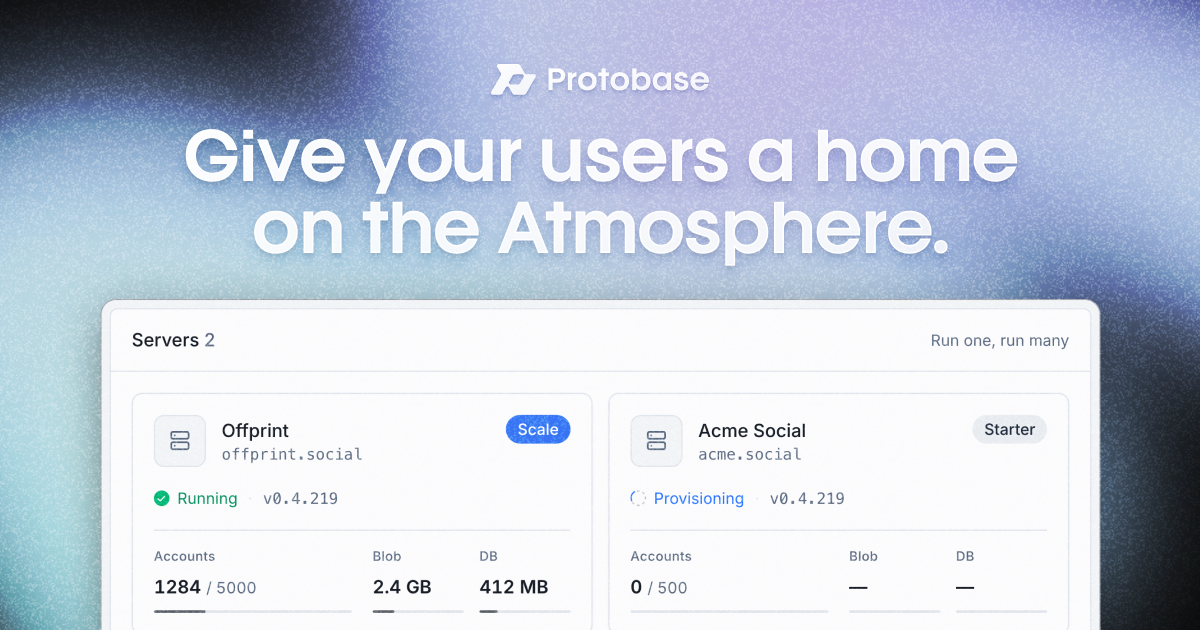
Protobase
Managed AT Protocol PDS infrastructure for your brand. Give your users a home on the Atmosphere — we handle the heavy lifting.