Online regex tester and debugger with real-time match highlighting, detailed explanations, substitutions, unit tests, benchmarking, and code generation. Supports PCRE2, JavaScript, Python, Go, Java, .NET, Rust, POSIX ERE, and POSIX BRE.
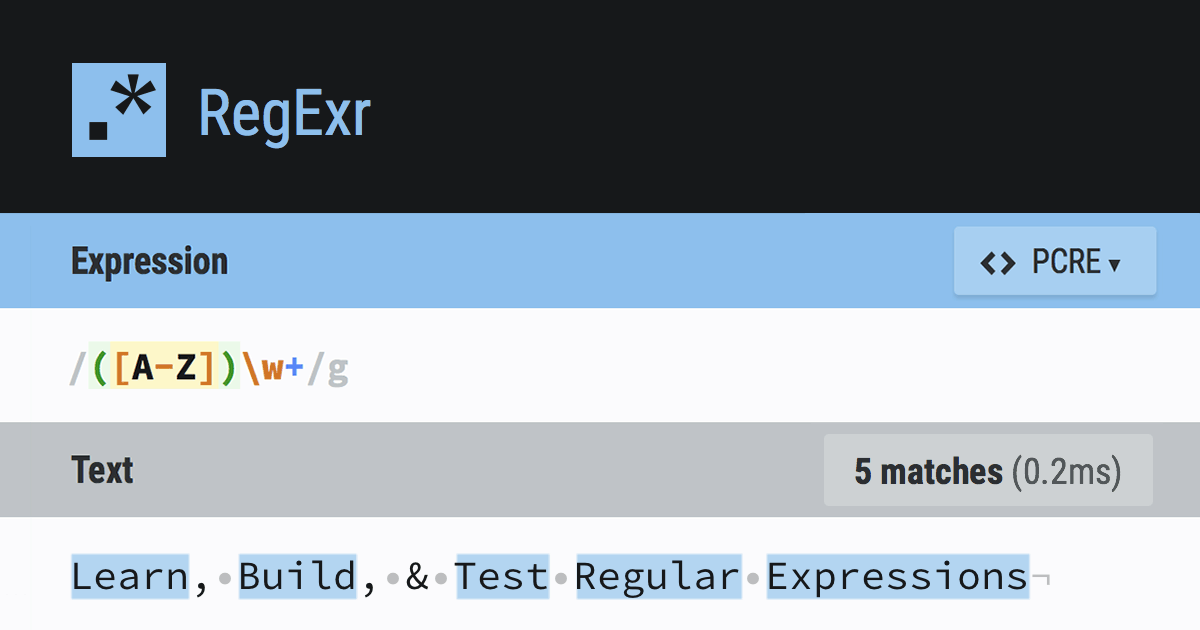
RegExr: Learn, Build, & Test RegEx
RegExr is an online tool to learn, build, & test Regular Expressions (RegEx / RegExp).
brevity1swos/rgx
regex101 for the terminal — real-time matching, 3 engines, capture groups, replace mode, syntax highlighting, plain-English explanations, undo/redo, mouse support. Written in Rust.
A new era for software testing - <antirez>
REA — Reverse Engineer Anything
Inspect apps, binaries and runtime behavior with your coding agent or terminal. REA connects local analysis tools through CLI and MCP.
lala-hakobyan/front-end-debugging-handbook
A comprehensive guide to debugging tools for modern, complex front-end applications. This handbook provides practical, real-world guidance on a complete suite of tools, from Chrome DevTools and framework extensions to integrated IDE debuggers.
Vibe-coded Go static analysis tools
Ideas are now a major bottleneck for vibe-coding. There are whole categories of software that simply don’t occur to me to write. Philip Zeyliger pointed me at one: Go static analysis tools. These are great candidates: easy to describe easy to test high value low risk He created a checker that requires slog.InfoContext instead of slog.Info when a context is available, to improve our telemetry/observability. I followed up with a checker that lets you annotate a Go struct as requiring complete, explicit annotation.
Hypothesis, Antithesis, synthesis
Introducing Hegel, our new family of property-based testing libraries.

Testing can be fun, actually
Writing and maintaining tests is boring. But they're also some of the most valuable code we can write. With this blog post you'll learn a criminally underrated testing technique to add to your testing toolbox that can make tests a whole lot more pleasant.

OG Check - Free Open Graph Meta Tags Checker & Validator Tool
Free online Open Graph checker and validator. Analyze, preview and optimize your website's meta tags for better social media sharing on Facebook, Twitter, LinkedIn. Generate OG code instantly.
Vim anti-patterns | Arabesque
The benefits of getting to grips with Vim are immense in terms of editing speed and maintaining your “flow” when you’re on a roll, whether writing code, poetry, or prose, but because the learning curve is so steep for a text editor, it’s very easy to retain habits from your time learning the editor that stick with you well into mastery. Because Vim makes you so fast and fluent, it’s especially hard to root these out because you might not even notice them, but it’s worth it. Here I’ll list some of the more common ones.
Magicoder: Empowering Code Generation with OSS-Instruct
We introduce Magicoder, a series of fully open-source (code, weights, and data) Large Language Models (LLMs) for code that significantly closes the gap with top code models while having no more...


Rusty thoughts on "Parse, don't validate" - Eli Bendersky's website
Like many programmers, I find Alexis King's Parse, don't validate article fascinating, because it gives a name to an idiom that seems familiar and important - one I've observed and used in the past without naming it explicitly. This post is a review of the "Parse, don't validate" pattern applied to the Rust programming language (the original post uses Haskell). I was particularly interested in finding educational examples of this pattern in the Rust standard library and other well-known projects.
es617/claude-replay
Convert AI coding agent sessions (Claude Code, Cursor, Codex) into self-contained, embeddable HTML replays
Script Wizards
A TTRPG and software studio. Small tools for running games, and a zine for hackers who play them.

Cognition | Agent Trace: Capturing the Context Graph of Code
We’re excited to join in Cursor, Cloudflare, Vercel, git-ai, OpenCode and others in support of [Agent Trace](https://agent-trace.dev/). As described in the spec, Agent Trace is an open, vendor-neutral spec for recording AI contributions alongside human authorship in version-controlled codebases.