How AI may quietly dismantle the feedback loop that turns inexperienced people into competent ones, and why my work matters to me.
More Than a Tool
What We Learned from a Year of Conversations About AI

</> htmx ~ Working With AI: A Concrete Example
In this essay, Carson Gross walks through a concrete bug fix in hyperscript to show where AI helped, where it fell short, and why keeping a knowledgeable human in the loop is what kept complexity in check.

Women Who Use AI Seen As Incompetent; Men Who Use AI Seen As Pragmatic
A 2026 study found that when women and men use AI tools to create identical resumes, evaluators view the women as less competent, while crediting the men with initiative.

The Picture They Paint of You
Musings on the way we frame Coding Assistants, AI SREs, and what this communicates in terms of how these roles are perceived.
I am often wrong
[I shared this note with my team earlier this week, and am posting it here as well. I hope it is interesting or helpful for others working on building product in the age of AI.]
Learn | Frontend Hire
AI writes the UI now. These tracks build the career it can't: frontend depth, product thinking, AI-powered building, and finding the work that pays for it.

AI Doesn’t Reduce Work—It Intensifies It
Aruna Ranganathan and Xingqi Maggie Ye from Berkeley Haas School of Business report initial findings in the HBR from their April to December 2025 study of 200 employees at a …
What happens when AI replaces the parts of work people love?
We’re using AI to move faster. I’m not yet convinced we’re using it to work better.

When AI builds itself
Our progress toward recursive self-improvement, and its implications.

How AI assistance impacts the formation of coding skills
Anthropic is an AI safety and research company that's working to build reliable, interpretable, and steerable AI systems.
I used AI. It worked. I hated it.
I used Claude Code to build a tool I needed. It worked great, but I was miserable. I need to reckon with what it means.

Harness Engineering for Self-Improvement
The concept of recursive self-improvement (RSI) dates back to I. J. Good (1965), where he defined an “ultraintelligent machine” as a system that can surpass humans in all intellectual activities and design better machines to improve itself. Yudkowsky (2008) used the phrase “recursive self-improvement” for a specific feedback loop: an AI uses its current intelligence to improve the cognitive machinery that produces its intelligence. This feedback loop in modern AI may indicate the model rewriting its own weights directly, or more broadly the model improves the training pipeline and the deployment system, which in turn enables a better successor model with improved performance across economically valuable tasks. The speed of research development in AI has been shown to drastically accelerated in frontier labs (Anthropic; OpenAI).
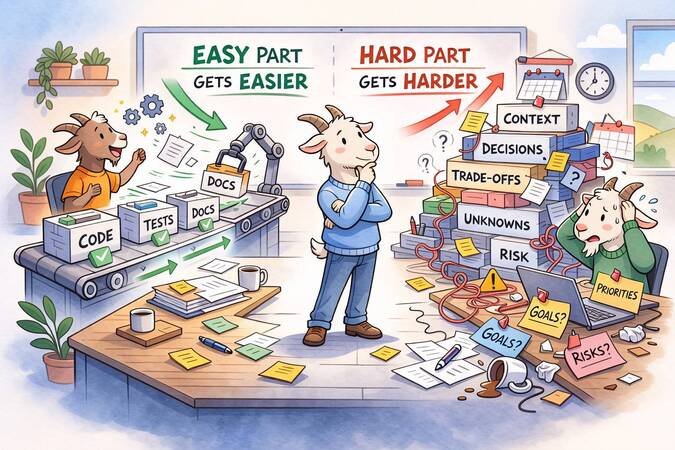
AI Makes the Easy Part Easier and the Hard Part Harder for Developers
AI handles writing code but leaves the hard work: investigation, context, validation. Why vibe coding has limits and AI assistance can backfire.
Breaking My Own Rule (Again): AI and the Job Hunt - Jacky Alciné
I said I wasn't going to lean on generative AI but I also said I was going to leave the tech industry. Here's what I actually used to keep applying and what it did (and didn't) do for me.

AI is a software un-crisis
I haven't asked her, but I bet Margaret Hamilton feels right at home bossing Claude around.