

Publish an HTTPS DNS record. Let browsers reach HTTP/3 on the first connection instead of wasting a round trip.
Flushes
The Internet's Bathroom. Post your flushes, see who else is in there, and keep every record in your own AT Protocol repo.
mess with dns
It's fun to learn by experimenting and breaking things! Here you can do weird DNS experiments with no consequences if you mess something up.
Margin – Get this Extension for 🦊 Firefox (en-US)
Download Margin for Firefox. Write in the margins of the web. Annotate any URL with AT Protocol.

Margin – Get this Extension for 🦊 Firefox (en-US)
Download Margin for Firefox. Write in the margins of the web. Annotate any URL with AT Protocol.

How I Came Up with Margin - Scan's leaflet
Introducing Margin Write on the margins of the internet, powered by the AT Protocol. Coming soon
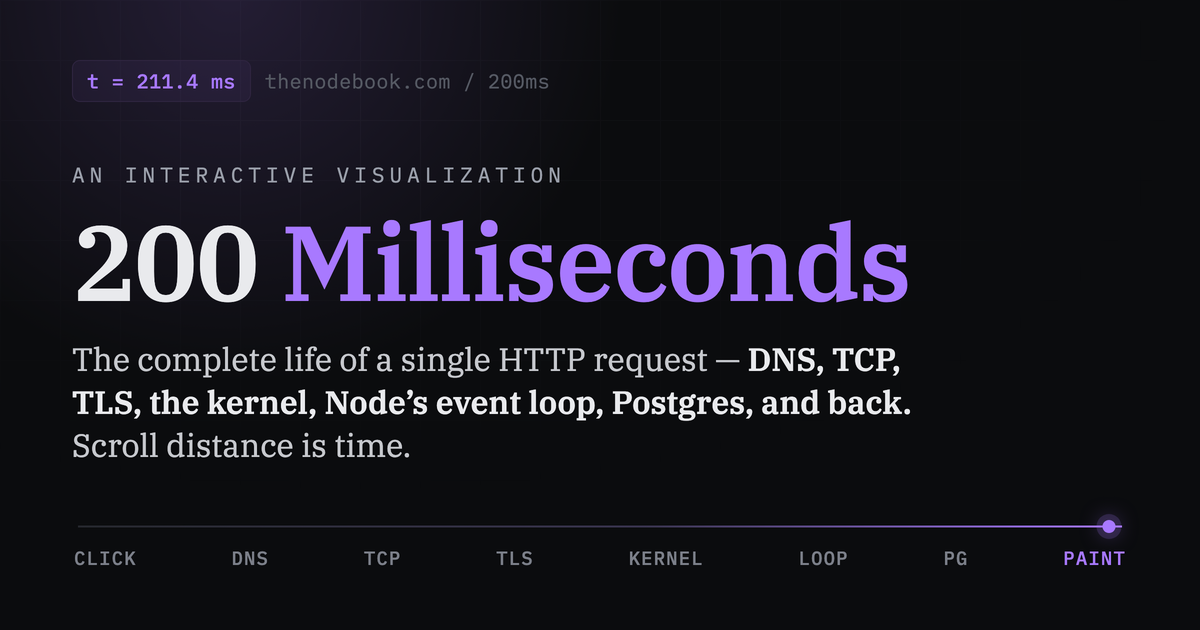
200 Milliseconds — the complete life of one HTTP request, visualized
A single HTTP request, traced in real time through DNS, TCP, TLS, the kernel, Node's event loop, and Postgres — then back to the pixel. Scroll distance equals time.
Slingshot: atproto edge record cache
API Documentation for Slingshot, a firehose-listening atproto edge record and identity cache.
Surf – Join the Surf Beta Waitlist
Ente Paste
Share sensitive text with one-time, end-to-end encrypted links that auto-expire after 24 hours.

Margin – rozšíření do 🦊 Firefoxu (cs)
Stáhnout Margin do Firefoxu. Write in the margins of the web. Annotate any URL with AT Protocol.
URL Scanner | Cloudflare Radar
Understand the security, performance, technology, and network details of a URL with a publicly shareable report.

primus852/traefik-ddns
This repository provides configuration files and instructions for setting up a Cloudflare Dynamic DNS (DDNS) service and a Traefik reverse proxy with Let's Encrypt SSL/TLS support. It includes Docker Compose configurations, environment variable templates, and detailed usage instructions to automate DNS updates and manage SSL certificates.
End-to-end encrypted relays for OCapN — Spritely Institute
Creating a direct connection between any two computers (not just from client to server) over the internet is notoriously difficult. Many home networks are behind NATs which prevent new inbound connections. Sometimes these NATs are from the ISP (carrier-grade NATs) which are impossible to work around with port forwarding and/or UPnP. While hole punching techniques can break through NATs, it's far from guaranteed. Thus, we need something that works in the general case: relays.