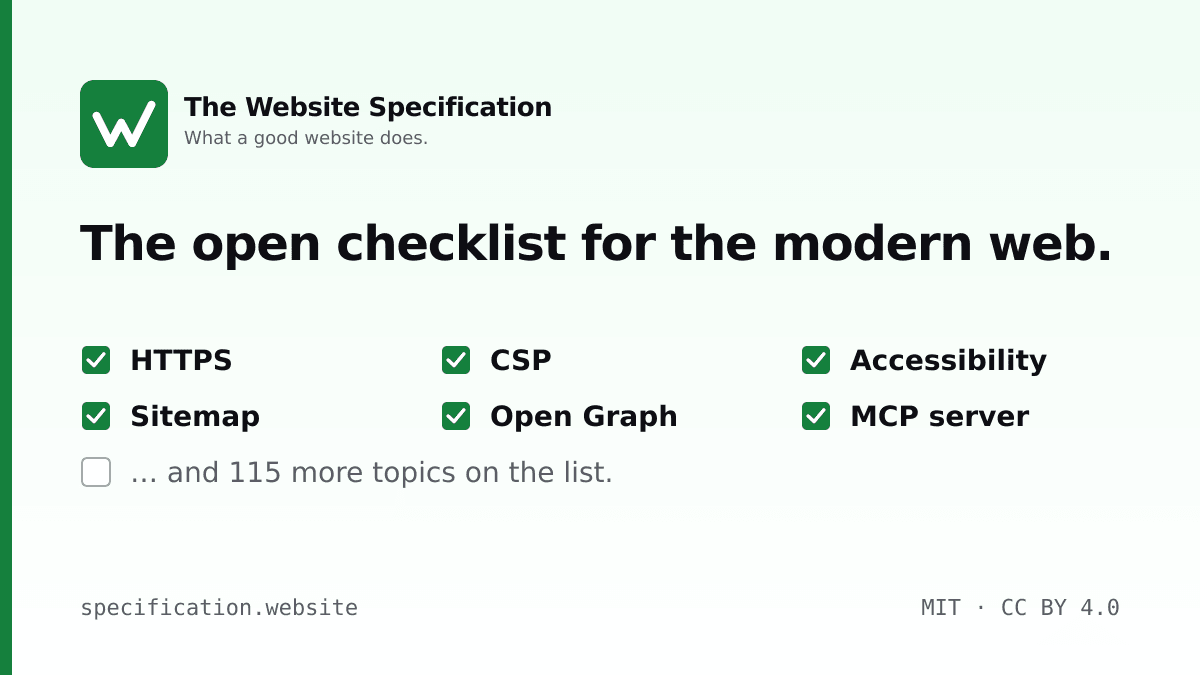
A platform-agnostic, full specification of the technical features a good website should have. Built in the open under an MIT licence.
Standard.site - One schema. Every platform.
Standard.site provides shared lexicons for long-form publishing on AT Protocol. Making content easier to discover, index, and move across the ATmosphere.
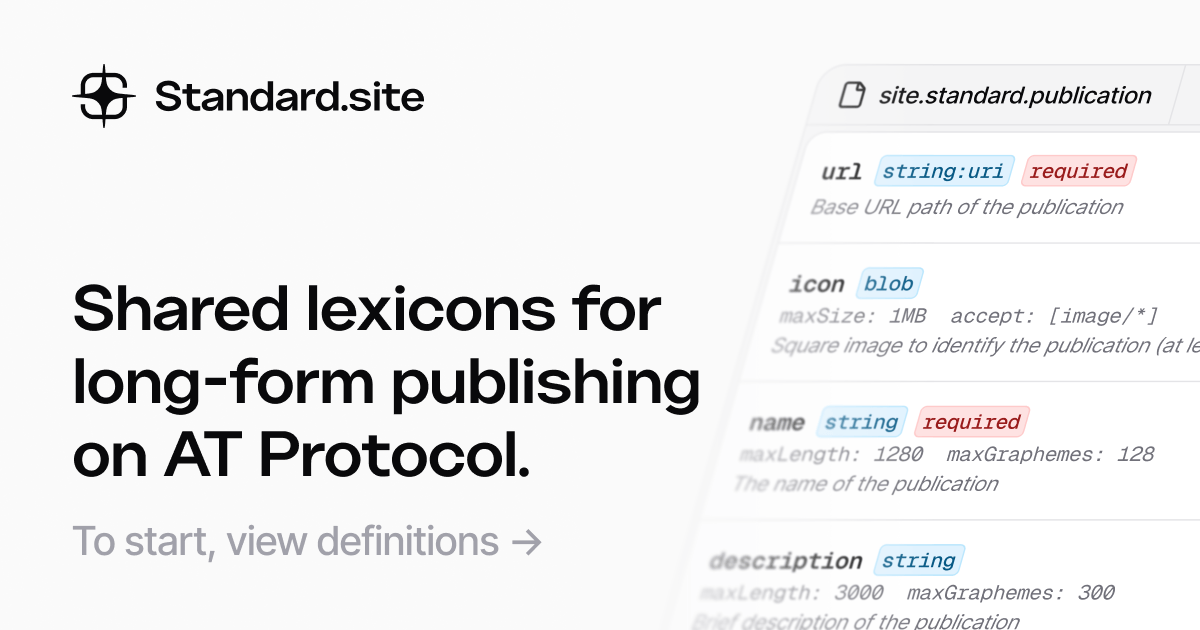
standard.site
standard.site: spannende technik-spielerei die das potenzial hat, dem offenen web gut zu tun.
The small web is beautiful
A vision for the "small web", small software, and small architectures.
What is RSL? | RSL: Really Simple Licensing
The open content licensing standard for the AI-first Internet
What is Standard Site, and why is it useful? - Leaflet Lab Notes
Lab Notes 029: explaining how Standard Site works, how it compares to RSS, and its utility for readers and publishers
The Web Needs a Context Layer Built on a Shared Protocol
Making context a shared protocol, rather than a platform feature, would let readers see competing perspectives anywhere on the web, argue Mallory Knodel, Evan Friedman, and Brad Friedman.


All you need is links
When Tim Berners Lee talks about how he designed the web, he uses an analogy from physics, describing his process as a quest to find “fundamental laws” which can generate a desired system:

[uZine 2] The Indie Web Manifesto
Manifest des unabhängigen Web Manifèste del Web independent Det Frie Web Manifest Manifesto del Web independiente Manifesto del Web indipendente Manifesto da Web independente Manifeste du Web indépendant
Specialisation | Code and Interactive Systems (Bachelor) | FH Salzburg
After completing the foundation year in your first year of study, you will choose your specialisation and focus on either Future Web & Mobile or Game & Immersive Tech. You will also select a specialisation – either Interaction Design or AI Engineering – to expand your knowledge and skills in a targeted manner.

Website Informer
Website.informer: complete data lookup & free aggregated report on any domain including whois, visitors, IP & DNS details, competitors, owners, etc
The Paradox of Open
Numerous organisations and initiatives have been launched with a belief in openness and free knowledge. Their proponents placed their bets on the combined power of networked information services and new governance models for the production and sharing of content and data. We – as members of this broad movement – were among those who believed it possible to leverage this combination of power and opportunity to build a more democratic society, unleashing the power of the internet to create universal access to knowledge and culture. For us, such openness meant not only freedom, but also presented a path to justice and equality.
From Attention to Intention - The Open Garden
Exploring business models for atproto and the open social web
W-Social: What does sovereignty mean for social media? – Open Future
The European Commission’s move to W-Social frames it as a European alternative to X, but its closed-source code and reliance on Bluesky’s infrastructure show that sovereign social media requires open infrastructure—not European ownership alone.
First thoughts on integrating with standard.site
Notes on the limitations and unresolved design questions encountered while integrating a blog with standard.site.