A reader for the standard.site publishing ecosystem
Leaflet — social publishing on the Atmosphere
A simple and powerful platform for social publishing — blogs, newsletters, and more!

Publishing on the Atmosphere with Standard.site
It's the summer of Standard.site and overwhelmingly, we've heard folks find the process complicated so Declan Chidlow is here to break the process down into something rather straightforward for you.
Hardcover
We're a social network for book lovers to find life changing books, track what you read & want to read, and connect with passionate readers.

Making a Ghost Blog a Valid standard.site Publication
This blog federates over ActivityPub through Ghost so Mastodon users can follow @index@subaud.io. standard.site is the counterpart for the AT Protocol side: a set of lexicons that describe a blog as records in an atproto repo, the same identity and data layer behind a Bluesky account. Anything

What is Standard Site, and why is it useful? - Leaflet Lab Notes
Lab Notes 029: explaining how Standard Site works, how it compares to RSS, and its utility for readers and publishers
Introducing Sequoia: Publishing for the Open Web
Today I'm excited to release a new tool for the AT Protocol: Sequoia. This is a CLI tool that can take your existing self-hosted blog and publish it to the ATmosphere using Standard.site lexicons.

Community by Design
Social media empower distributed content creation by algorithmically harnessing "the social fabric" (explicit and implicit signals of association) to serve this content. While this overcomes the bottlenecks and biases of traditional gatekeepers, many believe it has unsustainably eroded the very social fabric it depends on by maximizing engagement for advertising revenue. This paper participates in open and ongoing considerations to translate social and political values and conventions, specifically social cohesion, into platform design. We propose an alternative platform model that includes the social fabric an explicit output as well as input. Citizens are members of communities defined by explicit affiliation or clusters of shared attitudes. Both have internal divisions, as citizens are members of intersecting communities, which are themselves internally diverse. Each is understood to value content that bridge (viz. achieve consensus across) and balance (viz. represent fairly) this internal diversity, consistent with the principles of the Hutchins Commission (1947). Content is labeled with social provenance, indicating for which community or citizen it is bridging or balancing. Subscription payments allow citizens and communities to increase the algorithmic weight on the content they value in the content serving algorithm. Advertisers may, with consent of citizen or community counterparties, target them in exchange for payment or increase in that party's algorithmic weight. Underserved and emerging communities and citizens are optimally subsidized/supported to develop into paying participants. Content creators and communities that curate content are rewarded for their contributions with algorithmic weight and/or revenue. We discuss applications to productivity (e.g. LinkedIn), political (e.g. X), and cultural (e.g. TikTok) platforms.

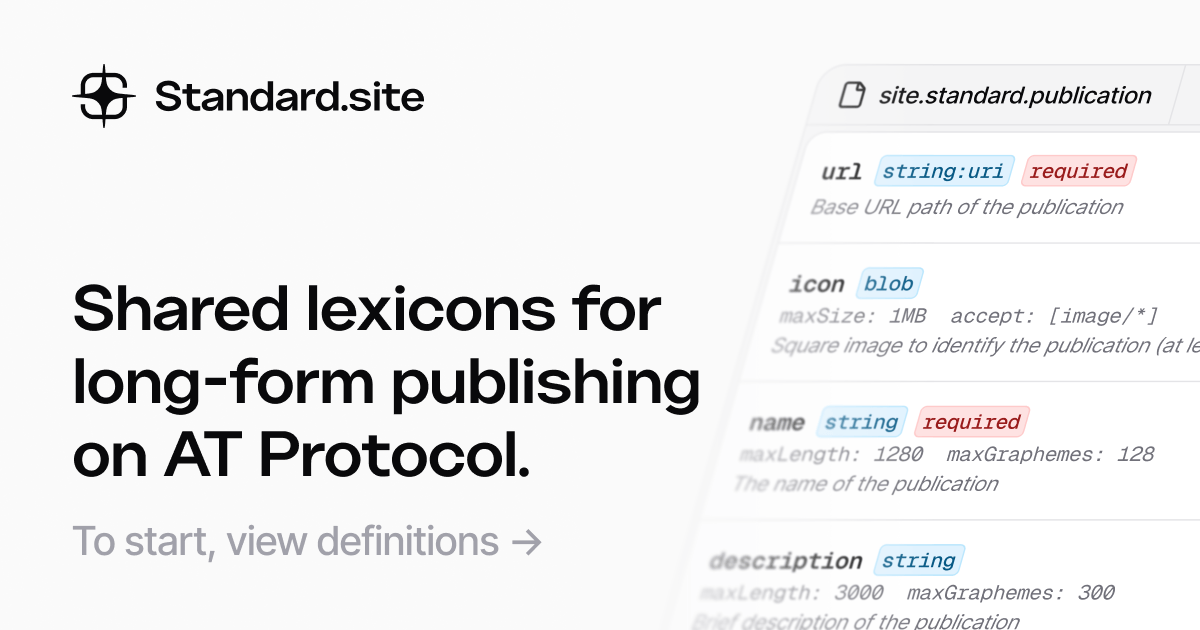
Standard.site - One schema. Every platform.
Standard.site provides shared lexicons for long-form publishing on AT Protocol. Making content easier to discover, index, and move across the ATmosphere.
Independent Journalism Atlas
Mapping the independent journalism ecosystem — 1,800+ verified creator-journalists by beat, platform, and geography.

Micropublish: Sign in
Create or modify posts on your Micropub-compatible website. Find out more about the requirements.
Can AT Protocol Fix Monolithic Platforms?
Social media algorithms can be redesigned to bridge divides — here’s how
"It falls to both the tech companies that built these systems and an engaged public to create technologies designed for social cohesion."