

A linked list is a linear data structure where each element is a separate object. Each element (we will call it a node) of a list is comprising of two items - the data and a reference to the next node. The last node has a reference to null. The entry point into a linked list is called the head of the list. It should be noted that head is not a separate node, but the reference to the first node. If the list is empty then the head is a null reference.
Collection (abstract data type)
In computer programming, a collection is an abstract data type that is a grouping of items that can be used in a polymorphic way.


DASL — Data-Addressed Structures & Links
A small set of simple, standard primitives to work on content-addressed data.

DASL — Data-Addressed Structures & Links
A small set of simple, standard primitives to work on content-addressed data.
Reference
Channels are queues that carry values and support multiple writers and readers. Channels are created with chan. Values in a channel are stored in a buffer. Buffers are never unbounded and there are several provided buffer types:
did:nostr - a Nostr key is a decentralized identifier
A W3C DID method where a Nostr public key resolves to a DID document. No registry, no chain, no minting.
Bulleted — an outliner for lists, notes, and plans
One outline instead of folders and files. Every line is saved to your own account, so it leaves when you do.
Nobody knows how the whole system works
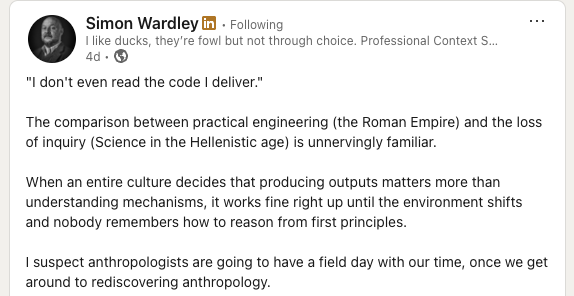
One of the surprising (at least to me) consequences of the fall of Twitter is the rise of LinkedIn as a social media site. I saw some interesting posts I wanted to call attention to: First, Simon W…
An introduction to "introduction": a common but rarely-named systems concept
Introduction is not always just a simple map from a name to a response containing addresses. In fact, it's more interesting when it's not simple.
LinkRing
Free link lists and webrings on the atmosphere. Your data, your atmosphere account, no catch.
Import members from one list into another, existing list
Link to source code. I'm not logging anything on this server, at least not on purpose, but you should still probably use an App Password then delete it when you're done.
Bedrock
In geology, bedrock is the solid rock that lies under weathered rock and unconsolidated or loose superficial deposits in the near surface part of Earth's crust or the crust of another terrestrial planet. The top of the bedrock is known as rockhead.


Presentation layer
In the seven-layer OSI model of computer networking, the presentation layer is layer 6 and serves as the data translator for the network.[2][3][4] It is sometimes called the syntax layer.[5]