

The term “web3” seems pretty fluid and is being used as a label for a bunch of disparate ideas. Given that it’s a decentralized group describing a decentralized movement, that lack of focus isn’t exactly surprising. Almost by definition it’s going to end up being different things to different people.
Why does this new W3C specification matter for the decentrazlized Web
This video explain what FedCM is and why it can be a turning point if we want more Sigle Sign On diversity on the web
The Internet Transition
The Internet is allowing us to build a richer, more complex society but the way in which we Internet today is failing to support the governance systems that a more complex world requires. I take a look at why these issues are related, try to develop an intuition for a way forward, and point at the emerging field that is coming together to build that future.

Don't Lie To Me About Web 2.0
If you’re like me and you’re trying to keep an open mind that there may someday be a non-scam application of blockchains, you’ve probably read some articles about “Web3”, which promises to re-decentralize the web by something something Blockchain.
The Web Needs a Context Layer Built on a Shared Protocol
Making context a shared protocol, rather than a platform feature, would let readers see competing perspectives anywhere on the web, argue Mallory Knodel, Evan Friedman, and Brad Friedman.

How the small web is creating an anti-slop internet
What is the small web? A new crop of platforms are answering algorithmic fatigue with a return to human-curated basics.

The IndieWeb Movement: Owning Your Data and Being the Change You Want to See in the Web · Jamie Tanna | Software Engineer
A look at what the IndieWeb is, why you should care, and how to get started with it.

Can AT Protocol Fix Monolithic Platforms?
Ambient Co-presence
Creating a subtle, peripheral, and synchronous sense of shared space and context on the web
Recently I’ve been thinking about a couple of... - Adam Wood
Recently I’ve been thinking about a couple of different tech-related things that sort of overlap. One is the (emerging) shape of the new social web; the other is a pull I’m feeling to try and lessen reliance on American companies. I’ve been interested in / concerned by what became of social media for some time.1 Since the sundering of Twitter in 2022, I’ve kept an eye on the various alternatives, with particular interest in Mastodon and Bluesky. Actually, to be more accurate, my interest has been in the protocols behind those platforms: ActivityPub and AT Protocol respectively. Both have their...

Digital Sovereignty
Digital sovereignty has a bad reputation. In internet governance circles, sovereignty is considered awkward enough to be referred to by as the "s-word." It is often associated with misguided attempts at returning to the era of national champions, like building a French search engine or a European Google, or worse with the eternal boogeyman that is the "splinternet." It doesn't have to be this way!

R. S. Doiel, Software Engineer/Analyst — Robert's ramblings
Today the Web and Internet is owned and controlled by large for profit corporations and a few governments1. Corporate ownership combined with government policies has left us as tenant and product. It has given us a surveillance economy and enshittification2.
An Ode to Links
Writing about the big beautiful mess that is making things for the world wide web.
You Might Debate It — If You Could See It
Writing about the big beautiful mess that is making things for the world wide web.
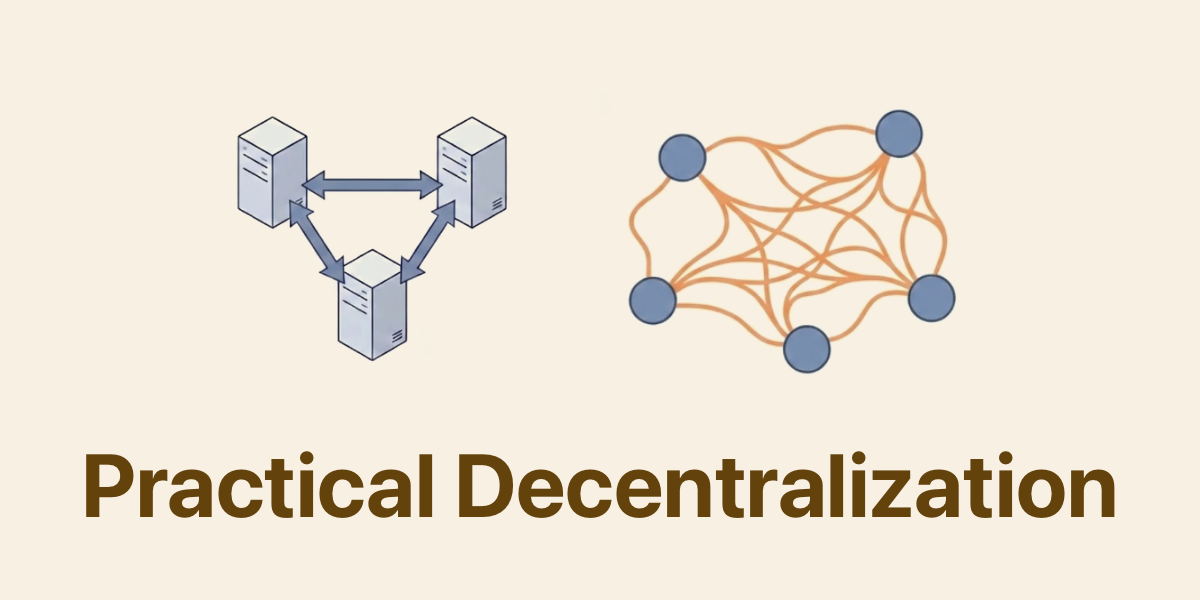
Practical Decentralization
The point of decentralization is to guarantee the rights of individuals and communities on the Internet. Pulling that off is a balancing act between practicality and ideology.
The IndieWeb Is Punk Manifesto
Three chords and a domain name. A manifesto for the DIY web.
An actually fucking good NSFW-friendly webcomics platform that isn't fucking webtoon is here - Multi-hyphenate
Y'all know I wouldn't say this shit if it wasn't true also please be normal to the dev guys