

Opaque feeds shape what you believe and you can never check whether they are working for you. We should insist on auditable algorithms, and support the platforms willing to build them.
From Feeds to Trails
To design the future of social media, rethink the interface before the algorithm.

feedle: Search and Discover Quality RSS Feeds from Thousands of Blogs and Podcasts
A search engine for blogs and podcasts, where every search is an RSS feed.

The Algorithm, Singular
A new European ruling on algorithmic amplification determines if an operator controls how content spreads on a platform. But applying it to open social networks turns out to be a problem.

Social media algorithms can be redesigned to bridge divides — here’s how
"It falls to both the tech companies that built these systems and an engaged public to create technologies designed for social cohesion."

Bluesky Custom Feeds - Built By You
Design, deploy, and grow custom feeds of any complexity on Bluesky with Graze.social.
Reclaim Your Algorithm - Babesky
This blog post has been a long time coming, so hydrate and get comfy, because we're diving into custom feeds today. Custom feeds give users the power to take ba...
Bluesky "For You" feed playground
This page shows recommendations generated by the For You custom feed. The algorithm has three simple steps:
🔭🖤🚀 Social media’s next evolution: decentralized, open-source, and scalable
How Blacksky grew to millions of users without spending a dollar
A quick guide to creating syndication feeds
RSS and syndication are the backbone of the web and have outlived many cycles of the tech industry. There's never been a better time to properly syndicate your content either, so Declan is here to give you a high level tour of your options.
After the Feed: Trust, connection, and the next era of social technology | New_ Public | May 2026
After the Feed: Trust, connection, and the next era of social technology By Eli Pariser, Co-Director, Angelica Quicksey, Managing Director, Arnobio Morelix, AI Fellow May 2026 Newpublic.org

Recently I’ve been thinking about a couple of... - Adam Wood
Recently I’ve been thinking about a couple of different tech-related things that sort of overlap. One is the (emerging) shape of the new social web; the other is a pull I’m feeling to try and lessen reliance on American companies. I’ve been interested in / concerned by what became of social media for some time.1 Since the sundering of Twitter in 2022, I’ve kept an eye on the various alternatives, with particular interest in Mastodon and Bluesky. Actually, to be more accurate, my interest has been in the protocols behind those platforms: ActivityPub and AT Protocol respectively. Both have their...

After the feed with Eli Pariser, Ben Smith, and Jasmine Sun
The political effects of X’s feed algorithm
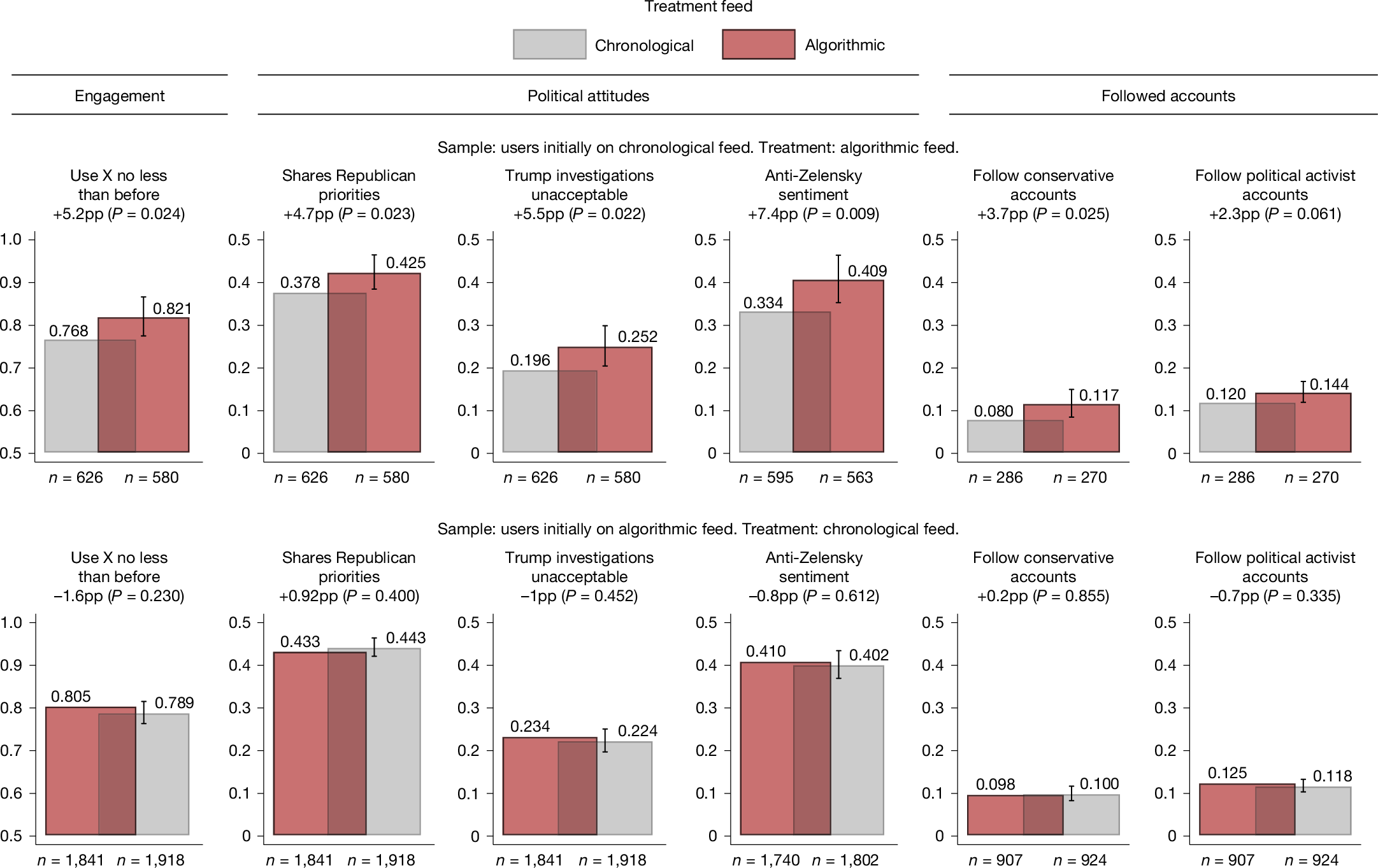
Feed algorithms are widely suspected to influence political attitudes. However, previous evidence from switching off the algorithm on Meta platforms found no political effects1. Here we present results from a 2023 field experiment on Elon Musk’s platform X shedding light on this puzzle. We assigned active US-based users randomly to either an algorithmic or a chronological feed for 7 weeks, measuring political attitudes and online behaviour. Switching from a chronological to an algorithmic feed increased engagement and shifted political opinion towards more conservative positions, particularly regarding policy priorities, perceptions of criminal investigations into Donald Trump and views on the war in Ukraine. In contrast, switching from the algorithmic to the chronological feed had no comparable effects. Neither switching the algorithm on nor switching it off significantly affected affective polarization or self-reported partisanship. To investigate the mechanism, we analysed users’ feed content and behaviour. We found that the algorithm promotes conservative content and demotes posts by traditional media. Exposure to algorithmic content leads users to follow conservative political activist accounts, which they continue to follow even after switching off the algorithm, helping explain the asymmetry in effects. These results suggest that initial exposure to X’s algorithm has persistent effects on users’ current political attitudes and account-following behaviour, even in the absence of a detectable effect on partisanship.
✅ @jcsalterego.bsky.social has been verified by @bsky.app.
