


The foundation for a general system of morals, this 174…
John Rawls
John Rawls (b. 1921, d. 2002) was an American political philosopher in the liberal tradition. His theory of justice as fairness describes a society of free citizens holding equal basic rights and cooperating within an egalitarian economic system. His theory of political liberalism explores the legitimate use of political power in a democracy, and envisions how civic unity might endure despite the diversity of worldviews that free institutions allow. His writings on the law of peoples set out a liberal foreign policy that aims to create a permanently peaceful and tolerant international order.
Against False Indulgences in LLM Alignment
Unnecessary moral concern, and the false indulgences that drive it.

A Nonideal Theory of Sexual Consent
Our autonomy can be compromised by limitations in our capacities, or by the power relationships within which we are embedded. If we insist that real consent requires full autonomy, then virtually no sex will turn out to be consensual. I argue that under conditions of compromised autonomy, consent must be socially and interpersonally scaffolded. To understand consent as an ethically crucial but nonideal concept, we need to think about how it is related to other requirements for ethical sex, such as the ability to exit a situation, trust, safety, broader social support, epistemic standing in the community, and more.
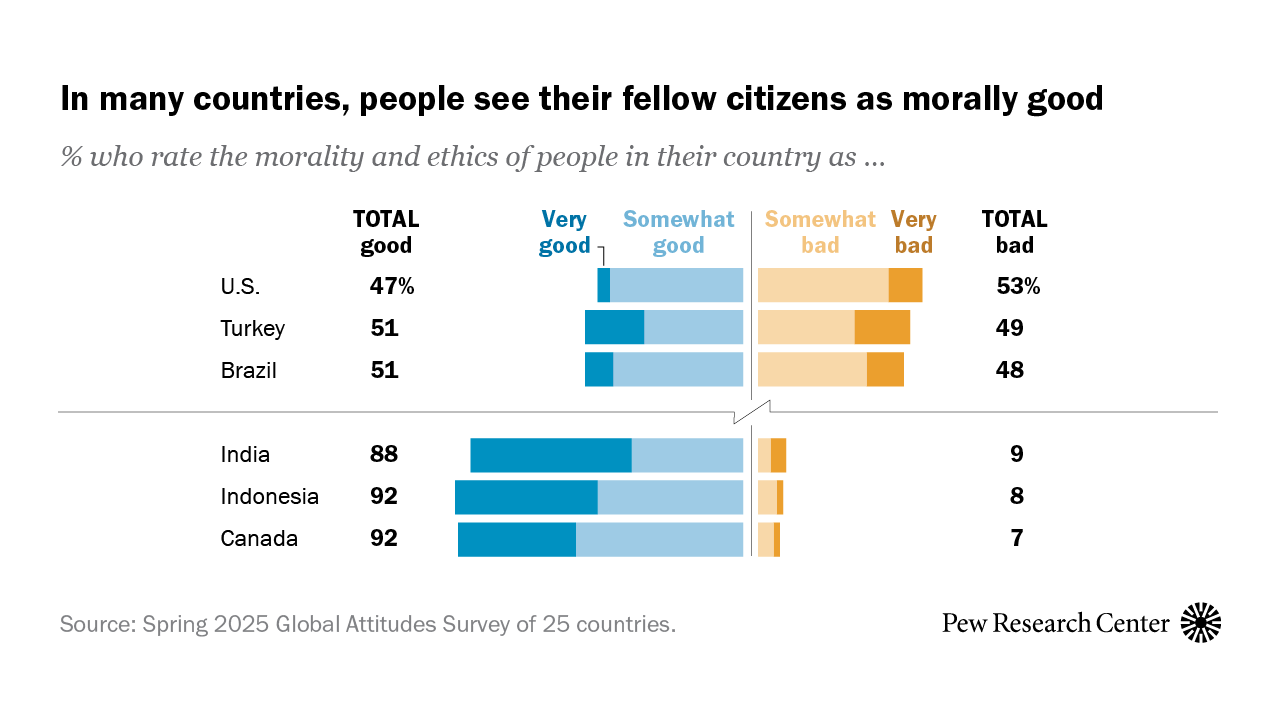
In 25-Country Survey, Americans Especially Likely To View Fellow Citizens as Morally Bad
Across 25 countries, Americans are the most likely to see the morality and ethics of people in their country as somewhat or very bad.
Science rightly impinges on Virtue Ethics
Iris Murdoch, C. P. Snow, Alasdair MacIntyre, and the role of Truth

The hidden ‘rules of the game’ that dictate how we navigate the world | Psyche Videos
How free are we really, if human behaviour embodies the complex, intertwined webs of society and history?

Robert Nozick’s Political Philosophy
Robert Nozick (1938–2002) was a renowned American philosopher who first came to be widely known through his 1974 book, Anarchy, State, and Utopia (1974),[1] which won the National Book Award for Philosophy and Religion in 1975. Pressing further the anti-consequentialist aspects of John Rawls’ A Theory of Justice, Nozick argued that respect for individual rights is the key standard for assessing state action and, hence, that the only legitimate state is a minimal state that restricts its activities to the protection of the rights of life, liberty, property, and contract. Despite his highly acclaimed work in many other fields of philosophy, Nozick remained best known for the libertarian doctrine advanced in Anarchy, State, and Utopia.
People & Technology
To understand AI’s effect on moral character, ethicist Kwame Anthony Appiah goes back to John Stuart Mill, and the idea that people are shaped by their choices.
Defending the Free Market: The Moral Case for a Free Ec…
Thirty years ago, the economic system of the Soviet emp…

Communities of Not
On the strange hostility that grows in communities built around abstinence.
Norms of Liberty: A Perfectionist Basis for Non-Perfect…
How can we establish a political/legal order that in pr…

What Theory is Not, Theorizing Is
CMV: The labor theory of value is flawed
72 votes, 407 comments. This might be an obscure topic, however, in some—largely Marxist circles— the approach seems to motivate much of the dialogue…

The Annotated Encyclical - a Hugging Face Space by society-ethics
Magnifica Humanitas, annotated with AI-ethics research
The Third Web
(This text is very long. Maybe too long. You can find a PDF and an EPUB of it below.The current version of this text will always live at https://web3.tante.ccSatya has created an audio version of this essay. Eine deutsche Version findet sich hier. Una versione italiana di questo testo è qui – grazie Nebbia! En […]