

This article looks at Deleuze and Guattari's understanding of molecular biology, focusing particularly on their reading of two highly influential works by the eminent French molecular biologists François Jacob and Jacques Monod, La logique du vivant (The Logic of Living Systems) and Le hasard et la nécessité (Chance and Necessity). In these two works, Jacob and Monod present the significance of molecular biology in broadly reductionist terms. What is more, the lac operon model of gene regulation that they propose serves to reinforce the so-called Central Dogma of molecular biology, according to which information passes from DNA to RNA to proteins, with no reverse route. However, Deleuze and Guattari discover intensive potentials within the descriptions of molecular biology offered by both writers. It is argued that Jacob's work in particular, as it has developed in the years since the publication of La logique du vivant in 1970, has itself developed these intensive potentials.
Deleuze and Biosemiotics: Biological Emergence, Agency, and Subjectivity in Logic of Sense and A Thousand Plateaus
Requisite variety and its implications for the control of complex systems
Recent work on the fundamental processes of regulation in biology (Ashby, 1956) has shown the importance of a certain quantitative relation called the law of requisite variety. After this relation had been found, we appreciated that it was related to a theorem in a world far removed from the biological—that of Shannon on the quantity of noise or error that could be removed through a correction-channel (Shannon and Weaver, 1949; theorem 10). In this paper I propose to show the relationship between the two theorems, and to indicate something of their implications for regulation, in the cybernetic sense, when the system to be regulated is extremely complex. Since the law of requisite variety uses concepts more primitive than those used by entropy, I will start by giving an account of that law.
On the Biology of a Large Language Model
We investigate the internal mechanisms used by Claude 3.5 Haiku — Anthropic's lightweight production model — in a variety of contexts, using our circuit tracing methodology.

ATProto explained for a slightly "technical" audience - Foxes
Hypothesis, Antithesis, synthesis
Introducing Hegel, our new family of property-based testing libraries.

Thoughts about the Leiden Declaration
Last September I went to a workshop at the Lorentz Centre in Leiden to discuss mathematics and AI with historians, philosophers, computer scientists, AI researchers, and mathematicians of several d…

Je kunt je zoekopdracht verfijnen aan de hand van de volgende jokers of wildcards:
Web of Science Master Journal List - WoS MJL by Clarivate
Discourse Graphs and the Future of Science | Protocol Labs Research
Interview between Tom Kalil, Chief Innovation Officer of Schmidt Futures, Dr. Evan Miyazono, Research Team Lead at Protocol Labs, and Dr. Matt Akamatsu, Assistant Professor of Biology at the University of Washington.

Home
This is where I post my articles and interviews. My most recent writing is on the science and ethics of genetic enhancement.

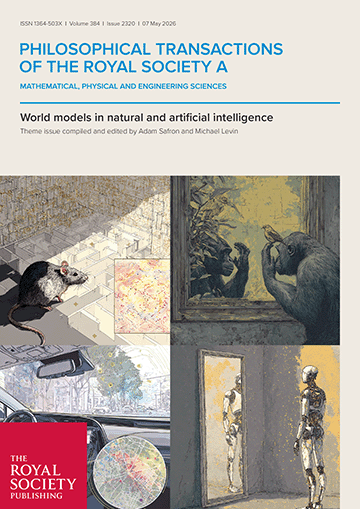
Volume 384 Issue 2320 | Philosophical Transactions of the Royal Society A | The Royal Society
Influential themed journal issues across the physical mathematical and engineering sciences.
Why the Fuss About Serverless? | HackerNoon
To explain this, I’m going to have to recap on some old work with a particular focus on co-evolution.

Les données au service de la connaissance des usages en ligne : l’exemple de l’analyse des logs de Gallica
1Face au rythme accéléré des innovations sociotechniques et à l'éclatement des pratiques numériques, construire une vision globale des usages d’une bibliothèque numérique comme Gallica (gallica.bnf.fr) constitue un véritable défi qui nécessite de mobiliser de nouvelles méthodes, en particulier celles permettant d’analyser des données de masse. Ces méthodes requièrent des compétences nouvelles par rapport à celles mobilisées traditionnellement dans l’univers de la connaissance des pratiques culturelles en général et des bibliothèques en particulier. C’est là une mutation importante. Le domaine des « études de publics », qui s’est développé dans des établissements tels les bibliothèques et musées depuis les années 1980, au confluent de plusieurs disciplines (sociologie, ethnologie, marketing, etc.), était traditionnellement le lieu d’un dialogue relativement équilibré entre les professionnels de ces établissements et les experts en charge de mener l’enquête, qu’ils soient chercheurs académiques ou consultants. Si des difficultés se présentaient, elles relevaient rarement de la compétence scientifique des interlocuteurs, les méthodes mobilisées, telles que l’enquête par questionnaire, l’observation ou l’entretien, étant facilement appropriables par tous. Cela ne signifiait bien entendu pas que tous pouvaient mener l’enquête, mais que tous pouvaient participer à la rédaction d’un questionnaire, comprendre l’enjeu des questions posées aux publics et se représenter le type de traitements réalisés sur les données collectées. Une telle participation au processus d’enquête est rendue plus difficile dans le cadre de la fouille de données (data mining), indispensable désormais pour la connaissance des usages en ligne. Un projet de recherche inédit sur les logs de connexion à Gallica, conduit dans le cadre d’un partenariat entre la Bibliothèque nationale de France (BnF) et Télécom ParisTech, témoigne pourtant de la possibilité d’inscrire la fouille de données dans un dialogue où chercheurs et professionnels s’efforcent de s’éclairer mutuellement sur les décisions à prendre pour conduire une analyse pertinente. Nous poserons dans un premier temps le cadre institutionnel et méthodologique dans lequel s’inscrit la connaissance des usages de Gallica, avant de présenter les apports de l’apprentissage automatique à cette connaissance et la manière dont ils peuvent être intégrés à la réflexion qu’une bibliothèque comme la BnF porte sur son offre en ligne.
IETF124: Authenticated Transfer (ATP) Pre-BOF - ATProto Community
Nov 5th, 2025 in Montreal
« Face aux canicules toujours plus précoces, intenses et prolongées, l’isolation thermique est impuissante, voire contre-productive »
TRIBUNE. Ce que l’isolation sait le mieux faire, c’est retenir la chaleur à l’intérieur, explique l’expert en énergies Cédric Philibert, dans une tribune au « Monde », qui recommande l’usage de pompes à chaleur, plus versatiles.

Leo Strauss
Leo Strauss was a twentieth-century German Jewish émigréto the United States whose intellectual corpus spans ancient, medievaland modern political philosophy and includes, among others, studies ofPlato, Maimonides, Machiavelli, Hobbes, Spinoza, and Nietzsche.Strauss wrote mainly as a historian of philosophy and most of hiswritings take the form of commentaries on important thinkers and theirwritings. Yet as he put it: “There is no inquiry into thehistory of philosophy that is not at the same time aphilosophical inquiry” (PL, p. 41). While much of hisphilosophical project involved an attempt to rethink pre-modernphilosophy, the impetus for this reconsideration and the philosophicalproblems that vexed Strauss most were decidedly modern. Straussespecially worried about the modern philosophical grounds forpolitical and moral normativity as well as about the philosophical,theological, and political consequences of what he took to be modernphilosophy’s overinflated claims for the self-sufficiency ofreason.