


What the Liberal Tradition Says on the Subject
Guide to Responsible, Strategic Reporting on Hate and Extremism
Recommendations for researchers, journalists and others on how to avoid unintentionally bolstering extremists and causing additional harm.

The thinking style that makes people vulnerable to extremism | Psyche Ideas
The people most drawn to ideological thinking and authoritarianism aren’t aware of what makes them so susceptible

How to Think About Politics Without Wanting to Kill Yourself
There are Enemies, and then there are Cowards.

Anti-democratic attitudes are highly contagious, new psychology study finds
The rise of anti-democratic sentiments might be driven by social contagion. Researchers have discovered that citizens often adapt their personal support for authoritarian rule to align with the political views of those around them.
This Is Your Brain on Metaphors
Our brains are wired to confuse the real and the symbolic. And the implications can be as serious as war and peace.

Liberalism in Dark Times: The Liberal Ethos in the Twen…
A timely defense of liberalism that draws vital lessons…

How to fight hate: New Humanist’s Autumn 2026 issue is out now
With race riots on the rise and the populist right gaining traction, we ask how the UK can push back

Political philosophy
Political philosophy studies the theoretical and conceptual foundations of politics. It examines the nature, scope, and legitimacy of political institutions, such as states. The field investigates different forms of government, ranging from democracy to authoritarianism, and the values guiding political action, like justice, equality, and liberty. As a normative field, political philosophy focuses on desirable norms and values, in contrast to political science, which emphasizes empirical description.

Police Records - CalMatters
Search California public records about law enforcement violence and misconduct.
John Rawls
John Rawls (b. 1921, d. 2002) was an American political philosopher in the liberal tradition. His theory of justice as fairness describes a society of free citizens holding equal basic rights and cooperating within an egalitarian economic system. His theory of political liberalism explores the legitimate use of political power in a democracy, and envisions how civic unity might endure despite the diversity of worldviews that free institutions allow. His writings on the law of peoples set out a liberal foreign policy that aims to create a permanently peaceful and tolerant international order.
Bridging Systems: Open Problems for Countering Destructive Divisiveness across Ranking, Recommenders, and Governance
Divisiveness appears to be increasing in much of the world, leading to concern about political violence and a decreasing capacity to collaboratively address large-scale societal challenges. In this working paper we aim to articulate an interdisciplinary research and practice area focused on what we call bridging systems: systems which increase mutual understanding and trust across divides, creating space for productive conflict, deliberation, or cooperation. We give examples of bridging systems across three domains: recommender systems on social media, collective response systems, and human-facilitated group deliberation. We argue that these examples can be more meaningfully understood as processes for attention-allocation (as opposed to "content distribution" or "amplification") and develop a corresponding framework to explore similarities - and opportunities for bridging - across these seemingly disparate domains. We focus particularly on the potential of bridging-based ranking to bring the benefits of offline bridging into spaces which are already governed by algorithms. Throughout, we suggest research directions that could improve our capacity to incorporate bridging into a world increasingly mediated by algorithms and artificial intelligence.

The Return of the Cutting-Off Way
Structural changes are driving us towards a more chaotic world, defined by "neither peace nor war, but conflict."

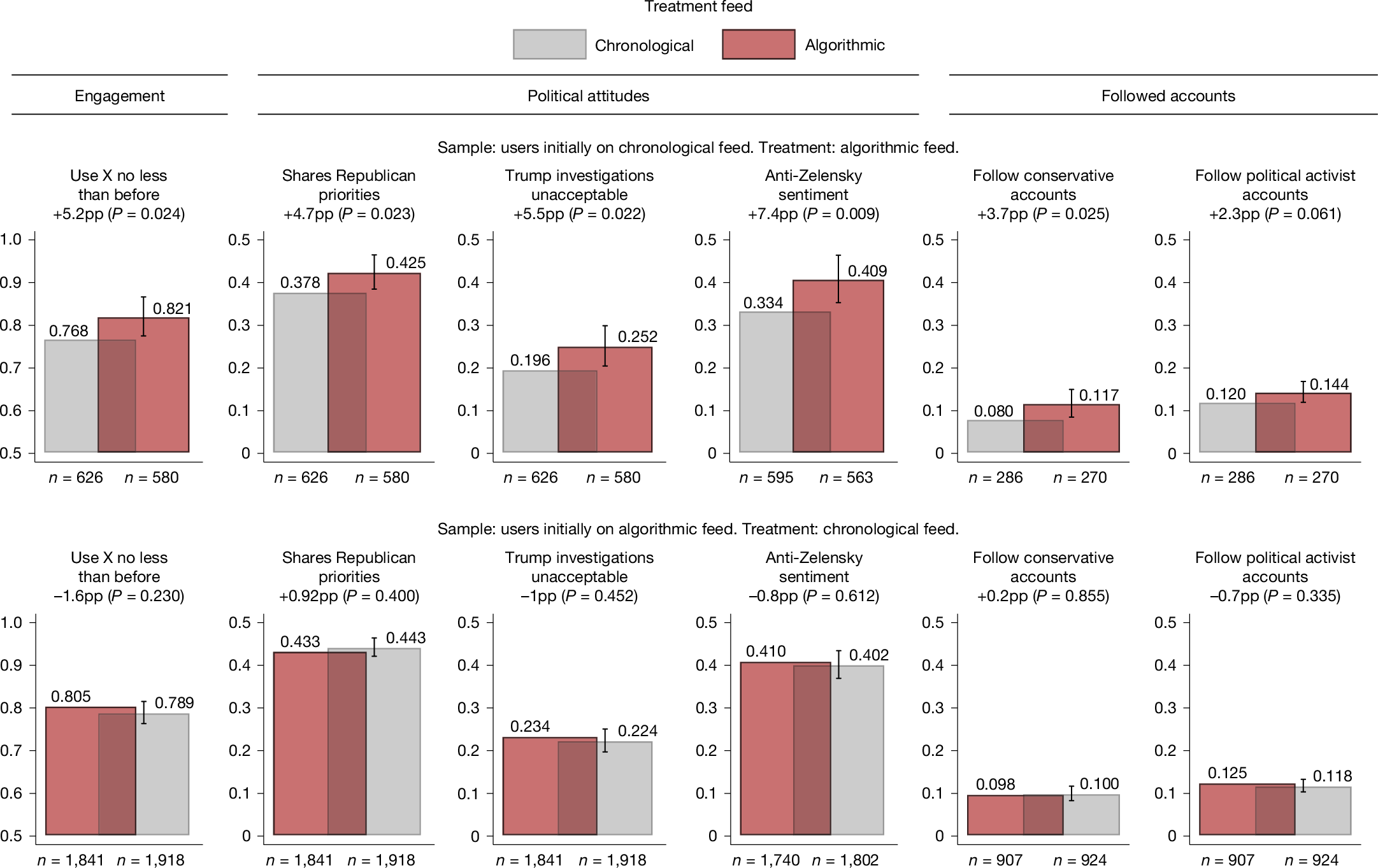
The political effects of X’s feed algorithm
Feed algorithms are widely suspected to influence political attitudes. However, previous evidence from switching off the algorithm on Meta platforms found no political effects1. Here we present results from a 2023 field experiment on Elon Musk’s platform X shedding light on this puzzle. We assigned active US-based users randomly to either an algorithmic or a chronological feed for 7 weeks, measuring political attitudes and online behaviour. Switching from a chronological to an algorithmic feed increased engagement and shifted political opinion towards more conservative positions, particularly regarding policy priorities, perceptions of criminal investigations into Donald Trump and views on the war in Ukraine. In contrast, switching from the algorithmic to the chronological feed had no comparable effects. Neither switching the algorithm on nor switching it off significantly affected affective polarization or self-reported partisanship. To investigate the mechanism, we analysed users’ feed content and behaviour. We found that the algorithm promotes conservative content and demotes posts by traditional media. Exposure to algorithmic content leads users to follow conservative political activist accounts, which they continue to follow even after switching off the algorithm, helping explain the asymmetry in effects. These results suggest that initial exposure to X’s algorithm has persistent effects on users’ current political attitudes and account-following behaviour, even in the absence of a detectable effect on partisanship.

POLYBIUS ACI
Authoritarian Consolidation Index - Real-time democratic health monitoring powered by political science research and AI