

finding meaning in life through literature, art, design, and culture ✦✧ through weekly posts and enthusiastic conversations. Click to read personal canon, by Celine Nguyen, a Substack publication with tens of thousands of subscribers.
Canonize: Creating a Personal Canon Template – Brendan Schlagel
I love the idea of the “personal canon”: an encapsulation, in list form, of those things that have most shaped you. A sort of annotated bibliography of influences.

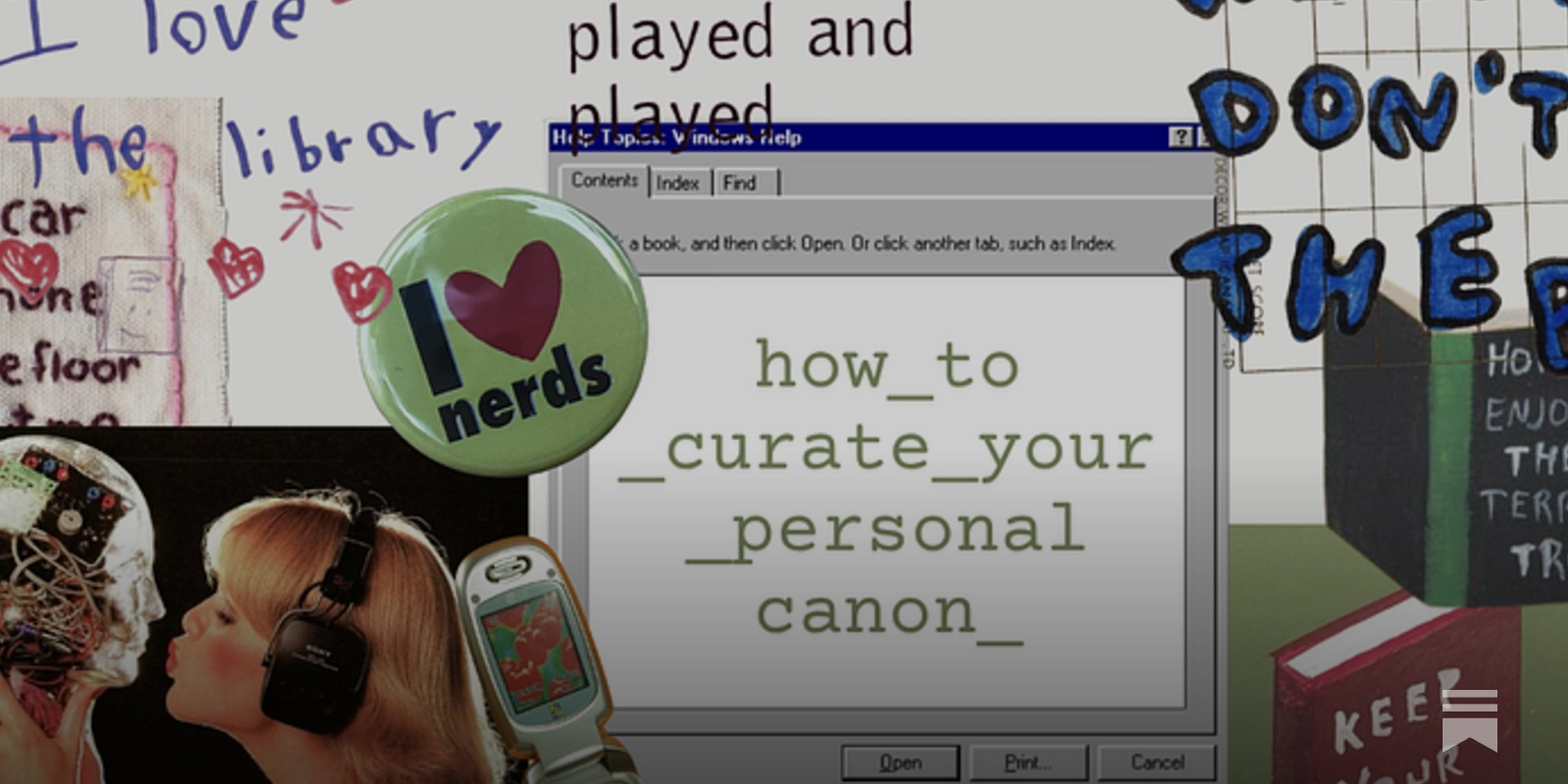
How to curate your personal canon
"The things won’t exist unless I signify my interest in them by at least noting down their names. Nothing exists unless I maintain it."
lore.farm — Collectivized Canon for Fictional Worlds
Create fictional worlds and build a shared canon with your community from across the ATmosphere. Includes support for Bluesky, Branchline, and more!
The End of Textuality - Real Housewives of San Francisco
Authenticity in the age of GenAI
Today · Standard Reader
Fresh writing from the publications you subscribe to, every day.

Canon van Nederland
Canonvannederland.nl is bedoeld voor alle geïnteresseerden in de Nederlandse cultuur en geschiedenis, en in het bijzonder voor leerlingen en docenten in bovenbouw basisonderwijs en onderbouw voortgezet onderwijs.
Hardcover
We're a social network for book lovers to find life changing books, track what you read & want to read, and connect with passionate readers.

Clarkesworld Magazine - Science Fiction & Fantasy
When Humans Are No Longer Born Human by Zhu Yixuan

Things You Lose - The Forge Literary Magazine
Things You Lose, a short fiction by Kelli Dianne Rule


Clarkesworld Magazine - Science Fiction & Fantasy
The Animator and the Glazer by Ju Chu, translated by S. Qiouyi Lu

A Catalog of an Entire House/Life
In a period of four years, Belgian photographer Barbara Iweins took a photo of every single thing in her house, “from my daughters torn sock to my sons

AI Safety Is a Narrative Problem · Special Issue 5: Grappling With the Generative AI Revolution
This op-ed explores power and narrative dynamics around AI. Drawing on pop-culture references, the professional experiences of the author and examples from 2023’s “Great AI Safety Hype Roadshow,” this piece draws on the literary criticism technique of practical criticism to consider how speeches and announcements from both Silicon Valley executives and research scientists to interrogate the media-friendly nature of p(doom) discourse—which focuses on the existential risks of AI (PauseAI, 2023)—and its likely consequences. The complexities of AI and its numerous social impacts can be difficult for even the most expert analyst to unpack. In spite of this, the potential of “existential threats” has successfully cut through to become a mainstay of mainstream media coverage over the last year. This piece will make the case that this is an effective narrative conceit that has achieved a number of ends that traditional science communication tends to find difficult, if not impossible, to achieve. Firstly, it is easy to understand. Simplification of this nature—that removes jargon and complexity and focuses on a single outcome—is much easier to fit on a TV rolling news ticker or on the cover of a tabloid newspaper than more well-balanced, representative opinions. Secondly, it inherits prior assumptions from well-known dramatic forms. P(doom) plays to stories familiar from Greek tragedy through to Marvel movies, in which lone male heroes battle ineluctable forces. Thirdly, it is imbued with urgency and so becomes difficult to ignore.

your long-form atmosphere · pub search
what you publish, who reads it, your semantic neighborhoods, and what you recommend