A patchwork of privacy laws, teen social media bans, and "digital sovereignty" pushes means the Internet you see depends entirely on where you're standing.
Digital Sovereignty
Digital sovereignty has a bad reputation. In internet governance circles, sovereignty is considered awkward enough to be referred to by as the "s-word." It is often associated with misguided attempts at returning to the era of national champions, like building a French search engine or a European Google, or worse with the eternal boogeyman that is the "splinternet." It doesn't have to be this way!

What happened to the fight for the Internet? -- Dustycloud Brainstorms
At the moment I am writing this, bad internet bills are being proposed across the US, Canada, Europe, and the UK. They're using the usual tactics: they claim they're fighting for kids or fighting security risks, but in general, that's what surveillance and censorship bills have always claimed.
Australia’s Teen Social Media Ban Is Just Training A Generation In The Art Of The Workaround
We’ve been covering Australia’s under-16 social media ban since before it went into effect, first noting the confusion and obvious implementation problems as pretty much everyone realiz…

The Internet Transition
The Internet is allowing us to build a richer, more complex society but the way in which we Internet today is failing to support the governance systems that a more complex world requires. I take a look at why these issues are related, try to develop an intuition for a way forward, and point at the emerging field that is coming together to build that future.

Governable Stacks against Digital Colonialism
Critics have been converging around the logic of colonialism to describe the Internet economy. If we are serious about the laden language of the colonial, we should be ready to learn from struggles against pre-digital empires and colonial regimes. Although acts of insurrection may attract more attention, one thing leaders and theorists of anticolonial resistance have stressed persistently is the centrality of self-governance in everyday life as both a means and end of their movements. But the dominant platforms for online communities are not well-suited for durable self-governing. Resistance often relies on the same colonial firms it opposes. What would community-governed technologies look like? This paper introduces the concept of “governable stacks”, a framework for self-governing as resistance to digital colonialism.
W-Social: What does sovereignty mean for social media? – Open Future
The European Commission’s move to W-Social frames it as a European alternative to X, but its closed-source code and reliance on Bluesky’s infrastructure show that sovereign social media requires open infrastructure—not European ownership alone.
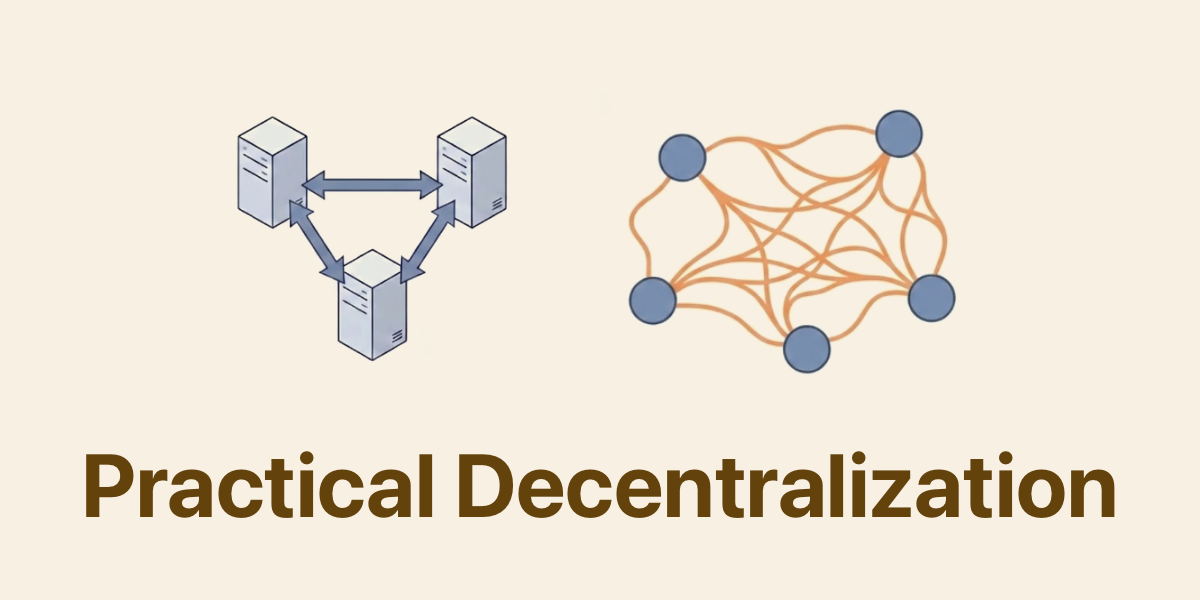
Practical Decentralization
The point of decentralization is to guarantee the rights of individuals and communities on the Internet. Pulling that off is a balancing act between practicality and ideology.
The Paradox of Open
Numerous organisations and initiatives have been launched with a belief in openness and free knowledge. Their proponents placed their bets on the combined power of networked information services and new governance models for the production and sharing of content and data. We – as members of this broad movement – were among those who believed it possible to leverage this combination of power and opportunity to build a more democratic society, unleashing the power of the internet to create universal access to knowledge and culture. For us, such openness meant not only freedom, but also presented a path to justice and equality.
Privacy as EU Tech advantage - The LeafPlaza Blog
Online crime loves legal massive data collection, grey systems, and jurisdictional gaps. Privacy-first design can actually reduce crime exposure and build trust in digital services. It is also central to the EU's tech autonomy: build systems aligning with European rights and risk models. Do not rely on foreign platforms or copy outside practices that might go against the EU values and needs.
The Public Interest Internet
What if the internet were public interest technology? Is that too wildly speculative? I think not. I am not talking about a utopian project here — a public interest internet would be a glorious imperfect mess and it would be far from problem-free. But while there is a lot of solid thinking about various digital issues or pieces of internet infrastructure (much of which I rely upon here), I have yet to read to an answer to this question: What global digital architecture should we assemble if we take seriously the idea that the internet should be public interest technology?

Gander: The Social Media You Want, Built in Canada
Fun, private, and ethical. We're changing the way social media is done around here, all without your personal data taking an unexpected trip down south.

We Need To Rewild The Internet
The internet has become an extractive and fragile monoculture. But we can revitalize it using lessons learned by ecologists.

Web Browsers, AI, and the Politics of Media Power
The left keeps building media strategies on top of platforms built to undermine them. As browsers are rebuilt for mass surveillance and manipulation, the systems that decide what people see and who gets heard are being rewritten without us. Control over the browser is control over political reality.

Home
A socially motivated website which provides information about protecting your online data privacy and security.